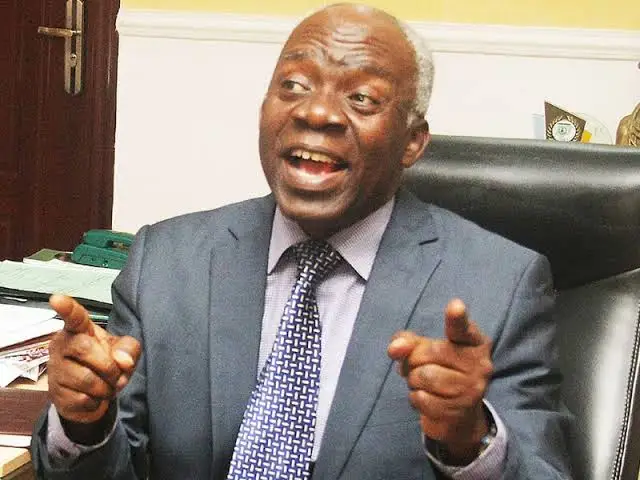
Foremost human rights lawyer, Femi Falana, has delivered a scathing verdict on Nigeria’s democratic journey, declaring that despite 27 years of uninterrupted civilian administration, the country is yet to achieve genuine democratic governance.
Falana said what exists in Nigeria today is largely civil rule rather than democracy, arguing that elections alone do not constitute democratic governance when millions of citizens remain trapped in poverty, insecurity, injustice and institutional failure.
Speaking virtually at the Second Annual General Meeting of Amnesty International Nigeria in Abuja on Saturday, the Senior Advocate of Nigeria warned that public confidence in constitutional rule could continue to erode unless democratic institutions begin to deliver tangible benefits to ordinary Nigerians.
While dismissing growing calls in some quarters for a return to military rule, Falana insisted that military governments could never be a better alternative. However, he maintained that Nigerians must confront the uncomfortable reality that the democratic ideals many fought and died for remain largely unrealised.
“Military rule is not better than democracy regardless of the frustrations people may have. But we must also be honest enough to admit that what we currently have is largely civil rule and not the full expression of democracy that Nigerians fought and sacrificed for,” he said.
The outspoken activist argued that the true test of democracy is not the conduct of periodic elections but the capacity of government institutions to guarantee justice, accountability, human rights, security, quality education, healthcare and economic opportunities for citizens.
He lamented that constitutional promises have remained largely theoretical for millions of Nigerians, widening the gulf between democratic expectations and the realities of daily life.
Falana’s remarks come amid increasing public frustration over economic hardship, insecurity, governance challenges and declining trust in public institutions, despite more than two decades of uninterrupted civilian rule.
He warned that democracy risks losing legitimacy in the eyes of citizens if elected governments fail to translate constitutional guarantees into meaningful improvements in people’s lives.
According to him, unless leaders prioritise institutional reforms, accountability and people-centred governance, Nigeria may continue to operate a civilian system devoid of the substantive democratic values that define a truly democratic state.
Earlier in his remarks, the Board Chair, Amnesty International Nigeria, Auwal Musa Rafsanjani noted that the past year has been one of bold action and significant milestones.
He said: “Our investigation into the Tiger Base anti-kidnapping police unit in Owerri, Imo State, stands as one of our most impactful interventions.”
He noted that: “The report uncovered entrenched human rights violations, including prolonged arbitrary detention, torture, extortion and enforced disappearances.”
Rafsanjani said: “We documented at least 200 deaths and disappearances between 2021 and 2025.”
About the Author