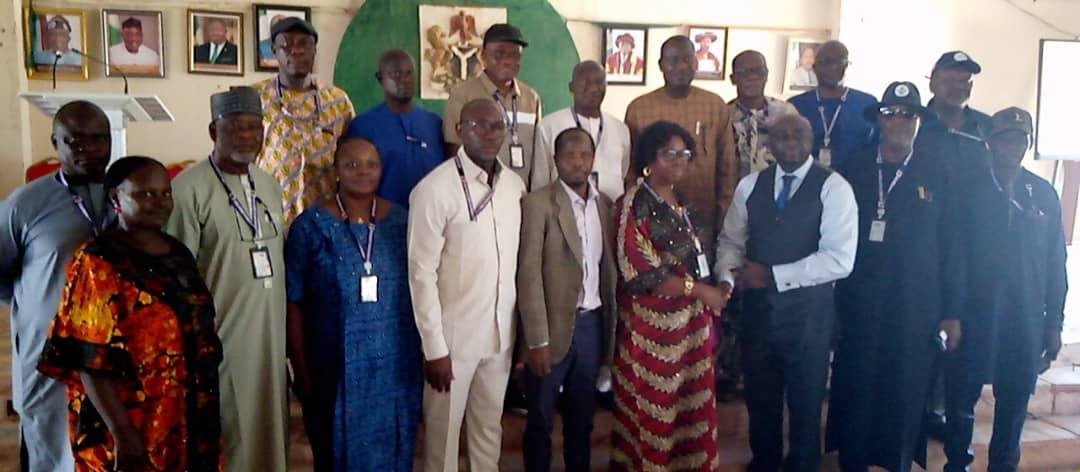
The Federal University of Education, Pankshin (FUEP), Plateau, on Friday held a one-day capacity building workshop on Research Commercialisation, Google Scholar and others.
The workshop was also aimed at enhancing lecturers”knowledge of the Open Researcher and Contributor ID (ORCID), an academic email which permanently links a researcher’s identity to their professional activities, and the Black Board, a web-based platform that aids institutions to host online courses and share digital materials.
The News Agency of Nigeria (NAN), reports that the training was for the academic staff, in collaboration with the Directorate of Research, Innovation, and Development.
Declaring the workshop open, Prof. Noel Wannang, the Vice-Chancellor (V-C), who welcomed all participants, expressed optimism that they would become research fellows in no distant time.
Wannang was represented at the event by Prof.Anthonia Chukwu, the Deputy Vice Chancellor of the university.
The V-C noted that lecturers had been impoverished for a long time under a system that had failed to recognise their importance to nation-building.
According to him, academics have what it takes to be rich; particularly those who are into research.
“These days, it is not about writing, publishing, and keeping the research in shelves of the library. There must be ways of getting them to the public domain, which is commercialisation.
“We are called to be visible because no matter how good you are in your field, if nobody sees and knows you, you are going nowhere.
“This workshop, therefore, is organised to help us go into commercialisable research and get ourselves visible,” he said.
Wannang called on all academic staff to take advantage of the workshop, work hard, and bring the university to the limelight.
Prof. Ayodele Adewole, from the University of Jos, who presented a paper titled: “Research Commercialisation” from ideas to impacts”, noted that with the large number of universities in the country, funding research had become difficult for the government.
“Universities can gain financial independence through research commercialisation, creating products and services that are commercially viable; which can generate wealth to both the university and the researchers.
“Research commercialisation is
by identifying research opportunities, making collaborations, and turning problems into research ideas, and to real impacts.
“When academic research finds solutions to real problems in the society or industries, they suddenly become millionaires by having the Intellectual Property (IP) right,” Adewole stated.
According to him, research must equate problem solving by moving from a mere academic exercise to practical and real-world problem solving.
“When we generate research proposals that solve some of the challenges industries are experiencing, they finance such, and it becomes profitable for both the university and the industries.
“When academic research collaborates with international partners and their proposals meet the required need of the foreign partners, the chances of funding are higher.
“This collaboration does not only build your reputation as a researcher, it also builds the institutional reputation which also helps in the ranking of universities globally.
“In the academia, we say publish or perish, but in this context, we can publish, create, and prosper,” Adewole added.
Mr Ibrahim Bawa, from the Directorate of ICT, University of Jos, also presented a paper titled: “Using digital academic tools to enhance academic visibility”.
Bawa explained how the lecturers could create and use digital tools for research commercialisation purposes.
“When you create your products, services, and innovations, you need digital tools to commercialise them.
“The LinkedIn account is a powerful platform that connects professionals, allows networking of people of like minds to showcase their achievements, contends with others, and provide career opportunities.
“ORCID account is like the institutional e’mail address which makes us visible and grants us access to lots of free things or at a discounted rate as students or lecturers.
“ORCID, on the other hand, connects our publications, journals, and papers worldwide. It also connects institutions, researchers, and publishers to the world database of journals.
“Google Scholar is very simple to use. It can be used to access research materials using Artificial Intelligence (AI),” he explained.
In a vote of thanks, Prof. Yohanna Mallo, the Director, Research Innovation and Development, thanked the school management and the resource persons for improving their visibility through the workshop.
Mallo called on all participants to put all they have learned into practice by commercialising their research to improve their financial well-being and that of the institution.(NAN)
About the Author