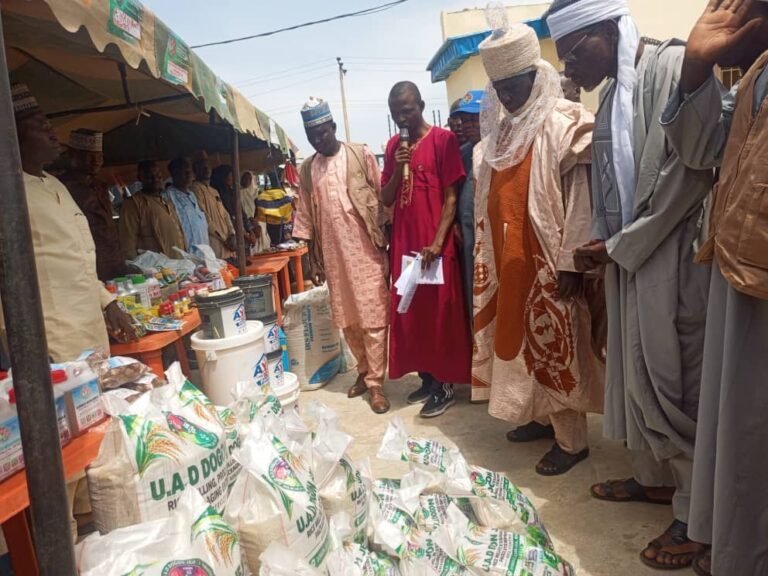
The Executive Director of the Global Initiative for Food Security and Ecosystem Preservation (GIFSEP), Dr Michael David, has urged state governors to prioritise food production as critical infrastructure to address hunger in Nigeria.
David, an environmental and agriculture expert, made the call while speaking on the 2026 World Food Day (WFD) theme, “Review of Political Campaign Promises on Food Sufficiency.”
According to him, Nigeria is blessed with climatic and geographical advantages, but governors have failed to take advantage of them, focusing only on bridges and airports while neglecting farmlands and irrigation schemes.
“If we have all of these resources and the climatic and geographical advantages, why are state governors not taking advantage of this? Infrastructure is beyond building bridges and airports.
” Farmlands, developed farmlands and irrigation schemes are also critical infrastructure that ensures we grow our own food and feed ourselves,” he said.
David lamented that Nigeria could not produce enough food to feed itself, yet systems within the country are creating artificial food shortages.
He urged governors to leverage their comparative advantages, noting that Benue is the food basket not just for yam but for varieties of food, while Kogi and Oyo are leading in cassava production.
“Every state in this country has a comparative advantage. If we say Benue grows yam, Benue State is not just about yam. If cassava and yam were the largest products we produced last year, why is garri still very expensive?” he queried.
He said 60 per cent of what farmers grow goes to waste, with tons of tomatoes, yams and other foods rotting at the back of markets, a situation worsened by climate change.
“A lot of women will tell you that they buy yams now and can’t store them. They keep them for a few days, and they get rotten. And it is the same with many other things,” he said.
He accused middlemen of exploiting farmers’ lack of storage and processing facilities to create artificial scarcity.
“When there is a glut in the market, they come, buy everything and store it. I remember two years ago, there were people who bought bags of maize for about 30,000 naira and sold them for hundreds of thousands during the lean period.
According to him, it is worrisome that agriculture employs up to 70 per cent of Nigerians in farming and processing, yet citizens remain hungry.
“If agriculture employs up to 70% of our citizens, both farming, processing and
all, why are Nigerians still hungry? It is a question that the political class needs to answer,” he said.
David said the immediate solution to food shortage was to support genuine smallholder farmers, not “briefcase Abuja farmers,” with small inputs and access to land, especially for women who dominate agriculture.
“We need to support the smallholder farmers. Women are big in agriculture in this country; many of them don’t have access to land. You can’t grow food without land,” he noted.
He said many dams across the country are underutilised and Nigeria could no longer depend on rain-fed agriculture alone due to climate change and rainfall variability.
“We can actually grow food all year round, and that is where climate resilience building comes in – providing quick and immediate weather information for farmers,” he said.
He also raised alarm over the loss of indigenous species like locust beans, which he said were more protein-rich than eggs and now sell for over N100,000 per bag due to deforestation.
“You will not find a nursery anywhere that has locust bean seedlings. We are losing all our indigenous trees, and we are not replacing them,” he said.
He attributed part of the food crisis to global design to keep countries in debt, noting that huge monthly debt servicing is crippling investments that should go to food production.
On making agriculture attractive to youth leaving villages, he said young people should focus on adding value through food processing, which Nigeria lacks.
He commended the Federal Government for creating the Ministry of Livestock Development and the Nigerian Livestock Growth and Advancement Strategy.
He lamented that courses like agricultural extension and soil science were dying in universities due to low enrollment.
“We need to slowly change the way we think. Eat local, buy local. Any amount of money you spend on buying local food, that money stays within the system,” he said.
Speaking on this year’s theme, ‘Innovate Today, Nourish Tomorrow,’ he said Africans had already innovated through traditional foods and warned against the chemicalisation of foods.
He urged Nigerians to vote for food sovereignty as general elections approach and eat local in return.
About the Author