By Sam Israel
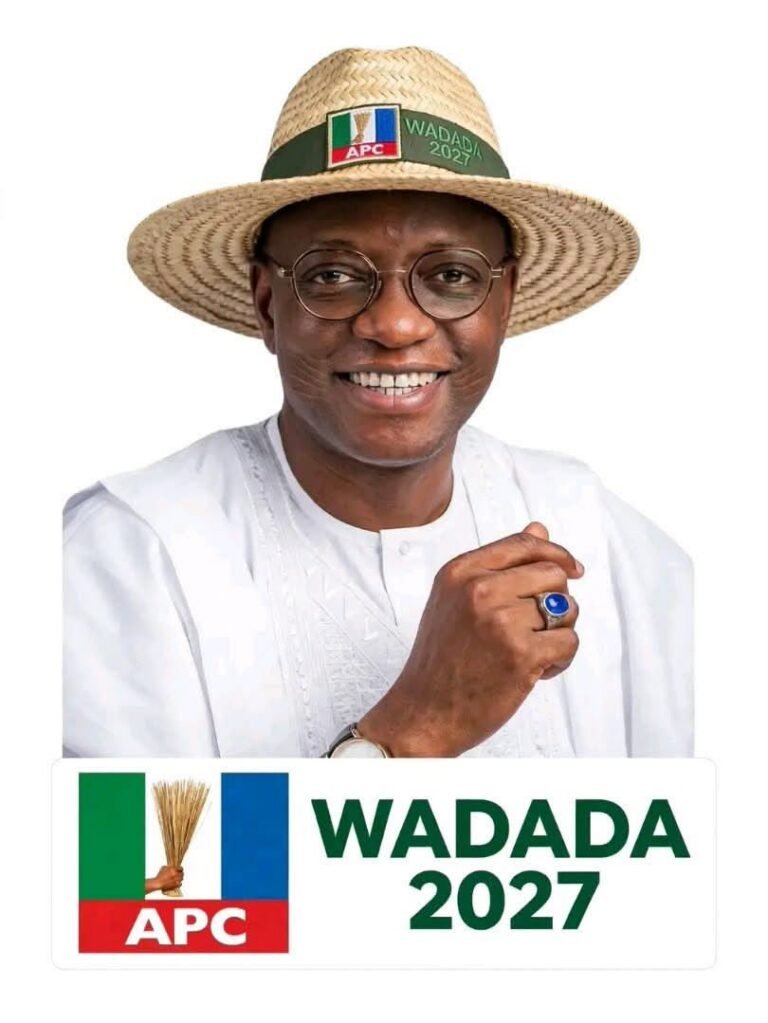
As Nasarawa State moves steadily towards the 2027 governorship election, one name that has become increasingly prominent in political discussions is Senator Ahmed Wadada Aliyu. His emergence as the All Progressives Congress (APC) governorship candidate has placed his political record, public profile and development agenda firmly at the centre of conversations about the state’s next chapter.
Wadada’s political relevance is not based solely on his current position in the Senate. His journey through the National Assembly, including his previous service in the House of Representatives and his present representation of Nasarawa West Senatorial District, has given him considerable experience in legislative politics and public affairs. His chairmanship of the Senate Committee on Public Accounts has also put accountability and oversight among the responsibilities associated with his public service.
His emergence as the APC candidate was itself a major political event. At the party’s governorship primary in May 2026, conducted across the state’s 147 electoral wards, Wadada was declared the winner with 195,285 votes. The result formally positioned him as the party’s standard-bearer for the 2027 governorship election.
Beyond the primary result, another factor distinguishing Wadada in the current political conversation is the effort to articulate a defined development programme. His published HEARTS Agenda presents proposals covering human capital development, energy and mineral resources, agriculture, infrastructure and security/good governance. The significance of such a framework is that it gives voters specific policy areas against which they can examine his promises and subsequently assess his performance if he receives a mandate.
The candidate has also publicly framed his proposed administration around continuity and further development rather than abandoning existing projects. In presenting his development blueprint, Wadada said the progress achieved under Governor Abdullahi Sule had raised expectations for whoever succeeds him. That position places his candidacy within an important question confronting Nasarawa: how can the state preserve useful achievements while addressing areas where citizens expect further progress?
Another element of Wadada’s political profile is his continuing engagement with different constituencies. Recent reports have documented his consultations with religious leaders and other stakeholders, during which he presented his legislative scorecard and discussed the HEARTS Agenda. He has described leadership as involving listening to citizens, understanding their concerns and building a shared vision.
His political visibility has therefore expanded beyond the traditional boundaries of legislative representation. From the National Assembly to community engagements and the governorship campaign, Wadada has increasingly become a familiar figure in Nasarawa’s political discourse. Whether that visibility translates into electoral support, however, remains a matter for voters and the democratic process to determine.
There is also a wider political significance to his candidacy. Governor Abdullahi Sule publicly backed Wadada as his preferred successor after consultations over the 2027 succession question. The governor’s support has consequently added another important dimension to the political discussion surrounding the APC candidate.
Perhaps the most important test of Wadada’s political standing is not simply how frequently his name appears in political conversations, but whether his experience, proposed policies and record can withstand sustained public scrutiny. In a democratic society, political prominence becomes meaningful when citizens can examine a candidate’s record, compare policy proposals and make informed judgments based on evidence.
For Nasarawa, therefore, the 2027 contest is becoming a debate about more than personalities. It is a debate about development, accountability, continuity, inclusion, infrastructure, human capital, agriculture, security and the kind of leadership citizens expect after the present administration. Wadada’s candidacy has undeniably become one of the central elements of that conversation.
Whether history ultimately records Senator Ahmed Wadada Aliyu as the political figure who successfully translated his growing prominence into the leadership of Nasarawa State will be decided by the electorate and the electoral process. What is already clear is that, as the 2027 election approaches, his political journey, legislative experience and HEARTS development agenda have made him a significant subject of public discussion in Nasarawa State.
Israel JP is the Senior Special Assistant on media to Senator Wadada
About the Author