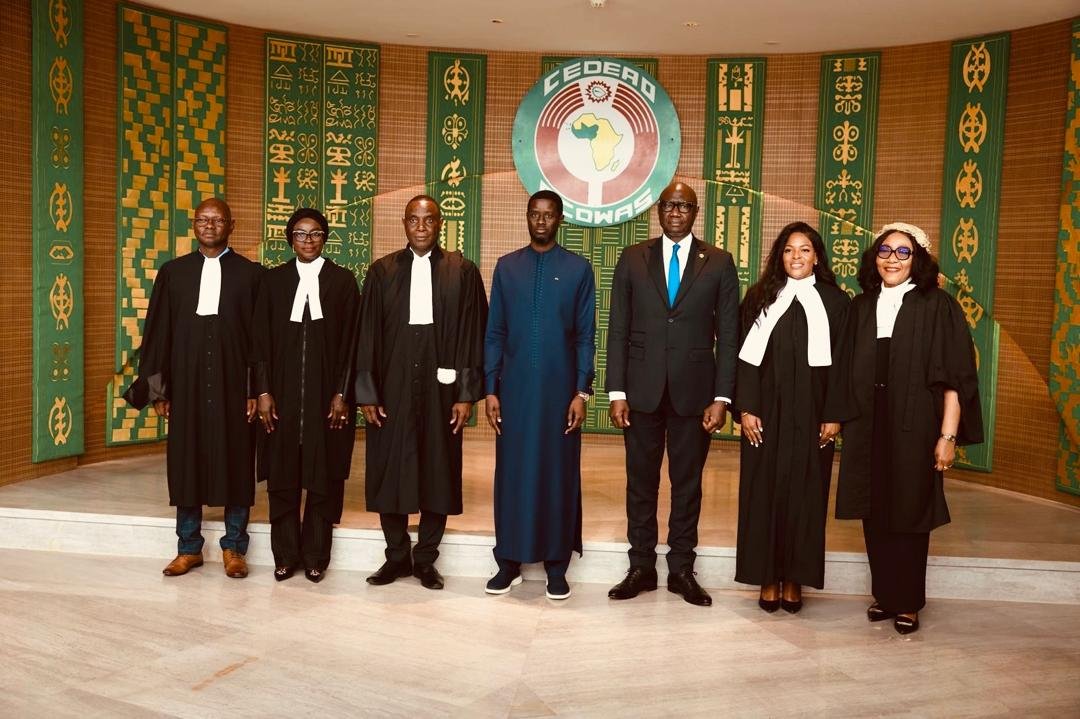
L-R: Justices Yaouza Ouro-Sama, Awa Bah, Désiré Henri Aihou, H.E. Bassirou Diomaye Faye - Chairman of Authority, H.E. General Birame Diop - President of ECOWAS Commission, Justices Charlyne Brumskine, and Henrietta Uzoamaka Didigu
The Economic Community of West African States (ECOWAS) on Tuesday swore in five new judges of its Community Court of Justice, with Chairman of the Authority of Heads of State and Government, President Bassirou Diomaye Faye of Senegal, charging them to strengthen public confidence in regional justice through impartial, credible and independent decisions.
Faye administered the oath of office to the judges at the ECOWAS Commission headquarters in Abuja, urging them to discharge their responsibilities without fear, favour or external influence as the region grapples with political, economic, security and environmental challenges.
The new judges are Désiré Henri Aihou of Benin; Justice Awa Bah of The Gambia; Charlyne Brumskine of Liberia; Henrietta Uzoamaka Didigu of Nigeria; and Dr Yaouza Ouro-Sama of Togo.
The ECOWAS Chairman said the Court had a crucial role to play in protecting citizens’ rights, ensuring fairness in the application of community laws and restoring confidence in regional institutions at a time when the region required stronger commitment to the rule of law.
“Through its decisions, it protects rights, serves as a reminder of everyone’s obligations, and strengthens trust in our institutions,” Faye said.
He urged the judges to allow the oath they had taken to guide them throughout their four-year tenure, particularly when determining cases brought before the Court.
Faye charged them to examine cases according to their conscience, deliver justice fairly and exercise their judicial responsibilities impartially without yielding to pressure from any quarter.
“That is why I urge you, throughout the duration of your mandate, to constantly keep in mind—especially at the moment of decision-making—the foundation of your oath,” he said.
The ECOWAS Chairman said the credibility of the Court would ultimately be measured by the quality of its judgments and the confidence those decisions inspired among citizens.
He urged the new judges to build on the Court’s achievements while contributing to efforts to modernise its operations and make regional justice more effective, accessible and accepted by the people.
The new judges were appointed for a four-year, non-renewable term by the ECOWAS Authority of Heads of State and Government at its 69th Ordinary Session in Lungi, Sierra Leone, on July 19, 2026.
Their appointment followed the December 2025 Supplementary Act SA.1/12/25 relating to the Community Court of Justice.
Under Article 3 of the Act, the Court is to comprise five independent judges selected from nationals of member states who possess high moral character and the qualifications required for appointment to a Supreme Court or equivalent judicial office.
Candidates must also demonstrate recognised competence in international law, particularly community or regional integration law, and have at least 20 years of professional experience.
Article 5 requires every judge to take an oath of office or make a solemn declaration before the Chairman of the Authority of Heads of State and Government before assuming judicial responsibilities.
The five new judges succeeded Justice Ricardo Cláudio Monteiro Gonçalves of Cape Verde; Justice Sengu Mohamed Koroma of Sierra Leone; Justice Dupe Atoki of Nigeria; Justice Gberi-Bè Ouattara of Côte d’Ivoire; and Justice Edward Amoako Asante of Ghana, whose four-year tenure had expired.
Faye commended the outgoing judges for their service and contribution to the development of community law and the region’s integration process.
“Through their stewardship and commitment, they have brought community law to life and contributed to building an ECOWAS that is mindful of the principles of justice, respectful of individual rights, and resolutely oriented toward integration,” he said.
Earlier, ECOWAS Commission President, General Birame Diop, said the swearing-in ceremony represented more than the formal assumption of judicial office, describing it as a commitment by the new judges to the citizens of the community and to a common legal order.
He said the oath required the judges to put aside personal interests and external influences and serve community law with honour, loyalty, impartiality and conscience.
“The oath marks the moment when the individual sets aside their personal interests and all external influences to serve only community law,” Diop said.
According to him, the ceremony also demonstrated that member states, at the highest political level, recognised the authority of the Court and were committed to respecting its independence.
Diop described the Community Court as one of ECOWAS’s most visible and accessible institutions, particularly because individuals can approach it to seek redress for violations of their rights.
“By opening its doors to individuals, the Community has given concrete meaning to the idea of an ECOWAS of the peoples, and no longer just of States,” he said.
He said the Court’s jurisprudence, particularly in the area of human rights, had attracted attention beyond West Africa and represented an important contribution to the region’s legal development.
Diop, however, stressed the need for stronger cooperation among the ECOWAS Commission, Judicial Council, Community Court, Parliament and member states, arguing that judicial independence and institutional dialogue should reinforce rather than undermine each other.
He disclosed that work was underway on the possible establishment of an Appellate Chamber for the Community Court.
According to him, a committee comprising representatives of community institutions had been constituted to examine the proposal, while recommendations from a recent international conference in Dakar would feed into the deliberations.
He said the ECOWAS Commission was prepared to contribute fully to the process.
Diop also urged member states to strengthen cooperation with the Court to ensure effective implementation of its decisions and consolidate the rule of law across the region.
The new judges are expected, upon assumption of duty, to elect a President and Vice-President from among themselves for two-year terms.
Their arrival comes at a consequential period for ECOWAS, with the Court expected to remain a key institution for the protection of citizens’ rights and the interpretation and enforcement of community law.
About the Author