The Catholic Bishops’ Conference of Nigeria (CBCN) has raised concerns over the state of democracy in the country, warning President Bola Ahmed Tinubu against any development that could weaken political opposition or lead Nigeria towards a one-party system.
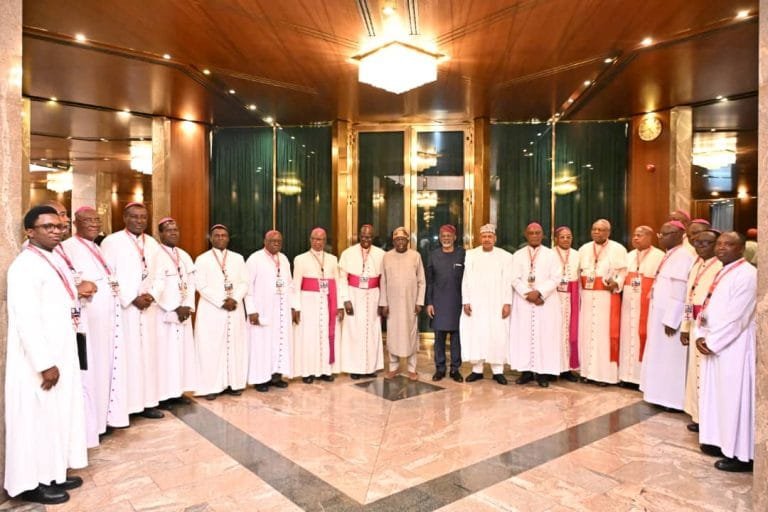
The Bishops made their position known on July 28, 2026, during a courtesy visit to the Presidential Villa, Abuja, where they presented a wide-ranging assessment of Nigeria’s political, economic, security and social conditions.
The delegation was led by the CBCN President, Most Rev. Matthew Man-Oso Ndagoso.
Addressing President Tinubu, Archbishop Ndagoso recalled the President’s past involvement in the struggle against military dictatorship and urged him to use his position to strengthen, rather than undermine, Nigeria’s democratic institutions.
The Bishops said there was growing public concern that political pluralism was being gradually weakened and that Nigeria could be moving towards a dominant one-party system.
They therefore urged President Tinubu to direct elected officials of his political party at all levels to ensure a level playing field for all political parties and candidates.
According to the Bishops, the President’s enduring legacy should be the preservation and strengthening of democratic institutions and political freedoms.
The CBCN also expressed concern over declining voter participation and growing public distrust in the electoral process.
The Bishops warned that the 2027 general elections must be free, fair, transparent and credible, stressing that anything short of this could trigger serious consequences for the country.
To restore public confidence, they called on the Federal Government to provide adequate and timely funding for the Independent National Electoral Commission (INEC) and simplify access to Permanent Voter Cards so that Nigerians can participate effectively in elections.
Beyond political concerns, the Catholic leaders painted a grim picture of Nigeria’s economic and security situation.
Archbishop Ndagoso said the country was “bleeding” as citizens continued to struggle with insecurity, economic hardship and the effects of government policies whose expected benefits had yet to reach many Nigerians.
While acknowledging President Tinubu’s expressions of concern over the difficulties facing citizens, the Bishops stressed that empathy must be accompanied by concrete action.
They identified the deteriorating electricity supply, poor road infrastructure and persistent economic hardship as major challenges undermining the administration’s Renewed Hope Agenda.
On security, the Bishops commended the government for the release of abducted schoolchildren and teachers in Oyo State and the prosecution of those allegedly responsible for the abductions.
However, they argued that such successes remained isolated when compared with the wider security situation across the country.
They expressed concern over continuing terrorism, banditry, kidnapping and other criminal activities, noting that homes, schools, churches, roads and other public spaces remained vulnerable to attacks.
The CBCN warned that persistent insecurity was not only threatening the lives and livelihoods of Nigerians but was also damaging the country’s sovereignty and its reputation as a major African nation.
The Conference also raised concerns about religious freedom and the implementation of constitutional rights across the country.
Referring to a February 10, 2026, Supreme Court judgment affirming the constitutional right of Muslim students at Rivers State University to freedom of religion and worship, the Bishops called for the same rights to be guaranteed to citizens of all faiths nationwide.
They specifically highlighted the difficulties faced by Christians in parts of northern Nigeria in acquiring land for churches and practising their faith freely.
The Bishops insisted that constitutional guarantees of religious freedom should be applied equally to all Nigerians, regardless of their faith or location.
The CBCN also highlighted Nigeria’s diplomatic relationship with the Holy See, noting the recent celebration of 50 years of diplomatic relations between Nigeria and the Vatican.
The Bishops referred to the visit of Vatican representative Archbishop Paul Gallagher and spoke of Pope Leo’s warm disposition towards Nigeria.
They subsequently appealed to President Tinubu to extend an official invitation to the Pope to visit Nigeria.
On education, the Bishops commended the Nigerian Education Loan Fund (NELFund) initiative, describing it as a positive step towards expanding access to tertiary education.
However, they expressed concern about the National Universities Commission’s moratorium on the establishment of new private universities.
According to the Conference, the restriction could further limit access to university education at a time when Nigeria faces a significant shortage of spaces for its growing youth population.
The Bishops also renewed their call for the return of mission schools to their original proprietors.
They concluded by calling for improved Church-State collaboration, sincere commitment to good governance and policies capable of addressing the economic and security challenges confronting Nigerians.
The CBCN also urged Nigerians to continue praying for wisdom and guidance for the nation’s leaders as Nigeria seeks a path towards greater stability, justice and development.
About the Author