Who does Nigeria’s democracy truly belong to?
Twenty-seven years after Nigeria’s return to democratic rule, one question continues to define our national journey: who does our democracy truly belong to?
Nigeria today marks twenty-seven years of uninterrupted democratic governance. For a country of our complexity and history, this continuity reflects institutional resilience and civic endurance. It also places us on the threshold of another defining milestone as we prepare for our 8th consecutive cycle of national elections since 1999.
Endurance, however, is not the same as fulfilment.
Democracy is not complete by time. It is strengthened by depth, widened by inclusion, and validated by fairness in participation.
At the centre of that democratic architecture stands Parliament.
The House of Representatives, as the largest deliberative assembly of Nigerians, remains the foremost institutional expression of representative democracy. It is where public voice is converted into law, where national priorities are shaped, and where accountability is institutionalised.
Parliament is, in essence, the mirror of democratic legitimacy. That mirror raises a continuing question: how faithfully does it reflect the society it represents?
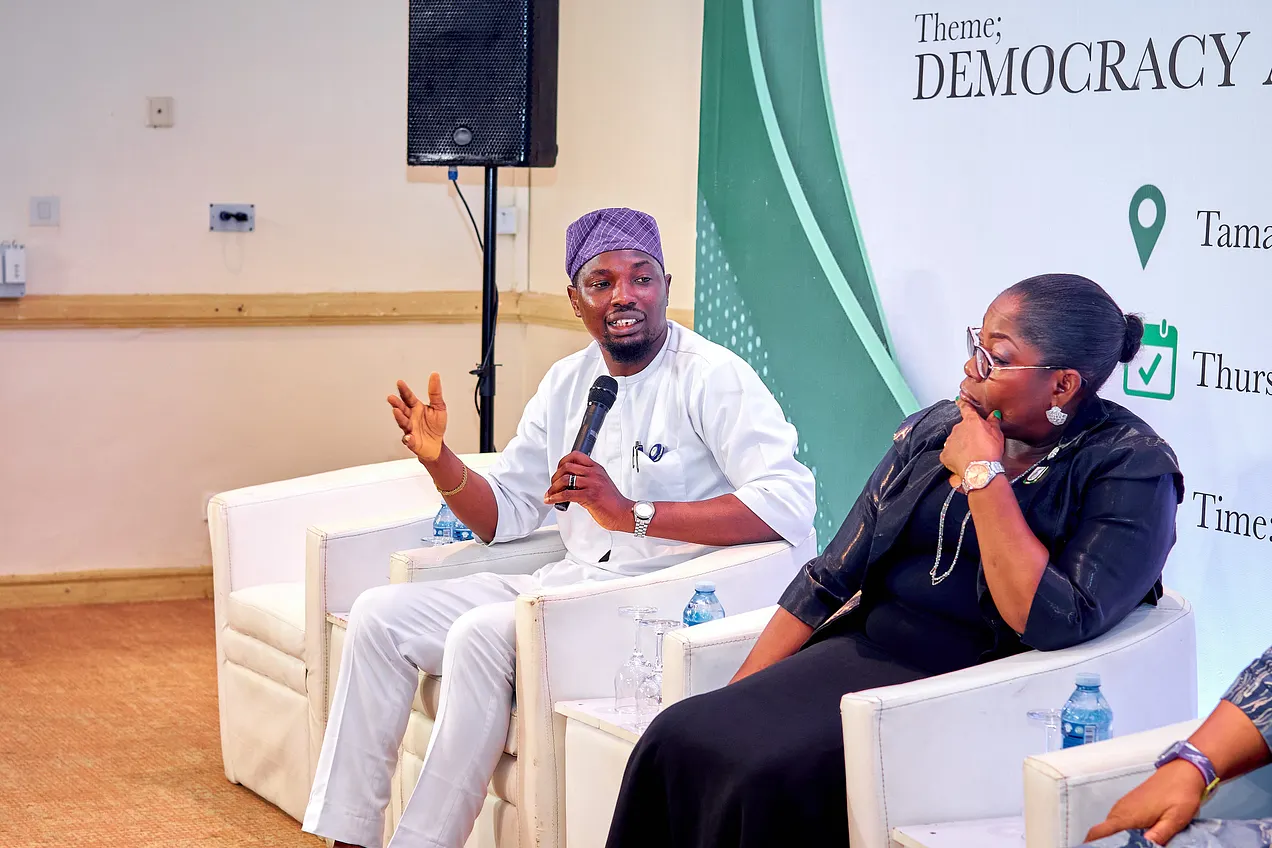
That question shaped an important engagement earlier this year during the International Women’s Day commemorations at the Goodluck Jonathan Foundation’s high-level policy dialogue on “Democracy and the Voices of Women: From Voice to Power.”
Representing my Principal, Rep. Akin Rotimi, Spokesman of the House of Representatives, the conversation focused on a central democratic challenge: expanding the pathways through which women move from participation into political leadership and decision-making power.
A parliament that does not sufficiently reflect the demographic composition of its people cannot fully claim the moral authority of representation.
Today, women occupy just 4.72% (17 seats) of the 360 seats in the House of Representatives. That figure is not only a statistic, but a democratic signal. It speaks to whose experiences shape legislation, whose realities inform policy, and whose priorities define national debate. Yet within that gap, deliberate institutional shifts are emerging.
The Rt. Hon. Abbas Tajudeen-led House of Representatives has taken clear steps toward mainstreaming inclusion. This commitment is embedded in Agenda 6 of the 8-Point Legislative Agenda (2023–2027), which situates inclusion as a core legislative objective rather than a peripheral concern.
The impact is visible.
Fifteen of the seventeen female Members of the House currently serve as Chairpersons or Deputy Chairpersons of Standing Committees, reflecting a conscious effort to situate women within structures of legislative influence.
This is further reinforced by dedicated institutional platforms such as the Committee on Women’s Affairs and the female-led Committee on Women in Parliament, both designed to strengthen gender-responsive lawmaking and oversight.
Legislative reform continues to serve as a critical instrument for expanding democratic access.
The Independent Candidacy Bill (HB 1630), sponsored by Rep. Akin Rotimi Jr., alongside the Special Seats for Women Bill (HB 1349) and other gender-responsive reforms affecting key institutions such as the Nigeria Police and the Nigeria Security and Civil Defence Corps, reflect ongoing efforts to broaden the democratic space.
Three reform directions remain central to deepening inclusion.
Political Party Reform: Political parties remain the primary gatekeepers of democratic participation. Their nomination structures determine access to power. Until internal party processes are deliberately reformed to guarantee fairer inclusion, democratic outcomes will continue to reflect structural imbalance.
Independent Candidacy: Democratic participation must extend beyond party control. Independent candidacy introduces alternative pathways into elective office, reducing structural exclusion and expanding opportunities for women, young people, and reform-oriented citizens.
Proportional representation. This is a necessary conversation for Nigeria’s democratic future. Majoritarian systems, by design, compress diversity into narrow electoral outcomes. Proportional representation expands democratic space by ensuring legislatures reflect the full composition of society, including women, persons with disabilities, youth, and other underrepresented groups. It strengthens representation by broadening access to power.
This is the real work of democratic maturity. Strong institutions and an engaged citizenry remain the twin pillars of democratic stability.
Institutions provide structure, accountability, and continuity. Citizens provide vigilance, legitimacy, and reform pressure. Democracy weakens when either side is absent.
That is why the ongoing constitutional amendment process carries such weight. The unanimous passage of the State Police Bill demonstrates what becomes possible when national urgency meets legislative consensus. It shows that structural reform is achievable when political will aligns with public necessity.
That same consensus must now extend to representation. The women’s bills deserve it. The Persons with Disabilities (PWDs) deserve it. Democratic inclusion deserves it.
Because the trajectory of Nigeria’s democracy will not be defined only by electoral cycles, but by the breadth of those who can access and exercise power within it.
As Nigeria marks twenty-seven years of democratic continuity, the task ahead is clear: to build a democracy that reflects its people in composition, amplifies their voices in decision-making, and protects their right to be represented.
Happy Democracy Day, Nigeria.
About the Author