Training
By Sani Idris Abdulrahman
Kaduna, Aug. 24, 2026 (NAN) The Universal Basic Education Commission (UBEC), in collaboration with Kaduna State Universal Basic Education Board (SUBEB), is strengthening climate resilience in schools across the state.
The initiative is being implemented through a State-Level Step-Down Training on the Greening Schools and Climate Change Education Intervention (GSCCEI).
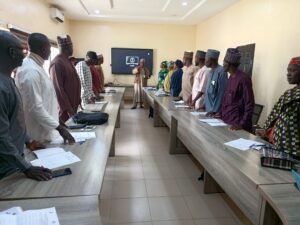
Speaking at the one-day training on Monday in Kaduna, Chairman of Kaduna SUBEB, Mubarak Muhammad, said the training was aimed at upgrading participants’ skills on greening schools.
Muhammad, represented by Hassan Usman, Kaduna SUBEB Secretary, said greening schools would not only beautify the environment, but also strengthen schools against climate-related hazards.
According to him, the initiative would improve resilience against windstorms, heavy rains and other natural disasters that damage school infrastructure.
He urged the participants to ensure that knowledge acquired was effectively applied to improve school environments.
In her remarks, the UBEC Executive Secretary, Dr Aisha Garba represented by Ibrahim Sani said the training was a significant milestone in the Federal Government’s education sector reform agenda.
Garba said climate change was one of the defining challenges of the time, requiring education systems to equip learners with knowledge, skills, values and attitudes for a sustainable future.
She said GSCCEI was UBEC’s strategic response, integrating environmental sustainability, climate change education, green skills and climate-resilient practices into basic education.
Garba said the initiative aligned with the National Education Sector Renewal Initiative and Nigeria’s commitment to the UNESCO Greening Education Partnership.
She said GSCCEI followed extensive consultations involving education institutions, ministries, departments and agencies, development partners, climate experts, academia and civil society organisations.
According to her, the consultations produced the National GSCCEI Implementation Guidelines and Handbook, providing the framework for implementation across states and the Federal Capital Territory.
Garba said UBEC would deploy a web-based monitoring and evaluation portal to support real-time reporting, performance tracking and monitoring of implementation nationwide.
She urged state implementation teams to ensure timely, accurate and consistent reporting, saying reliable data would be critical to measuring progress and improving implementation.
She said the African Centre for Environment, Agriculture and Rural Development (ACEARD) was appointed National Technical Consultant for GSCCEI.
Garba said ACEARD would provide technical guidance, capacity building, implementation support, monitoring and tracking of state-level implementation in collaboration with UBEC.
Rabiu Idris, Director, Schools Management, Kaduna SUBEB, said the training would strengthen participants’ understanding of climate change and its effects on schools.
Idris said participants would subsequently transfer the knowledge gained to teachers and head teachers across the state.
He said the initiative would help schools understand climate-related risks and adopt measures to protect learners and school infrastructure.
The facilitator, Misbahu Adamu from the National Centre for Strengthening Mathematics and Science Education, said the programme was designed by UBEC in collaboration with ACEARD.
Adamu said the programme was aimed at educating teachers on implementing greening schools and climate change education intervention in their respective schools.
He said the federal government and UBEC recognised the importance of introducing GSCCEI to schools through teacher training to educate children on tackling climate change challenges.
Adamu said the intervention would also expose learners to agricultural opportunities and entrepreneurship, including crop production, poultry, fishery and other agricultural enterprises.
He said the approach was expected to produce productive learners by combining climate education with practical agricultural entrepreneurship.
“The idea of this programme is to train the teachers on how to implement greening school and climate change education intervention in their various schools,” he said.
The facilitator said GSCCEI would also help expose learners to agricultural entrepreneurship as part of efforts to build a greener and more productive Nigeria.
Adamu said the intervention adopted a whole-school approach combining curriculum integration, teacher capacity building, infrastructure greening and community engagement.
He said the programme’s seven pillars included greening schools, promoting green entrepreneurship, teacher training, greening communities and national greening competitions.
He listed climate change clubs and environmental and social safeguards among the other pillars, stressing the need for coordinated implementation across schools and communities.
Gloria John, Kaduna SUBEB Desk Officer for GSCCEI, said the intervention was designed to educate basic school learners about climate change and build their resilience.
John said activities under the programme included tree planting, establishment of school gardens and other practical environmental initiatives.
She said the major objective was to ensure that knowledge acquired during the training was transferred to schools across Kaduna State.
The News Agency of Nigeria (NAN) reports that GSCCEI also promotes green skills, school gardens, waste reduction, recycling and practical learning to strengthen environmental awareness among learners.
Participants at the step-down training included SUBEB officials, LGEA desk officers, agricultural officers, representatives of relevant MDAs, State School-Based Management Committee and non-governmental organisations.
The training also seeks to strengthen school-community collaboration and make basic schools centres of sustainability, innovation and climate resilience. (NAN)(www.nannews.ng)
SA/YMU
Edited by Yakubu Uba
========
About the Author