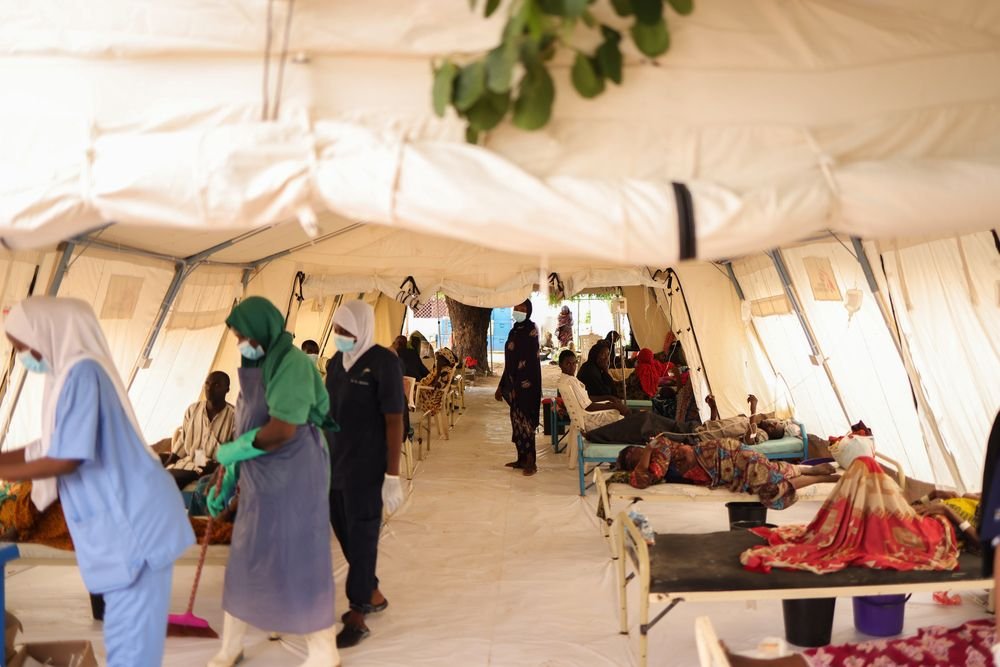
In Borno state, northeastern Nigeria, thousands of people have been affected by a rapid surge in suspected cholera, leaving healthcare facilities overwhelmed while healthcare workers struggle to keep pace.
Among those affected is 13-year-old Muhammad Usman, who was brought by an ambulance to the MSF-supported Cholera Treatment Centre (CTC) in Maiduguri after developing symptoms.
“He started vomiting, had diarrhoea and complained of stomach pain,” says Hadiza Ali, Muhammad’s mother. “Later, he lost consciousness. We realised it could be cholera.”
Muhammad is one of thousands of people affected since the first patients with suspected cholera were reported on 1 May 2026. Infections have risen rapidly, driven by overcrowded informal settlements, limited access to safe drinking water, inadequate sanitation, and poor waste management. As of 12 July, the Borno state Ministry of Health (MoH) had reported more than 35,500 patients with suspected cholera and 198 deaths in the state.
Cholera is an acute bacterial infection of the intestine that spreads through contaminated food and water, causing severe watery diarrhoea and dehydration. Without prompt treatment, the disease can become life-threatening within hours.
As the transmission has intensified, Médecins Sans Frontières (MSF) is responding to the surge in collaboration with health authorities and other humanitarian organisations. Across Borno state, MSF now supports two Cholera Treatment Centres and five Cholera Treatment Units – specialised facilities providing inpatient care for people with severe symptoms of suspected cholera – alongside 17 oral rehydration points which offer treatment closer to affected communities.
As of 12 July 2026, MSF had treated over 24,000 patients with suspected cholera since responding to the surge, with over one in four presenting with severe symptoms.
“We have significantly expanded our response over the past two months, but the transmission is still spreading faster than efforts to contain it, mainly due to a lack of access to clean water, sanitation and healthcare,.” says Bienfait Tombola, MSF project medical coordinator in Maiduguri.
While many communities are aware of suspected cholera cases, understanding of how the disease spreads remains limited.
Kyari Ali, 65, sought treatment at the CTC after suddenly developing diarrhoea and severe weakness.
“Many people in my family and community have suspected cholera. I even have relatives who are also here in the treatment centre,” says Kyari. ” I don’t know how I got the disease, I don’t know how cholera spreads.”
To increase understanding of cholera, MSF has expanded community awareness campaigns, alongside other preventative measures, such as infection prevention measures, healthcare workers training, and improvements to water and sanitation, including chlorinating water at key collection points. In early July, health authorities, supported by MSF, conducted an oral cholera vaccination campaign that reached over 2.6 million people.
Despite the significant efforts made to curb the transmission, many communities, particularly those living in informal settlements, still lack access to clean water, sanitation and healthcare, allowing transmission to continue. The outbreak has also spread beyond Borno into neighbouring Plateau state, where the MoH has reported 102 patients with suspected cholera as of 12 July 2026.
With health facilities under sustained pressure and new infections continuing to emerge, strengthening access to clean water, sanitation, surveillance and timely treatment is critical. Furthermore, vaccination campaigns must urgently be expanded across affected areas to help slow transmission and prevent further loss of life.
About the Author