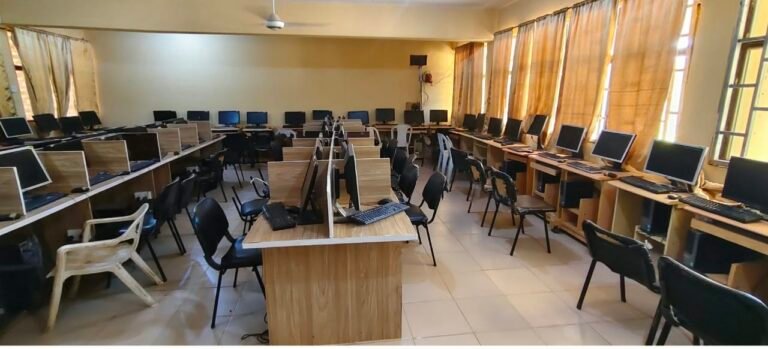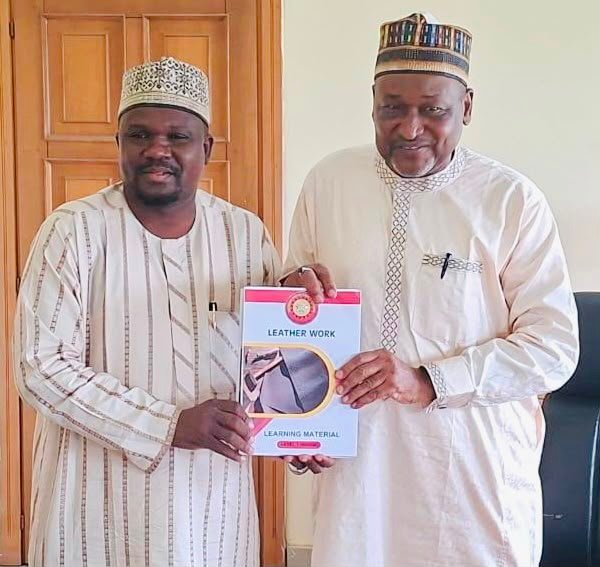
The Executive Secretary of the National Board for Technical Education (NBTE), Prof. Idris Muhammed Bugaje, has described the unveiling of Nigeria’s first Hausa-translated technical training manual at the Katsina Youth Craft Village as a landmark step in making skills education accessible to local communities, while also commending Governor Dikko Umaru Radda for investing over N5 billion in the centre.
Bugaje gave the commendation during a courtesy visit by officials of the Katsina Youth Craft Village to his office in Kaduna where the delegation presented newly developed, Hausa-translated learning materials covering various trade areas offered at the centre.
Speaking during the visit, the NBTE boss said the level of investment and commitment shown by the Radda administration had positioned Katsina as a leading state in skills development in Nigeria.
“Katsina Youth Craft Village is doing very well, and it is very commendable, especially now under the leadership of Dr. Dikko Umaru Radda. I know that previously there was a slowdown, but as soon as this administration came in, it injected a lot of funding, interest and support, and that is how you have been able to achieve all these marvellous figures,” Bugaje said.
Leading the delegation, the State Coordinator of the Katsina Youth Craft Village, Engr. Kabir Abdullahi Kofar Soro informed the NBTE Executive Secretary that the state government, under Radda, had continued to prioritise skills acquisition as a pathway to economic empowerment for young people in the state.
He said the Craft Village currently runs 14 trade areas, with learning materials developed and translated into the Hausa language to make technical and vocational knowledge more accessible to residents in rural communities.
“Our people, even in the rural communities, are often left behind in terms of skills education. But if we translate this material into Hausa, the knowledge will reach them more easily,” the State Coordinator said, adding that the initiative was inspired by how nations such as China had advanced technologically by teaching and transmitting knowledge in their native language.
Engr. Kabir further disclosed that the Craft Village had engaged professors and language experts to ensure an accurate and high-quality translation of the training manuals, working under the guidance of a lead consultant, Dr Shehu Abdulkadir.
He revealed that the centre was preparing for its second graduation ceremony, expected to hold next month, where 1,662 trainees across various trades would be certified, nearly three times the 600 graduates recorded in the previous cohort.
According to the State Coordinator, a tracking mechanism put in place by the Craft Village shows that between 80 and 85 per cent of previous graduates are now engaged in one form of business or another linked to their trade.
The delegation also disclosed that the Craft Village now has three External Quality Assurance Managers(EQAMs), about four to five Internal Quality Assurance Managers(IQAMs) and over a hundred of Quality Assurance Accessors across the state’s senatorial zones, supported by about 250 instructors and facilitators.
Responding, Bugaje said he was confident that the trainees would graduate with National Skills Qualification (NSQ) certification under the National Skills Qualification Framework (NSQF), and pledged that his office would attend the forthcoming graduation ceremony.
He commended the Craft Village for developing standardised learning materials for trades such as leatherwork and urged the state to consider allowing the manuals to be adopted nationally, citing a similar precedent in Kaduna State, where the state governor had approved the use of locally developed materials as national documents following a request from the Federal Ministry of Education.
“This is very commendable, and the fact that you have translated these materials into Hausa is another interesting development, because it will make the training more relatable to trainees,” Bugaje said. “In skills training, instruction can be given in any local language, and this removes the barrier between understanding a concept and being able to apply it.”
The NBTE boss further advised that the Craft Village consider translating some of the training materials into Ajami script, with a view to extending skills training to Almajiri pupils across the state, noting that equipping the pupils with vocational skills would help address the challenge of street begging associated with the informal Almajiri education system.
He recalled that during the era of the Sokoto Caliphate, Almajiri pupils were supported by the state and taught various trades alongside their Islamic education, and called for a return to that model through collaboration between the Craft Village and the Islamic School Board in Katsina State.
Bugaje also urged the Craft Village to expand its scope beyond the current 22 trade areas and to consider training artisans for specialised roles required in major infrastructure projects, including the Ajaokuta-Kaduna-Kano (AKK) gas pipeline, the proposed Nigeria-Morocco gas pipeline, and the Mambilla hydroelectric power project, all of which he said would require tens of thousands of skilled workers in the coming years.
He commended the state government for merging various skills programmes under the Katsina Youth Craft Village to ensure better coordination, and expressed optimism that the initiative would continue to grow under the current administration.
The NBTE Executive Secretary, who is an indigene of Katsina State, said he looked forward to attending the forthcoming graduation ceremony to celebrate the achievements of the trainees and the state’s continued investment in technical and vocational education.
About the Author