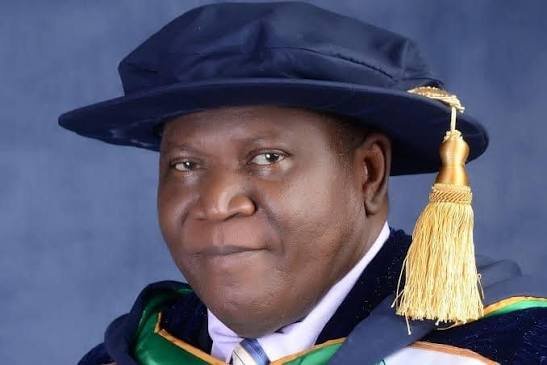
Professor Yakubu Aboki Ochefu
Nigeria now lends young people money to enter university but almost nothing to start an enterprise when they leave, Professor Yakubu Aboki Ochefu said on Thursday while delivering the 10th Convocation Lecture of the Federal University Lokoja.
Professor Ochefu, a former Secretary-General of the Committee of Vice-Chancellors of Nigerian Universities, spoke at the Multipurpose Hall, Felele Campus, on “The Confluence Generation: The University, the Graduate and the Society That Must Become Our Laboratory”.
The university is graduating 5,638 students this week. “The graduate walks out of the gate owing the state and owning nothing,” he said.
Patient capital for graduate enterprise
The professor of Economic History credited the Federal Government for the Nigerian Education Loan Fund and the YouthCred programme of the Consumer Credit Corporation, but said neither was designed for a graduate who wants to build a business.
He noted that the ₦47 billion the Corporation reports lending to about 300,000 young people comes to roughly ₦157,000 each.
“That will buy a telephone. It will not buy a shredder for plastics, a cold room or a briquette press,” he said, adding that credit priced at about two per cent a month and repayable within months suits trading and cannot finance equipment.
On the green and circular economy, he said: “We have announced the jobs and left out the finance.”
He asked the Federal Government to open a Graduate Green Enterprise Window at the Bank of Industry or the Development Bank of Nigeria, with single-digit interest, a five- to seven-year repayment term, a moratorium of at least one year, and equipment leasing in place of cash.
He also proposed accepting validated final-year projects as feasibility studies for a first loan backed by a credit guarantee, reserving a share of public contracts in waste collection, recycling and solar maintenance for graduate-owned firms, and deferring repayment of education loans for graduates who start registered enterprises.
A first home for young adults, Professor Ochefu described the landlord’s demand for one or two years’ rent in advance as “the first capital requirement of adult life”, one that arrives before the first salary.
He pointed to Britain, where the government adds 25 per cent to the savings of first-time buyers under 40 and announced a £4.7 billion “Your First Home” equity loan scheme in its Budget of 28 October 2026.
By contrast, he said, the National Housing Fund has about six million contributors while the Federal Mortgage Bank has been booking fewer than 500 mortgages.
The newer MOFI Real Estate Investment Fund had lent ₦128 billion to 1,859 families by June, about ₦69 million a family, to beneficiaries whose average age is 42. “Let us call it what it is, which is a scheme for those who have already arrived,” he said.
He proposed a First Home Savings Account within the National Housing Fund for Nigerians under 35, with government adding a quarter to every naira saved; a reserved share of planned federal housing units for young first-time occupiers on rent-to-own terms; a starter equity loan; and state laws enforcing monthly or quarterly rent. “Capital and a roof are what turn staying in Nigeria from an act of endurance into a reasonable choice,” he said.
From knowledge warehouse to intelligence machine
Turning to the universities, Profeesor Ochefu said the system was designed to supply graduates to the state and kept the same design after the state stopped hiring. “We went on producing for an employer who had left the building,” he said. Most Nigerian universities, he said, operate as warehouses of knowledge: it is received from elsewhere, stored in lecture notes, issued to students and collected back in examinations. “Nobody was ever fed by a warehouse that kept its doors shut,” he said.
He proposed that the university become an “intelligence machine”, using the word as a strategist does: one that takes in problems from its surroundings, works on them with the methods of its disciplines and delivers findings to people who can act on them. “A library is not intelligence until somebody asks it a question.” Society, he argued, is the laboratory of such a university, and the hundreds of thousands of final-year projects shelved every year are the largest unused research workforce in the country. He urged the Federal University Lokoja to set up a “Confluence Problem Register”, in which state and local governments, companies, market associations and traditional councils lodge their most pressing problems each year and departments draw project topics from it.
Professor Ochefu, who is also the National Chairman of the Association of Nigerian University Alumni, called on every university to survey its graduates twelve to eighteen months after convocation and publish what has become of them.
On artificial intelligence, Ochefu said students had discovered that a machine would write the final-year project for them, and that detection software would not solve the problem. The answer, he said, is the project that sends the student into the community. A machine can write a literature review on flooding, but “it cannot stand in Ganaja in September, measure how high the water rose on the wall of a house and ask the owner what she lost”. Such a project is the honest one, he said, “because it cannot be done from a bed with a telephone”. He also asked for an end to rival accreditation. A student, he said, may enrol in a programme approved by the National Universities Commission and learn in the third year that the professional body does not recognise it. “The student is the casualty of a boundary dispute between two agencies of the same government.” He proposed joint panels of the Commission and the professional bodies: “one visit, one instrument and one verdict”.
A degree in getting things done
Drawing on eight years in the Benue State Government, Ochefu said Nigeria “is not short of plans or of clever people. It is short of arrangements that make the right thing the routine thing.” He recommended that Nigerian universities introduce a Postgraduate Diploma and an M.Sc. in Implementation Science, open to graduates of any discipline. In place of a conventional dissertation, each student would take one stalled policy or project in a ministry, a local government or a firm and carry it to delivery.
A word to parents
Addressing parents and guardians directly, Ochefu said the degree no longer carries the job guarantee it did in their youth. “You have kept your side of that bargain. You deserve to be told the truth about the other side,” he said. “That is no fault of your child, and it does not mean that your sacrifice was wasted.” With machines now doing the routine work a new graduate was once hired for, he said, the value of a degree has moved from what its holder can reproduce to what its holder can judge.
Stay, Go or Log In
To the graduands, Ochefu set out three paths. To stay is to build a working life in Nigeria, mostly in small firms, farming, construction, logistics and the trades. To go is to emigrate. “Some of my generation call it desertion, and I will not join them,” he said, while warning of the fees, discounted certificates and distance from family. To log in is to live in Nigeria and work online for clients elsewhere. The internet, he said, “has made the world reachable, which is different” from making it flat. He declined to recommend one path. “You are adults, and the choice is yours.” What travels through all three, he said, is a reputation for doing what one has promised. He also refused to blame graduates for the labour market, noting that only about 14 of every 100 employed Nigerians are wage employees, according to the National Bureau of Statistics. “I will not stand here and blame the swimmer for the width of the river.”
About the Author