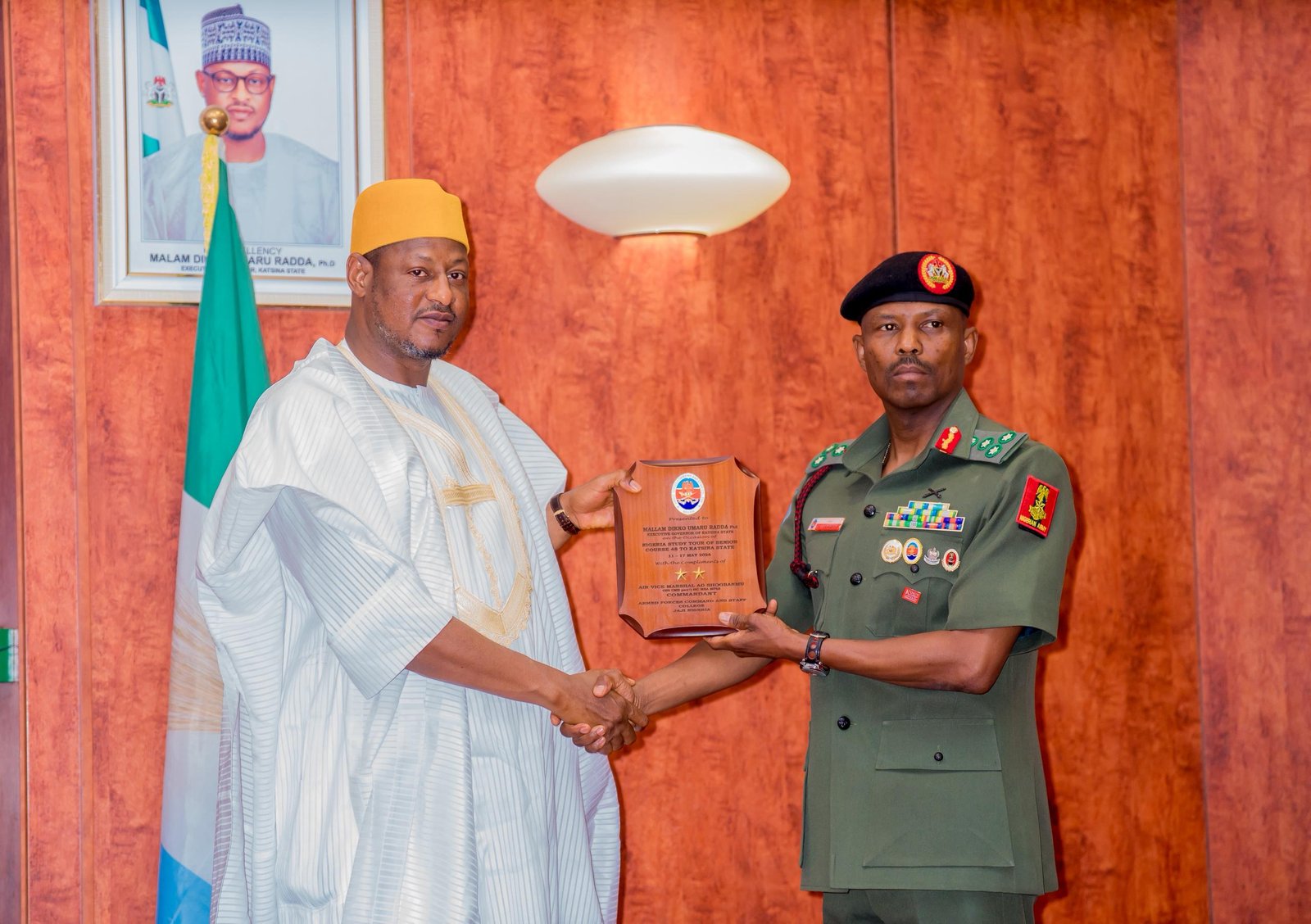
Katsina State Governor, Malam Dikko Umaru Radda, has disclosed that Katsina State now serves as a practical model for studying community engagement in security management, noting that the choice of the state for the study tour was deliberate.
Governor Radda made this known while receiving participants of Senior Course 48 from the Armed Forces Command and Staff College, Jaji, who were in the state on a study tour.
The delegation comprises 91 members, including academic and administrative staff, student officers from the Army, Navy, and Air Force, as well as international participants from The Gambia, Côte d’Ivoire, and Liberia.
They are in Katsina as part of its Environmental Study Tour themed “Promoting Community Engagement for Enhanced National Security and Prosperity.” The visit provided an opportunity for the state government to showcase practical approaches to tackling insecurity and advancing development.
“Security is not something that can be resolved overnight. It requires a thorough understanding and a coordinated approach. We believe your study will contribute to developing workable solutions for the country,” Governor Radda stated.
Radda highlighted his administration’s community-based security strategy and key development strides, while reaffirming his commitment to strengthening security through inclusive community engagement.
He described the theme as timely and highly relevant to Nigeria’s current security realities, stressing that sustainable security solutions must involve local communities.
“The kind of study you are undertaking is what the nation needs at this moment. It helps us understand the role communities can play in strengthening our security architecture at both sub-national and national levels,” the Governor explained.
He noted that such study tours are critical in shaping professional military knowledge and generating practical research capable of influencing policy not only in Nigeria but across Africa.
Governor Radda explained that prior to his administration, Katsina faced significant security challenges, with many local government areas under threat.
He said a detailed assessment revealed that conventional security personnel alone were insufficient to address the scale of insecurity nationwide.
“We realized that the number of military, police, and civil defence personnel is far below what is required to effectively secure the country. That is why we had to adopt a community-driven approach,” he said.
He emphasized that most security incidents occur in remote communities where response time can take hours, making it necessary to establish a local first line of defence supported by community-based intelligence.
The Governor further clarified that insecurity in Katsina is largely criminal—such as cattle rustling and kidnapping—rather than ideological, making community participation essential in addressing it.
He added that some criminal activities were sustained through local support networks, hence the need for grassroots collaboration.
Governor Radda highlighted the establishment of the Katsina Community Watch Corps as a major intervention, explaining that members were recruited through structured processes, trained by the military and police, and deployed to complement conventional security agencies within legal frameworks.
“They understand the terrain and can respond faster. Their role in intelligence gathering and early response has significantly helped us reduce insecurity to the barest minimum,” he noted.
He added that the initiative has improved access to previously unsafe areas, with all local government areas now largely accessible and farming activities significantly restored.
The Governor also disclosed that community-led engagements involving traditional rulers, religious leaders, youth groups, and local authorities have complemented government efforts in restoring peace. In some instances, communities independently facilitated peace arrangements, with authorities and security agencies serving as observers.
“We made it clear that government would not negotiate from a position of weakness, but communities themselves engaged constructively, and in some cases, it yielded positive results,” he said.
He commended the Armed Forces and other security agencies for their sacrifices, acknowledging the personal cost borne by personnel in the line of duty.
“Our soldiers and security personnel make enormous sacrifices, leaving their families behind to protect the country. This commitment must never be taken for granted,” he said.
Earlier, the Team Leader of the delegation, Brigadier General K. Rabiu, said the visit formed part of the nationwide study tour of participants of Senior Course 48 of the Armed Forces Command and Staff College.
He explained that the team is one of seven syndicate groups deployed across selected states, including Benue State, Jigawa State, Katsina State, Kogi State, Nasarawa State, Niger State, and Plateau State as part of the 2026 Nigeria Environmental Study Tour.
“The Armed Forces Command and Staff College is a tri-service institution established to train operational-level officers and prepare them for higher command and staff responsibilities,” he noted.
He added that the College admits officers from allied African countries and operates exchange programmes with nations such as Ghana and South Africa, strengthening regional cooperation and military diplomacy.
Speaking on the objective of the study tour, Brigadier General Rabiu said it is designed to expose participants to real-life governance, development, and security challenges across the country.
“Participants are required to conduct research on critical national issues and present practical, policy-relevant solutions that can contribute to national development,” he said.
He described the theme of the tour as timely and significant, noting that it reflects the urgent need to integrate communities into national security strategies.
“This theme reflects the urgent need to integrate communities into national security strategies and deepen collaboration between citizens and security institutions,” he added.
According to him, the delegation’s visit to Katsina is specifically aimed at studying the state government’s efforts in promoting community engagement as a tool for enhancing security.
“We are here to understand how your administration’s initiatives are contributing to strengthening the operational effectiveness of the Armed Forces of Nigeria,” he said.
Rabiu commended Governor Radda’s administration, describing Katsina as a model for community-driven security and development.
“Since our arrival, we have observed that Katsina State has become a strong reference point in community-based security initiatives, particularly through engagement with traditional rulers, community watch groups, and local stakeholders,” he stated.
He further highlighted key developmental strides in the state, including infrastructure projects, agricultural mechanization, and improvements in the education sector.
“These efforts clearly demonstrate that security and development are interconnected and must be pursued together,” he said.
Those in attendance included the Deputy Governor, Hon. Faruk Lawal; Speaker of the Katsina State House of Assembly, Hon. Nasir Yahaya Daura; the Chief Judge, Justice Musa Danladi; the Grand Khadi; the Principal Private Secretary to the Governor, Hon. Abdullahi Aliyu Turaji; and members of the Katsina State Executive Council.
About the Author