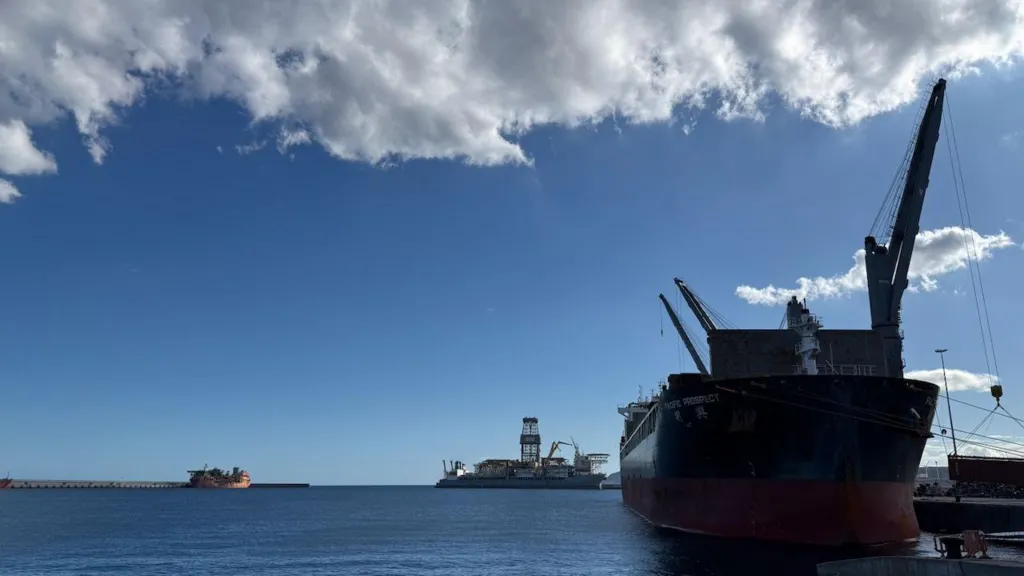
Spain has started evacuating passengers from a hantavirus-stricken cruise ship anchored near Tenerife in the Canary Islands.
Health Minister Mónica García said the operation was “proceeding normally” and that all passengers on board the MS Hondius were still asymptomatic.
They will be divided into groups by nationality and ferried to the coast in small boats. Charter planes will be on the tarmac at the local airport, ready to repatriate them to their home countries.
Fourteen Spanish nationals will be first to disembark, then those flown out by the Netherlands, including Dutch, Greek and German passengers, and part of the crew.
Other flights are poised to leave after that, including to the UK and US. The last evacuation flight is expected to leave on Monday to Australia.
The Hondius pulled into the port of Granadilla before dawn on Sunday, a month after the first passenger died on board.
The sun then rose to reveal it anchored offshore, with military police boats on patrol and a major operation unfolding on land to help more than 100 passengers and crew disembark.
At about 07:00 (06:00 GMT) on Sunday, medical teams went on board to check everyone for signs of the virus.
There have been meticulous preparations to receive the ship, which won’t be permitted to reach shore: a security perimeter of one nautical mile was enforced around it as it approached the island.
Dozens of intensive care specialists are on stand-by at the Candelaria hospital in Tenerife in case anyone from the Hondius becomes seriously ill during the transfer. A strict isolation facility has one bed fully equipped to deal with infectious diseases, complete with testing kit and a ventilator.
“We are absolutely ready,” chief intensive care doctor Mar Martin told me on the unit, where large numbers of protective suits, masks and gloves are already piled up for staff.
“We’ve never seen [hantavirus] before – but it’s a virus, with some complications, just like we manage every day. We are fully trained for that.”
The complex operation to prevent the rare Andes strain of this virus spreading is described by Spain’s health minister as “unprecedented”.
On Saturday, she stressed that the risk of contagion for the general population was low. “We believe that alarmism, misinformation and confusion are contrary to the basic principles of preserving public health.”
Security measures in the port, an industrial facility in the south of Tenerife, increased notably on Saturday. Spain’s military police and disaster response teams have both set up large reception tents and access to the waterfront is restricted.
Spanish nationals leaving the ship will be flown to Madrid, where they face a mandatory quarantine in the Gomez Ulla military hospital. Complete isolation would be gruelling – the virus has an incubation period of up to nine weeks – and it is not clear how long people in Spain or elsewhere will be quarantined.
The head of the World Health Organization (WHO) Tedros Adhanom Ghebreyesus, now in Tenerife to oversee the disembarking, has praised the authorities for their “solid and effective response” to this outbreak. (BBC)
About the Author