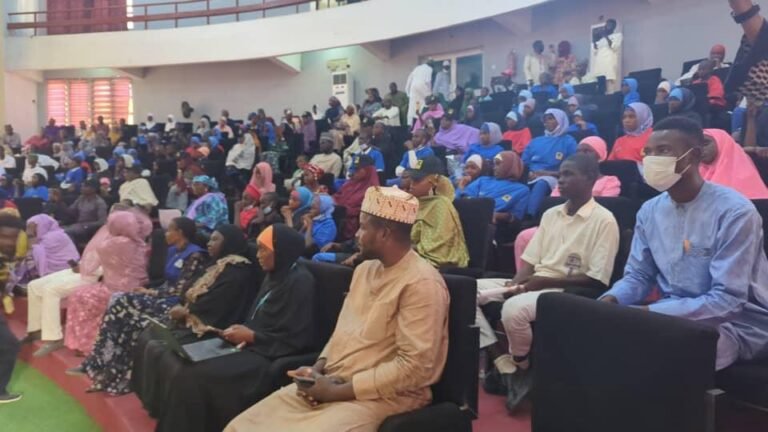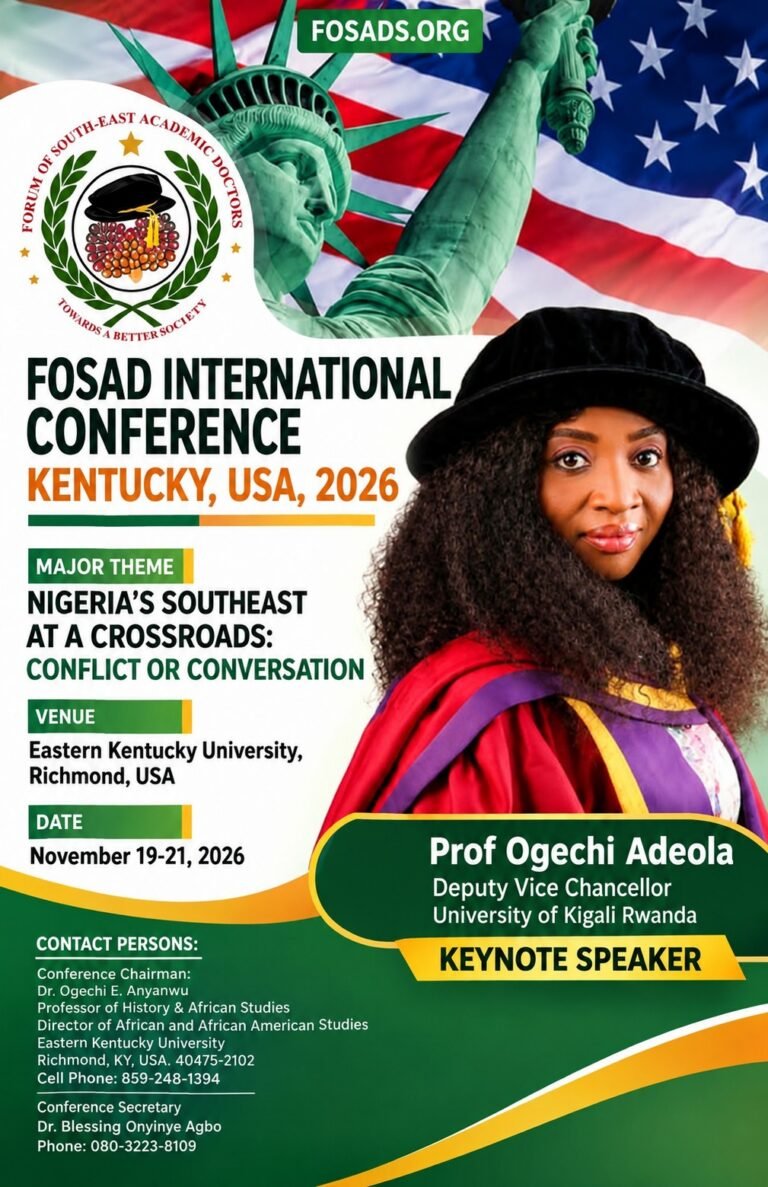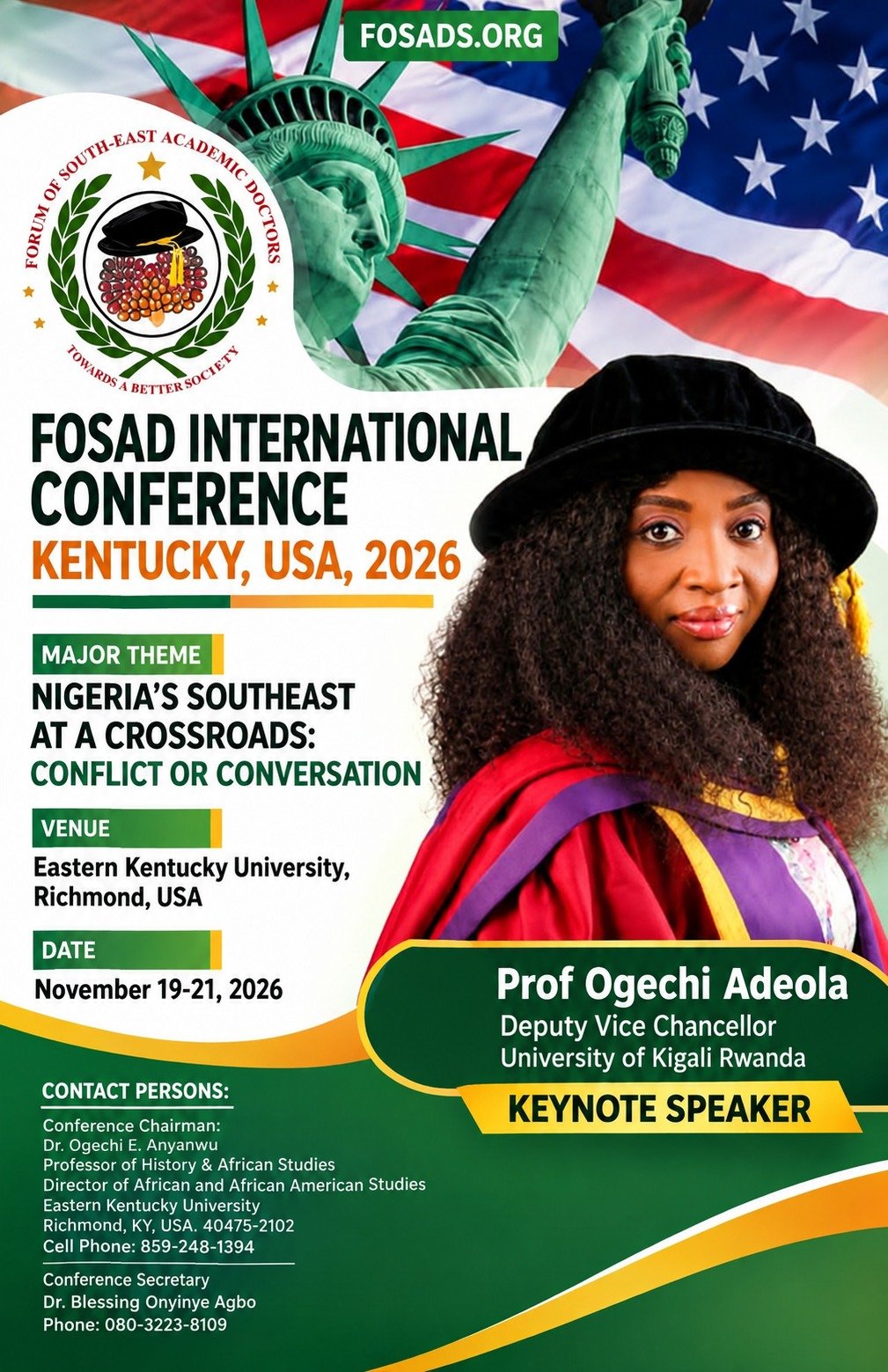
The Forum of South-East Academic Doctors (FOSAD) has called for renewed commitment to dialogue, collective responsibility, regional cooperation and sustainable development as scholars and professionals examined the challenges confronting Nigeria’s South-East at its 2026 International Conference.
The conference, held on November 19 – 21, 2026, was themed, “Nigeria’s South-East at a Crossroads: Conflict or Conversation?”
The gathering brought together academics, researchers and other professionals to examine the historical foundations, contemporary realities and future prospects of the South-East, with particular attention to insecurity, economic development, Igbo identity, leadership, social cohesion and the need for coordinated regional action.
In his welcome address, the President of FOSAD, Dr Anayochukwu Stephen Nwala, described the conference theme as more than an academic question, saying it was central to the future of the Igbo people and their pursuit of peace, unity and sustainable development.
Nwala said the conference provided an opportunity for scholars to interrogate the challenges facing the region and develop practical recommendations that could guide its future.
He expressed confidence in the quality of the keynote address and research presentations, noting that the resource persons had been carefully selected based on their expertise and contributions to their respective fields.
The FOSAD president emphasized that the outcome of the conference must translate into practical action rather than become another academic document abandoned on library shelves.
Drawing a comparison with the 31st United Nations Climate Change Conference, COP31, in Türkiye, which adopted the theme “COP of Implementation”, Nwala stressed the importance of moving beyond declarations and commitments to measurable results.
He said FOSAD was committed to ensuring that the research findings and recommendations generated at the conference would be followed up and translated into actionable programmes.
Anyanwu calls for collective responsibility
Also speaking, the 2026 Conference Chair, Dr Ogechi E. Anyanwu, commended the FOSAD leadership and conference planning committee for their contributions to organizing the gathering.
He disclosed that the conference received 72 abstracts, expressing optimism that the presentations would generate meaningful intellectual discussions on reclaiming the Igbo past and reimagining its future.
A major part of his message centered on the need for constructive engagement, open-mindedness and the willingness to reconsider long-held assumptions.
According to Anyanwu, the future of relationships between the South-East and its neighbours, both within Nigeria and beyond, depends partly on the ability of people to listen to differing perspectives and resolve disagreements through meaningful conversations.
He maintained that evidence, facts and reason should guide public discussions, rather than prejudice, hostility and entrenched positions.
Posing a fundamental question about the future of the region, Anyanwu argued that the choice before the people was between conflict and conversation, urging them to embrace dialogue as the foundation for peaceful coexistence and progress.
He also called on FOSAD members to take collective ownership of the association, promote its activities and contribute to its growth and sustainability.
Adeola identifies the South-East paradox
The keynote address, delivered by Professor Ogechi Adeola, examined what she described as the “South-East Paradox”, focusing on the contradiction between the region’s remarkable entrepreneurial achievements and its continuing struggle to translate individual success into collective prosperity.
Titled “The South-East Paradox: Olaudah Equiano, Igbo Identity and the Choice Between Conflict and Conversation”, the presentation explored the historical, cultural, economic and political factors shaping the region’s contemporary experience.
Adeola argued that the South-East possesses considerable entrepreneurial capacity, professional expertise, cultural resilience and diaspora connections, but has not adequately converted these strengths into reliable public infrastructure, security, effective leadership and shared economic prosperity.
She challenged the region to consider why individual enterprise and commercial success had not translated into equally strong public institutions and common development outcomes.
The keynote speaker used the life and writings of Olaudah Equiano, the eighteenth-century Igbo-born writer and abolitionist, to illustrate the importance of historical memory, dignity, evidence-based advocacy and peaceful engagement.
Drawing from Equiano’s autobiography, The Interesting Narrative of the Life of Olaudah Equiano, published in 1789, Adeola highlighted his account of Igbo society, particularly its kinship relationships, community support, shared responsibilities and traditional mechanisms for resolving disputes.
She recalled Equiano’s description of a society in which individuals contributed to the common good and communities supported one another.
According to Adeola, Equiano’s experience demonstrated how a person could transform personal suffering into a powerful voice for justice, build alliances across social boundaries and influence institutional change through testimony, persuasion and advocacy.
She urged the Igbo people to learn from his approach by documenting their history truthfully, speaking with evidence, building partnerships and pursuing peaceful solutions to disagreements.
Igbo identity and the spirit of Nwanne
The presentation also examined the philosophical significance of the Igbo concept of Nwanne, describing it as more than a cultural expression of kinship.
Adeola explained that Nwanne represents mutual responsibility, solidarity, reciprocity, dignity and the obligation not to abandon one another.
She connected the philosophy to the popular Igbo expression, “Onye aghala nwanne ya,” meaning “Let no one leave a sibling behind.”
She argued that the principle should extend beyond family relationships to influence economic cooperation, leadership, social protection and regional development.
The speaker particularly highlighted the Igbo apprenticeship system, known as Igba-boi, as an example of how solidarity can become an organized economic model.
She explained that the system combines mentorship, practical business training, trust, locally generated capital and the establishment of new entrepreneurs.
The model, she noted, creates opportunities for young people to acquire business skills, establish independent enterprises and support the next generation.
Adeola challenged the South-East to apply the same cooperative principles to public development, arguing that a people capable of building successful businesses together should also be able to build stronger institutions and common infrastructure.
Five paradoxes confronting the region
The keynote identified five major paradoxes confronting the South-East: prosperity without sufficient public goods; cultural pride alongside division and mistrust; resilience that continues to coexist with vulnerability; security challenges that undermine freedom and dignity; and leadership talent without adequate coordination.
On economic development, Adeola questioned why thriving commercial centres such as Onitsha, Aba and Nnewi continued to operate alongside inadequate infrastructure, unreliable power supply and other public service challenges.
On identity, she urged the region to protect its cultural dignity without treating differences of opinion or background as disloyalty.
She also warned that resilience should not become an excuse for accepting persistent insecurity, unreliable services and disrupted livelihoods.
On security, she stressed that citizens must be able to travel, trade, study and express grievances peacefully without fear or intimidation.
She further called for stronger cooperation among the five South-East state governments, arguing that problems involving transport, energy, education, security and investment often transcend state boundaries.
Seven-point agenda for regional renewal
To address these challenges, Adeola proposed a seven-point renewal agenda covering safety, dialogue, economic development, learning, youth participation, diaspora partnerships and accountable delivery.
She called for civilian protection and respect for the rule of law, inclusive dialogue involving women, young people and affected communities, stronger regional markets and infrastructure, and increased investment in skills, research and innovation.
She also advocated meaningful opportunities for young people and responsible engagement with the South-East diaspora to attract investment and expertise.
On implementation, she proposed that stakeholders begin with a 100-day action framework involving inclusive consultations, agreement on priorities, publication of baseline information, pilot projects, monitoring and independent evaluation.
She stressed that dialogue alone would not resolve the region’s challenges unless it was supported by safety, inclusion, accountability, evidence and measurable commitments.
FOSAD urged to take the lead
Adeola identified important roles for FOSAD scholars, including documenting history, investigating the causes and effects of conflict, organising inclusive conversations, evaluating development programmes, mentoring young people and advocating accountable institutions.
She encouraged researchers and students to undertake studies on historical memory, the Igbo apprenticeship system, public infrastructure, diaspora investment, regional cooperation and practical approaches to dialogue after conflict.
The keynote concluded with a call for collectivism, unity and focus, urging the South-East to choose conversation over conflict.
The conference, moderated by Dr Uzor Ngoladi, the Secretary General of FOSAD and Dr Victoria Ojiako, reinforced the position that the region’s future depends not merely on its historical achievements or individual successes, but on its ability to translate those strengths into collective development, security, institutional accountability and a shared vision.
As the conference message emphasized, the challenge before the South-East is no longer simply whether its people can succeed individually, but whether they can work together to build a future in which everyone can flourish.
About the Author