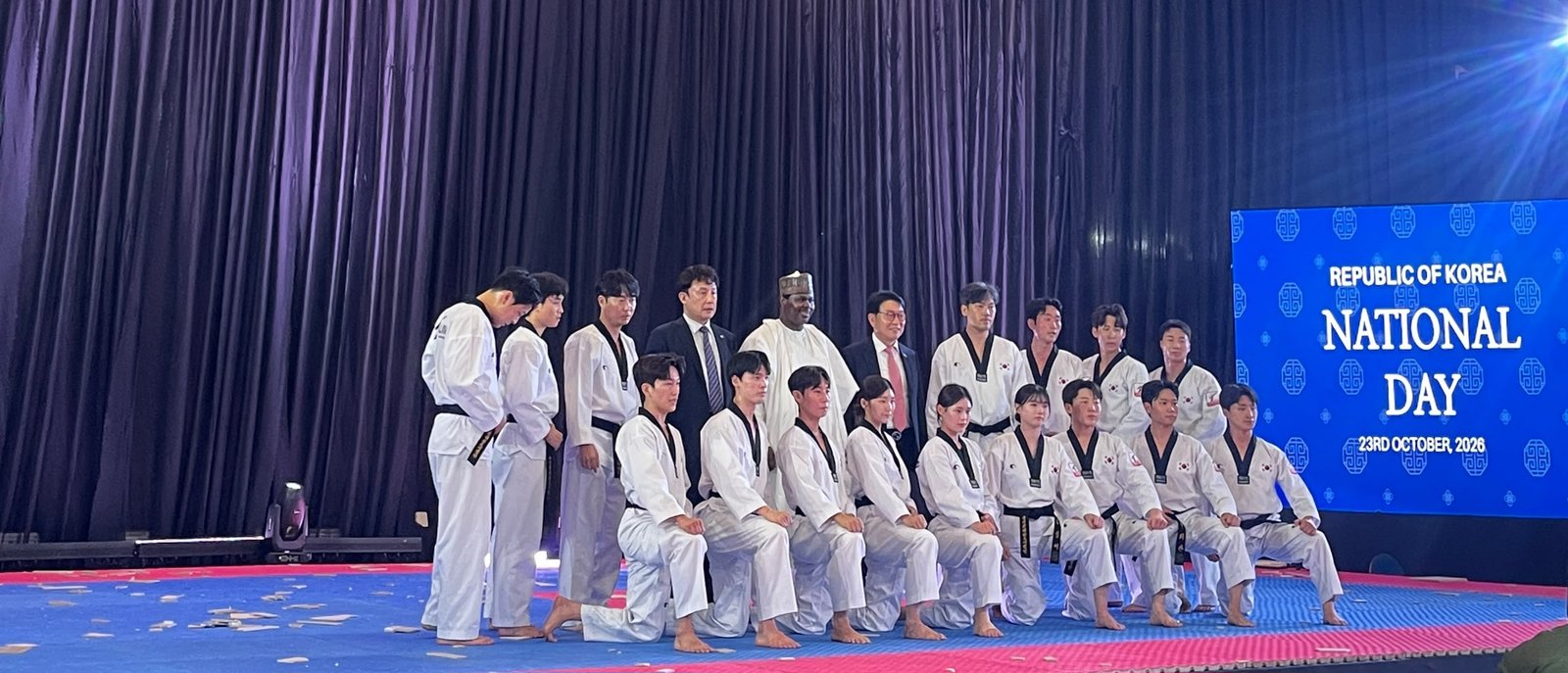
Nigeria has urged South Korean companies to increase investment in manufacturing, agriculture, technology and shipbuilding, seeking to leverage Korea’s industrial expertise to boost local production, create jobs and accelerate economic growth.
The appeal was made by Babagana Wakil, Chief of Protocol at the Ministry of Foreign Affairs, who represented the Minister of Foreign Affairs, Ambassador Bianca Odumegwu-Ojukwu, at a reception to mark Korea’s National Day in Abuja on Friday.
Speaking on behalf of the minister, Wakil said Korea’s achievements in industrialisation, technology and infrastructure offered valuable lessons for Nigeria as it pursued economic diversification. He urged Korean firms to explore opportunities in local manufacturing and assembly, shipbuilding and other industries capable of expanding Nigeria’s industrial base.
He said Nigeria was interested in Korean expertise in agricultural mechanisation, particularly rice production and processing, to improve productivity and support food security. Other priority areas included digital technology, infrastructure, education, technical training, maritime security and fisheries.
Wakil reaffirmed the Nigerian government’s appreciation for Korea’s contributions to the country’s economic growth and skills development, stressing the need to expand trade and investment for mutual benefit.
South Korean Ambassador to Nigeria, Jeong Yoan, highlighted initiatives supported by his country in youth entrepreneurship, education and agricultural employment, describing Nigeria’s young population as a major asset.
He disclosed that the Korea International Cooperation Agency (KOICA), the Small and Medium Enterprises Development Agency of Nigeria (SMEDAN) and the United Nations Development Programme (UNDP) broke ground in September on the Abuja Centre for Entrepreneurship.
The centre is expected to support hundreds of young entrepreneurs and start-ups in turning business ideas into viable enterprises.
Jeong also said Korea’s Smart School project, implemented with the Universal Basic Education Commission (UBEC), had reached 8,000 children and trained more than 300 teachers and school leaders.
In agriculture, KOICA and the Food and Agriculture Organisation (FAO) are implementing initiatives aimed at creating green jobs for young Nigerians. Approximately 2,000 Nigerian officials have also received training in Korea through KOICA programmes, he said.
“Our shared goal is simple: more opportunities for young people, stronger local businesses, and better lives for our people,” Jeong said.
The ambassador named Daewoo Engineering & Construction, LG, Samsung, Hyundai and Solpia among Korean companies operating in Nigeria’s energy, manufacturing, clean water and digital technology sectors.
He said the Korean Embassy, working with the Korea Trade-Investment Promotion Agency (KOTRA), would continue to promote investment, technology transfer and local employment.
Jeong said Korea respected Nigeria’s development priorities and sought to work with the country as an equal partner, adding that stronger commercial ties could create jobs, strengthen local businesses and generate shared prosperity.
Nigeria and South Korea established diplomatic relations in 1980, with ties spanning trade, investment, education and technical assistance. Nigeria is seeking to build on those relations to attract more capital and expertise for industrial expansion and employment generation.
About the Author