By Sadiq Muhammed
There are moments when history must be revisited, not to reopen old wounds, but to prevent the powerful from writing the past in a way that silences the people who came before them.
The story of the Jukun people of the Benue Valley is one such story.
For years, the history and identity of the Jukun communities in Benue have received far less attention than they deserve. Yet historical records, colonial documents and scholarly research provide evidence of an established Jukun presence along the Benue River long before the modern political boundaries of Benue State were created.
The question, therefore, is not whether the Jukun have a history in the area. They do. The more uncomfortable question is whether a minority community is gradually being expected to surrender its historical identity in order to fit into the political and cultural framework of a larger neighbouring ethnic group.
One of the most revealing pieces of documentary evidence is the 1919 Gazetteer of Muri Province, a British colonial record that refers to the settlement as “Abinsi (Abise).” That reference demonstrates that Abise was a recognised historical name more than a century ago, long before contemporary ethnic politics in Benue State.
Today, the settlement is predominantly known officially as Abinsi. The existence of the two forms does not, by itself, prove that somebody deliberately erased the name Abise. But it raises a legitimate question, why should the historical name by which the Jukun people identified their community be treated as though it has no significance?
For the Abise people, a name is not merely a word on a government document. It is memory. It is ancestry. It is identity. It is a connection between the living and those who inhabited the land before them.
If a community wishes to preserve the name Abise, that cultural preference deserves respect.
The Jukun presence in the Benue Valley predates the creation of Nigeria’s present administrative boundaries. Historical scholarship on the Awanu-Jukun of Abinsi documents their political and social organisation and their longstanding relationship with the Benue River region. Colonial records likewise contain separate reports concerning Jukun settlements in what was then called Tiv Division.
This matters because the modern language of “settlers” and “indigenes” can sometimes erase complicated histories.
The Jukun are not people who suddenly appeared in Benue in the twentieth or twenty-first century. They have their own traditional institutions, cultural practices, ancestral connections and historical memory. They should not have to prove their existence every generation.
Perhaps the most troubling issue is what happens when recognition of a minority community becomes conditional upon that community adopting the identity of another.
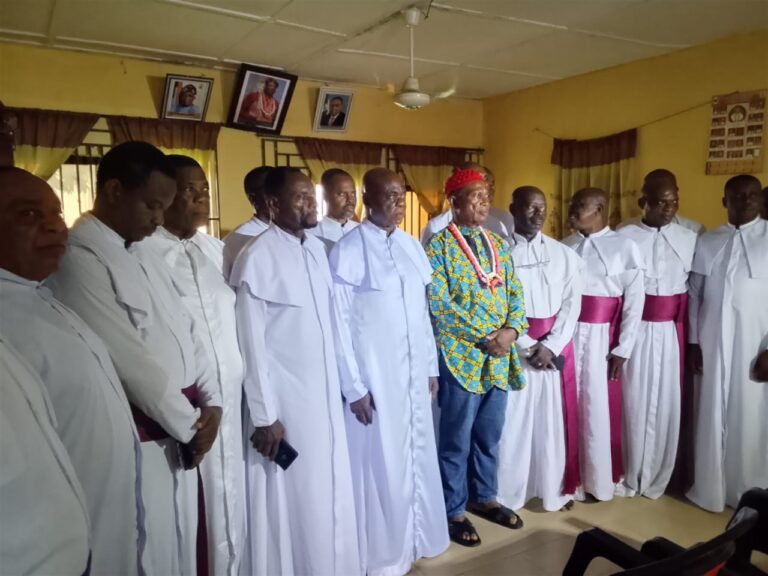
Research concerning the Awanu-Jukun reports that Jukun traditional authorities in Benue have been placed within Tiv traditional structures and that the Jukun traditional ruler has been required to wear Tiv traditional attire and beads at traditional council meetings. The National Association of Jukun Wanu has also publicly complained about alleged marginalisation and pressure on its traditional institutions.
If these reports are accurate, they raise a fundamental question.Why should a Jukun traditional ruler have to dress like a Tiv traditional ruler in order to be recognised?
A traditional ruler represents his people. If he is Jukun, there should be nothing controversial about him appearing in Jukun traditional attire. Culture should not be treated as a political concession.
The Jukun do not need to become Tiv in order to deserve recognition.
Defending the Jukun Abise does not require hatred of the Tiv. The Tiv have their own history, grievances and legitimate interests. They have lived across large parts of the Benue Valley for generations and have every right to preserve their language, culture and traditions.
But respect must be reciprocal.
The same rights that the Tiv claim for themselves must be available to the Jukun. If Tiv people have the right to determine how their traditional rulers dress, the Jukun should have the same right. If Tiv communities have the right to preserve their historical names, Jukun communities should have that right. If Tiv history deserves to be taught and remembered, Jukun history deserves exactly the same treatment.
Equality does not mean that the minority must adopt the identity of the majority.
One of the dangers facing minority communities in Nigeria is the assumption that numerical strength automatically confers historical ownership.
It does not.
A community does not become historically insignificant simply because another ethnic group eventually becomes more numerous around it. Nor should political boundaries be used to erase older cultural identities.
If the Jukun people have maintained their identity despite decades of demographic and political changes, their resilience should be respected rather than interpreted as an obstacle to somebody else’s dominance.
The state has a responsibility to protect minority cultures precisely because minorities do not possess the numerical strength to protect themselves through numbers alone.
The Jukun–Tiv question should therefore not be reduced to ethnic rivalry. It is a test of whether Nigeria’s commitment to pluralism means anything at the local level.
Nigeria cannot condemn ethnic domination in one part of the country while ignoring allegations of domination elsewhere. A community cannot demand respect for its own historical grievances while dismissing the historical grievances of its neighbour.
No ethnic group should be expected to surrender its cultural identity simply because it lives within a state where another group is more numerous.
The Jukun people deserve to be heard. They deserve to preserve their name. They deserve recognition of their history. They deserve the right to maintain their traditional institutions. They deserve the freedom to wear their own traditional attire. And they deserve to participate fully in the political and social life of Benue without being required to become culturally indistinguishable from the majority.
The best way forward is not to manufacture another ethnic confrontation. It is to open the archives. Let historians examine the colonial records. Let scholars document the oral traditions of the Abise people. Let the government establish the historical origins of the community’s name. Let the Jukun explain their own traditional institutions rather than allowing others to define them.
The 1919 British record already gives us an important starting point: “Abinsi (Abise).”
That historical reference should remind us that names have histories and that histories belong to the people who lived them.
The Jukun people should not have to disappear culturally in order to remain physically present.
They should not have to exchange their traditional identity for political recognition.
And they should never have to choose between being accepted by their neighbours and remaining who they are.
Abise is more than a name. It is a history. It is a people. And that history deserves to be remembered.
About the Author