By Sam Israel
The rain may have come and gone, the kilometres may have been many, and the road may have stretched across the length and breadth of Nasarawa State, but the message carried by the Maryam Ahmed Wadada Aliyu Women Empowerment Programme remained remarkably simple: a woman lifted is a family strengthened, and a family strengthened is a community transformed.
That message found its final destination on Sunday in Keffi, where the empowerment train that began its journey in Awe Local Government Area on Monday, August 10, brought to a close an extraordinary tour of all 13 local government areas of Nasarawa State.
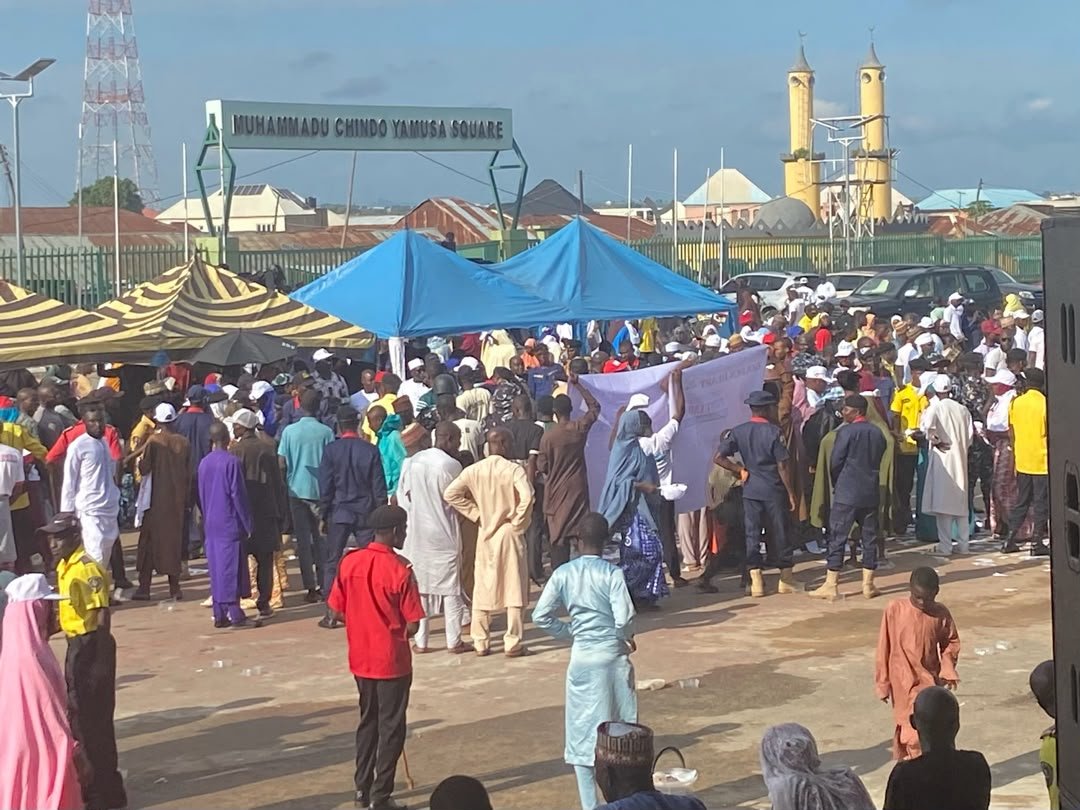
At the Muhammad Chindo Yamusa Square in the heart of Keffi, thousands of jubilant women gathered, not merely to catch a glimpse of Hajiya Maryam Ahmed Wadada Aliyu, but to celebrate a gesture they described as an uncommon demonstration of compassion and concern for women struggling to provide for their families.
Many of the women who thronged the venue—young, elderly and middle-aged alike—described Hajiya Maryam as “a woman with the heart of gold,” applauding what they said was a practical intervention at a time when many families are confronted by economic hardship.
The programme, which provided financial empowerment to women across the 13 local government areas, was conceived to enable beneficiaries to establish or strengthen small businesses and create sustainable sources of income.
Addressing the mammoth crowd in Keffi, Hajiya Maryam said the objective was not simply to distribute money, but to give women an opportunity to escape the grip of poverty and build a better future for themselves and their families.
She described women as the backbone of the family, stressing that assisting them could no longer be postponed.
According to her, when a woman receives the means to trade, farm, process food, or establish a small enterprise, the benefit rarely ends with her. It reaches her children, her husband, her extended family and, ultimately, the community.
She therefore urged the beneficiaries to invest the money wisely and turn the intervention into a foundation for sustainable economic independence.
But beyond the immediate empowerment, the Keffi gathering also carried a political message.
Hajiya Maryam called on the women of Nasarawa State to support the governorship aspiration of her husband, Senator Ahmed Wadada Aliyu, saying his emergence as governor in 2027 would provide an opportunity to institutionalise people-centred programmes capable of reducing poverty and expanding economic opportunities across the state.
She promised that, if given the opportunity to serve as First Lady, she would champion programmes that directly respond to the needs of ordinary people, particularly women and vulnerable families.
The chairman of Keffi Local Government Council, Dr. Idris, in his welcome address, commended Hajiya Maryam for establishing what he described as an unprecedented poverty-alleviation initiative targeted at women.
He urged the beneficiaries to resist the temptation to consume the money and instead invest it in ventures capable of generating continuous income.
The chairman also assured that Keffi, the home of Senator Wadada, would demonstrate overwhelming support for his governorship ambition in the 2027 election.
A Royal Blessing for the Journey Ahead
Before commencing the final phase of the empowerment programme in Keffi, Hajiya Maryam and her entourage paid a courtesy visit to the Emir of Keffi, Dr. Chindo Yamusa III, to seek his royal blessings.
The visit provided another significant moment in the journey that had taken the empowerment train through the diverse communities of Nasarawa State.
Speaking at the palace, Hajiya Maryam acknowledged the fatherly role the Emir had continued to play in the political career of her husband and expressed appreciation for the traditional institution’s guidance and support.
She also appealed for the continued support of traditional rulers across the state for Senator Wadada’s political aspiration.
Responding, the Emir of Keffi, Dr. Chindo Yamusa III, described Senator Wadada as a worthy son of Keffi and pledged his support for his aspiration.
His words added a traditional dimension to a programme that had, over the preceding days, been defined largely by grassroots engagement.
A Journey That Went Beyond Money
From Awe to Keffi, the empowerment train was more than a procession of ceremonies. It became a moving window into the economic realities confronting women across Nasarawa State.
At every stop, beneficiaries arrived with different stories, different needs and different hopes. Yet the common denominator was the same: the desire to have something with which to start, restart or strengthen a means of livelihood.
For Hajiya Maryam, the journey also became a listening tour.
In an interview after the final event, she thanked everyone who travelled with her across the state, assuring them that their sacrifices and efforts would not be in vain.
She said the tour opened her eyes more deeply to the realities confronting communities across Nasarawa State and promised to confront those challenges one after another if she becomes First Lady.
That perhaps became the most significant outcome of the tour.
The money handed to beneficiaries may be spent, invested and multiplied, but the knowledge gained from travelling through all 13 local government areas could become an enduring blueprint for future interventions.
A New Political Conversation
As the empowerment programme takes a pause, its political implications are already becoming part of the conversation in Nasarawa State.
The beneficiaries now carry not only financial assistance but also a personal experience of an intervention that reached them in their communities.
For supporters of Senator Ahmed Wadada Aliyu, this grassroots contact represents the beginning of a wider political relationship ahead of the 2027 governorship election.
For the women themselves, however, the immediate concern is more practical: whether the money received can become the seed of something bigger.
And that is precisely where the success or otherwise of the programme will ultimately be measured—not by the size of the crowds at the ceremonies, but by the number of women who turn the assistance into functioning businesses, additional income and improved livelihoods.
The story of the Maryam Ahmed Wadada Aliyu empowerment programme is therefore not ending in Keffi.
It may only be beginning.
A Shared Philosophy of Service
One striking feature of the Wadada household is the emphasis placed on empathy for ordinary people.
Husband and wife appear to share a political philosophy in which service is measured by its impact on those at the bottom of the economic ladder.
While Senator Wadada has built his political profile around grassroots engagement, legislative interventions and his ambition to lead Nasarawa State, his wife has increasingly emerged as a prominent voice in women-focused empowerment and social intervention.
Their supporters believe the combination could define a new approach to governance—one that places ordinary families at the centre of development planning.
If Senator Ahmed Aliyu Wadada eventually occupies the Government House in Lafia in 2027, the expectations generated by the empowerment tour will be considerable.
The women who gathered across Nasarawa State will expect the promise of empowerment to evolve into policies that create jobs, support enterprise, strengthen families and expand opportunities.
For now, the buses have returned, the stages have emptied and the crowds have dispersed.
But across the 13 local government areas, thousands of women are left holding something more valuable than the cash in their hands: the possibility that a small beginning can become a sustainable livelihood.
And if the dreams expressed throughout the journey translate into political reality in 2027, the Maryam Wadada empowerment train may eventually be remembered not simply as a tour of 13 local government areas, but as the opening chapter of a much larger story about women, compassion, empowerment and the search for a new direction for Nasarawa State.
Israel JP is the Senior Special Assistant SSA on media to Senator Ahmed Wadada Aliyu.
About the Author