Anambra identified as major transit hub for human trafficking, illegal migration
Anambra State has been identified as one of Nigeria’s major transit routes for human trafficking, illegal migration, child labour and exploitation, prompting renewed calls for stronger public awareness and collective action to combat the growing menace.
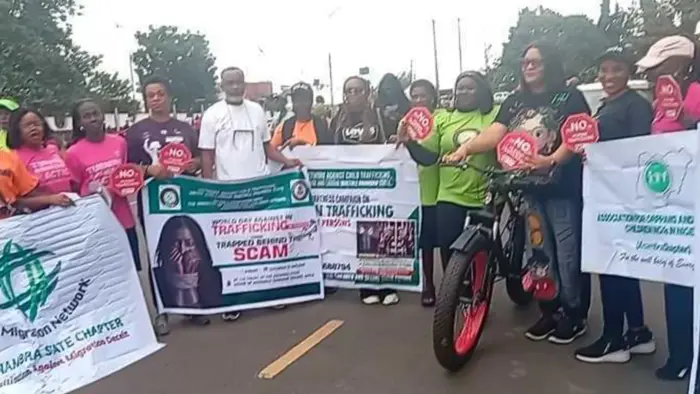
The concern was raised during the 2026 World Day Against Trafficking in Persons and Illegal Migration, commemorated in Awka through a joint initiative involving the Anambra State Government, the Nigeria Immigration Service (NIS), the Nigeria Security and Civil Defence Corps (NSCDC), the International Federation of Women Lawyers (FIDA), the Network Against Trafficking in Persons, Child Abuse and Labour, Zaram Life Foundation, the Association of Orphans and Vulnerable Persons, and other civil society organisations.
The event, themed “Trapped Behind the Scam,” featured a road walk from the Anambra State House of Assembly to major locations within Awka, where participants displayed placards bearing messages against human trafficking, child labour, child abuse and illegal migration.
Speaking at the event, the Commissioner for Women and Children Affairs, Mrs Esther Onyekesi, attributed the state’s vulnerability to its thriving commercial activities and strategic location, which attract large numbers of people and vehicles daily.
She warned residents, particularly young people, to be cautious of fraudulent promises of overseas education, employment and skill acquisition opportunities, stressing that many of such offers end in exploitation and human trafficking.
Onyekesi urged residents to verify travel and job opportunities before making commitments and advised them to reject any arrangement that appears suspicious.
At the Mgbakwu Tricycle Terminal, the Permanent Secretary in the Ministry of Justice, Mrs Nkiru Mokwe, encouraged members of the public to report suspected cases of job and travel scams, saying timely reporting is crucial to dismantling trafficking networks.
“We must break the culture of silence. If you see something, say something,” she said.
Co-convener of the programme, Miss Eucharia Onyemaobi, noted that Anambra’s geographical position and vibrant economy have made it a preferred transit point for traffickers.
She called on the government to intensify awareness campaigns, particularly in rural communities, to educate parents and young people about the dangers of deceptive migration schemes disguised as educational or employment opportunities.
Also speaking, Executive Director of Zaram Life Foundation stressed that traffickers prey on vulnerable individuals, urging citizens to make informed migration decisions and avoid travelling without adequate information.
Legal practitioners at the event also warned of the severe legal consequences of engaging in trafficking-related offences.
The Chairperson of the International Federation of Women Lawyers (FIDA) in Anambra State, Mrs Amara Muojeke, reminded members of the public that human trafficking, illegal migration, child labour, ritual-related crimes and exploitation are punishable under Nigerian laws, with penalties ranging from fines to prison terms of between two and ten years depending on the offence.
Another FIDA member, Barrister Chioma Onuoha, identified poverty as a major factor driving trafficking and illegal migration, while calling on schools, religious organisations, communities, the media and government agencies to collaborate in addressing the problem.
She urged parents to prioritise education and vocational training for their children instead of exposing them to risky migration arrangements.
Officials of the Ministry of Women and Children Affairs, however, argued that poor value orientation and irresponsible parenting also contribute significantly to the problem, condemning situations where children are deliberately sent away under the guise of pursuing education or employment only to end up being exploited.
The Deputy Commandant of the Nigeria Security and Civil Defence Corps (NSCDC), Ebere Nwufoh, said the corps remains committed to tackling human trafficking through its specialised Anti-Human Trafficking Initiative Unit, which handles cases involving gender-based violence, child abuse, domestic violence and trafficking.
She appealed to commercial transport operators to report suspicious movements involving children and potential trafficking victims.
The Head of Anti-Smuggling and Migration at the Nigeria Immigration Service in Anambra State, Theophilus Muozoba, warned young Nigerians against travelling to countries known for high trafficking risks without proper documentation or legitimate purposes.
He explained that the Immigration Service has strengthened travel screening procedures, including requiring intending travellers to present evidence of return tickets and proof of sustainable means of livelihood before departure.
Participants concluded the event by calling for sustained collaboration among government agencies, security organisations, civil society groups and community leaders to eliminate human trafficking, illegal migration and child exploitation across the state.
About the Author