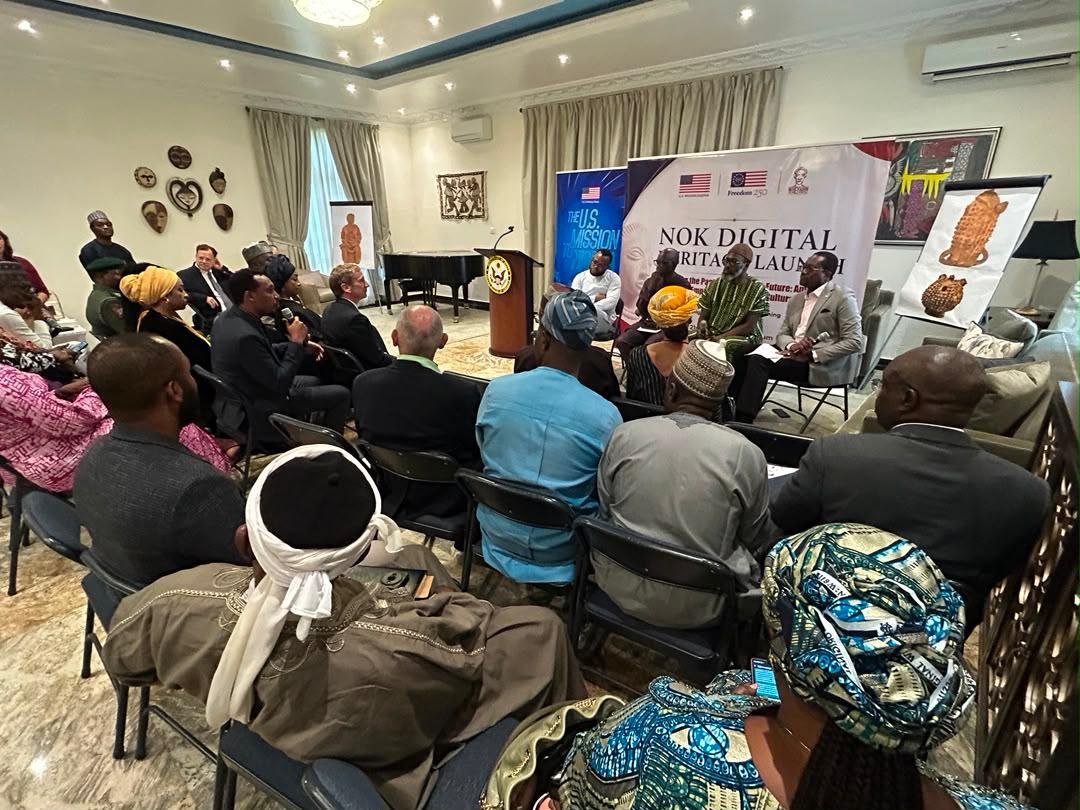
Nigeria has launched a new digital offensive against the international trafficking of its priceless cultural treasures, unveiling a technology-powered platform capable of authenticating, tracing and protecting ancient Nok artefacts in what officials described as a major breakthrough in the fight against organised heritage crime.
The initiative, unveiled Tuesday in Abuja in partnership with the United States Government, introduces advanced digital documentation and NFT-based authentication technology that creates permanent digital identities for ancient artefacts, making it easier to identify stolen objects, establish ownership and frustrate illicit trafficking across international borders.
Officials said more than 250 Nok artefacts have already been digitally catalogued under the project, while the Nok Museum has been upgraded and dozens of Nigerian youths trained in digital heritage preservation as part of efforts to secure one of Africa’s oldest civilisations from criminal exploitation.
The project, implemented by the Wheyham Report Foundation through the United States Ambassadors Fund for Cultural Preservation, is expected to strengthen Nigeria’s campaign to recover antiquities that have disappeared into foreign museums, auction houses and private collections following decades of illegal excavation and smuggling.
Speaking at the launch, the Chargé d’Affaires of the United States Embassy, Keith Heffern, said the initiative demonstrates that technology has become one of the most effective tools for protecting cultural heritage while undermining transnational criminal syndicates that profit from trafficking in antiquities.
He said the platform creates verifiable digital records that significantly improve the authentication and traceability of artefacts, reducing opportunities for stolen cultural objects to enter the international art market unnoticed.
“The results speak for themselves: over 250 Nok artefacts digitally preserved, a fully upgraded museum, 50 Nigerian youths trained in cutting-edge digital skills, and 50,000 people reached nationwide,” Heffern said.
According to him, the United States has committed about $1.2 million to cultural preservation projects across 21 Nigerian states over the past five years.
“When Nigeria’s heritage is protected, criminal networks are disrupted and the foundation for prosperity—for both our nations—is secured,” he added.
The significance of the initiative extends beyond archaeology. International trafficking in cultural property has increasingly been linked to organised crime, money laundering and the financing of illicit activities, making the protection of heritage an emerging security concern for many countries.
Recognising that reality, Minister of Defence, General Christopher Musa (Rtd), declared that safeguarding Nigeria’s cultural heritage should be regarded as a matter of national security rather than simply preserving historical relics.
“Our history, our culture and our shared heritage construct national identity. They build confidence in our people, foster unity across our diversity and cultivate values that hold us together in times of stress,” Musa said.
He warned that the erosion of historical consciousness among young Nigerians poses a threat to national identity, stressing that countries unable to preserve their past risk weakening the foundations of their future.
“If you don’t know your past, your future is lost in history,” he said.
Musa also advocated greater investment in museums, historical monuments and digital technologies capable of making Nigeria’s rich cultural heritage accessible to millions of people across the world.
Minister of Arts, Culture, Tourism and Creative Economy, Hannatu Musa Musawa described the initiative as a landmark achievement under the Federal Government’s programme to modernise cultural preservation through technology.
She said the project fulfils commitments contained in the cultural preservation agreement signed between Nigeria and the U.S. Embassy in February 2025 and would ensure that priceless heritage survives even when physical artefacts face threats from theft, deterioration or conflict.
“Digital preservation does not replace the physical work of guarding a site or conserving an object. It makes sure that work reaches people who will never visit Kaduna State, and that the record survives even where the objects themselves are at risk,” Musawa said.
She disclosed that the Federal Government plans to replicate the model across other archaeological sites and cultural traditions nationwide.
The Nok civilisation, which flourished between about 1500 BC and 500 AD across parts of present-day Kaduna, Plateau and neighbouring states, occupies a unique place in world history.
Its discovery in 1928 transformed archaeological understanding of ancient Africa after researchers uncovered sophisticated terracotta sculptures and evidence of early iron-smelting technology, disproving long-held misconceptions that sub-Saharan Africa lacked advanced civilisations before external contact.
Yet decades of illegal excavation have fuelled a thriving black market in Nok artefacts, with many priceless objects disappearing into overseas collections.
Project Lead of the Wheyham Report Foundation, Barrister Yahaya Maikori, said the initiative is intended not only to preserve artefacts but also to build a digital ecosystem that supports archaeological research, cultural tourism, heritage education and future efforts to repatriate stolen objects.
He said the foundation would continue documenting certified Nok artefacts around the world while advocating the establishment of a world-class Nok Museum capable of receiving repatriated collections.
Supported by the U.S. Embassy, the National Commission for Museums and Monuments, Yale University and the Ham community, the project signals Nigeria’s determination to deploy 21st-century technology against centuries-old heritage crime.
For a country that has long watched its cultural treasures disappear through illegal trafficking, the digital identity now being assigned to Nok artefacts could become one of the strongest weapons yet in the fight to preserve—and eventually recover—Nigeria’s priceless past.
About the Author