Child Health and Mortality Prevention Surveillance (CHAMPS), a project at the Abubakar Tafawa Balewa University Teaching Hospital (ATBUTH) has expressed willingness to partner a Bauchi based Civil Society Organization,
Journalists for Public Health and Development Initiative (J4PD), to improve evidence-based reporting on child health and mortality.
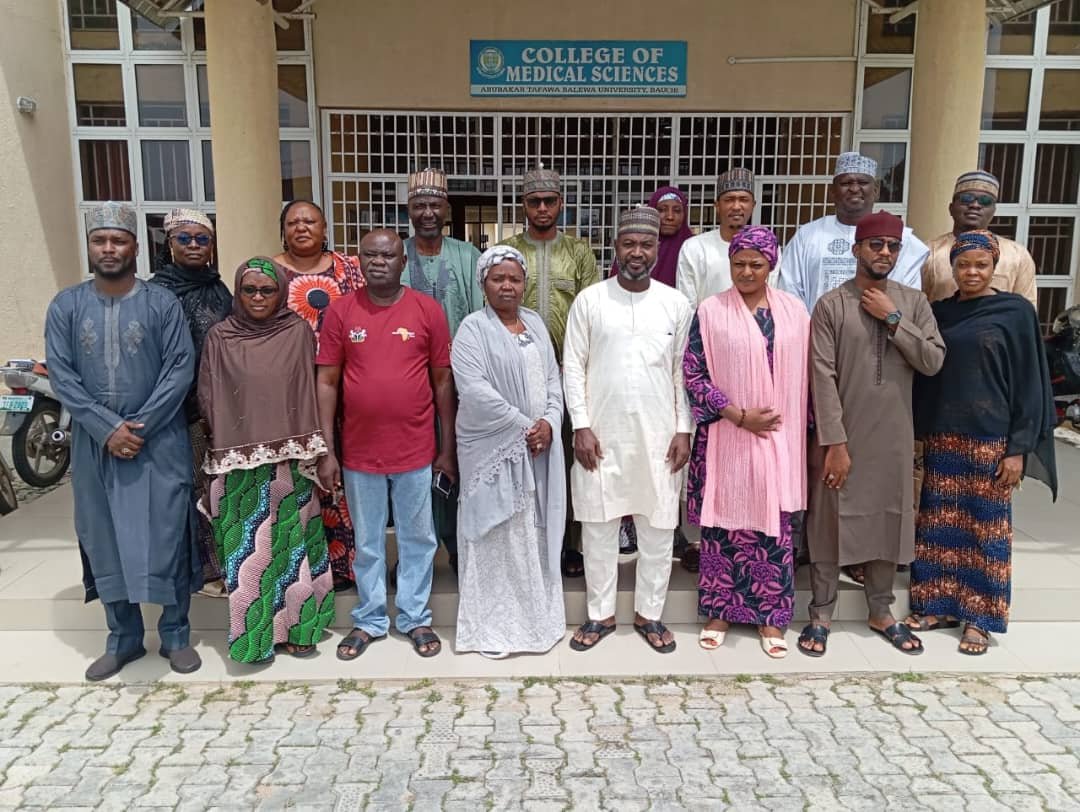
The expression was made by the Principal Investigator of CHAMPS, Dr. Bashir Farouk Mohammed, during a courtesy visit by members of J4PD at the College of Medical Sciences, Abubakar Tafawa Balewa University Teaching Hospital (ATBUTH), Bauchi.
He stressed the need for such a partnership describing the media as an important ally in turning scientific evidence into public action.
He said, “Thank you very much. I want to first and foremost welcome you, the leadership and members of Journalists for Public Health and Development Initiative. I remember when I saw the letter, that was last year, and I saw the title of the association, I was like, wow, this is really what we need to communicate what we are doing. Because you’re not just Journalists, but you also have special interest in public health.”
He stressed that, “And what we do here at CHAMPS is essentially a subset of public health. So CHAMPS, as it were, it stands for Child Health and Mortality Prevention Surveillance. So it’s a surveillance process, meaning we are tracking deaths among children below the age of five years, including stillbirths.”
According to him, “And we do that in specified communities. We are not everywhere. We designated and mapped out some communities within Bauchi State, two local governments in particular. And even the two local governments, it is not everywhere. So some communities within two local governments in Bauchi State.”
The Principal Investigator added, “That is where we have our catchment area where we established our HDSS, Health and Demographic Surveillance System, where we have the map of that place, we had enumerated the population in there, the households there, every person that is living in that community. And we are tracking deaths within that community below the age of five years, including stillbirths.”
“Now, the essence is actually for prevention, and that’s where the P in the CHAMPS comes. It’s not just for fun, to have the numbers, to say these are the numbers. The primary aim is to prevent future deaths from what we can learn from the deaths that are occurring or that have occurred in the past. So we are using the past and the present to better the future,” he added.
Bashir Farouk Mohammed further said that, “And the most significant component of CHAMPS is what is called data to action. That is to say, whatever it is that we do, we want to say, okay, if these are the deaths, we just don’t want to say these are the numbers, but we want to see what are the actual and precise causes of deaths among these communities, so that we take the information to three levels.”
He then explained, “Number one, at family levels. We are going to go back to the families, sit with them, let them know that these are the things we have found related to the death of your child in the past. These are some risk factors that we have determined. These are some of the contributing factors. These are things you can do at your own level, at family level.*
He added, “And then the second layer is, we take it to the community. Periodically, we will have, or we generate enough data to speak at community level. We can go to that community, have a town hall meeting with stakeholders, and then let them know that in this, your community, over this period of time, these are our findings.”
He added, “And at community level, these are the things, the recommendations that we feel if you put them in place, they will help in preventing more deaths among your community.”
“And the third layer is to go to the policymakers and other stakeholders, where we will also have periodically, when we have enough data that speaks to policy, then we can go gather people, including government, some other NGOs, and everybody in that space of maternal and child health, to say that these are our findings, and these are our recommendations with respect to the policies that we have,” he added.
According to him,”This policy that we have on this, we feel that it can be tweaked because of this evidence that we have generated. Or this one that is not even in place, we are recommending for the policymakers to look into it and see the possibility of having a policy guideline towards that, because we have documented that it can actually help in solving some of these problems.”
He added, “So, this is what the essence, the very essence, foundational thinking and drive of what CHAMPS is all about. It’s a global project, actually, that is funded by the Gates Foundation.”
According to him, “Presently, it is in Eight countries across the world. We have two countries in Asia, Pakistan and Bangladesh. And we have Six countries in Africa- Nigeria, Sierra Leone in West Africa. We have Mozambique and South Africa, and we also have Kenya and Ethiopia in North Africa. So, these are the Eight countries where you have CHAMPS projects. And it started about 12 years ago. In Nigeria, it was in the Ninth year of the project that it came to Nigeria.”
Bashir Mohammed further said that,”In Nigeria, we have two sites. We have a site in Calabar, domiciled with the University of Calabar, and we have another site in Bauchi, which is domiciled here in ATBU. Now, as I said, the project is meant to generate data, accurate, precise data. Just like we keep emphasizing that you want to give accurate information, you want to give precise information.”
“Now, our own mantra is also to generate accurate data. I give you an example. In our environment, you have a child who comes with fever and convulsion, and he lost consciousness. He is brought to ATBU Teaching Hospital. Sometimes you may not, the parents, because it’s out-of-pocket expenditure, basically in our society and country. So sometimes they may not even have the money to do the necessary investigations to unravel really what causes the illness,” he added.
He stressed that,”But the physicians, the doctors, will, base on their knowledge, the common things that could cause fever and convulsion in this category of children, maybe severe malaria that is touching the brain, which is called cerebral malaria, maybe meningitis. So, you just combine the management for meningitis and severe malaria, and you give the child. Now, the child gets up, gets better, and is discharged.”
According to him,”They say, you’re suspecting this to be the cause, but this could also be the other cause. Now, even in the event of you having the funds or the means to investigate sometimes, like for instance, this particular case, you do your malaria, it’s not malaria, also maybe it’s meningitis.”
“So you take the cerebrospinal fluid, CSF. You send it to the lab for analysis. But unfortunately, our labs can only investigate and determine maybe bacteria. If it’s a viral cause, we don’t have the capacity. If it is fungal, if it is protozoa, other organisms, very difficult. We don’t have the facilities to diagnose that. Even the bacteria, we have some limitation.”
Speaking earlier, the Executive Director of the Journalists for Public Health and Development Initiative (J4PD), Ms Elizabeth Kah, said that, “J4PD, as the name implies, is a network of Journalists committed to reporting on issues relating to public health, maternal, newborn and child health (MNCH), nutrition, education, and sustainable development. We are a duly registered organization with the Corporate Affairs Commission, established not only to report the news but also to give back to society by promoting accurate, evidence-based information that improves people’s lives.”
She stressed that,”Despite the many health interventions taking place across our communities, key health indicators remain poor. We believe one of the reasons is that critical health information is not always communicated in ways that are easily understood by the public.”
According to her, “As Journalists, we have a responsibility to bridge that gap by translating complex health information into clear, factual, and compelling stories that inspire positive health-seeking behaviours.”
Elizabeth Kah said, “Our purpose today is threefold: to formally introduce J4PD to CHAMPS, to learn more about your work and activities, and to explore areas where we can collaborate to amplify your efforts and achievements. We understand that CHAM8 is involved in critical work around child mortality prevention, surveillance, and research.”
She added, “As you generate data and evidence, there is a need for effective communication to ensure that these findings reach policymakers, communities, and families in ways they can understand and act upon.”
The J4PD ED stressed, “We believe Journalists should be involved throughout the process—not only during the dissemination of research findings—so that we understand the methodology, context, and significance of the work. This will enable us to report accurately and responsibly.*
She added that, “We are also interested in helping document and share success stories. For example, when families consent to child mortality investigations or autopsies, sharing their experiences—ethically and respectfully—can help other families understand the importance of such processes in preventing future deaths. By telling these stories, we can demonstrate that understanding why one child died may help save many others.*
According to her, “Journalism today is no longer about simply reporting what someone says. It is increasingly about solutions journalism—highlighting evidence-based responses to community challenges and showcasing practical solutions that can be replicated elsewhere. We see this as an important area where J4PD and CHAMPS can work together.”
“We are particularly interested in collaborating on capacity building. While Journalists have broad knowledge across many sectors, we are not specialists in every field. Health reporting requires a solid understanding of technical concepts, research methods, and data interpretation. We therefore seek opportunities for training and knowledge sharing that will strengthen our ability to report health issues accurately and effectively,” She added.
The ED assured that, “At J4PD, we are committed to professionalism and ethical journalism. We believe every report should uphold human dignity, respect confidentiality, and be based on verified facts. Our goal is to ensure that the information we publish is accurate, balanced, and beneficial to society.”
She concluded, “We look forward to establishing a long-term partnership with CHAMPS in the areas of training, knowledge exchange, advocacy, and the dissemination of evidence that can influence policy and improve child health outcomes in our state.
About the Author