All democratic institutions and stakeholders in the country, as well as the citizenry have been urged to stand firmly in defence of the rule of law and constitutional order.
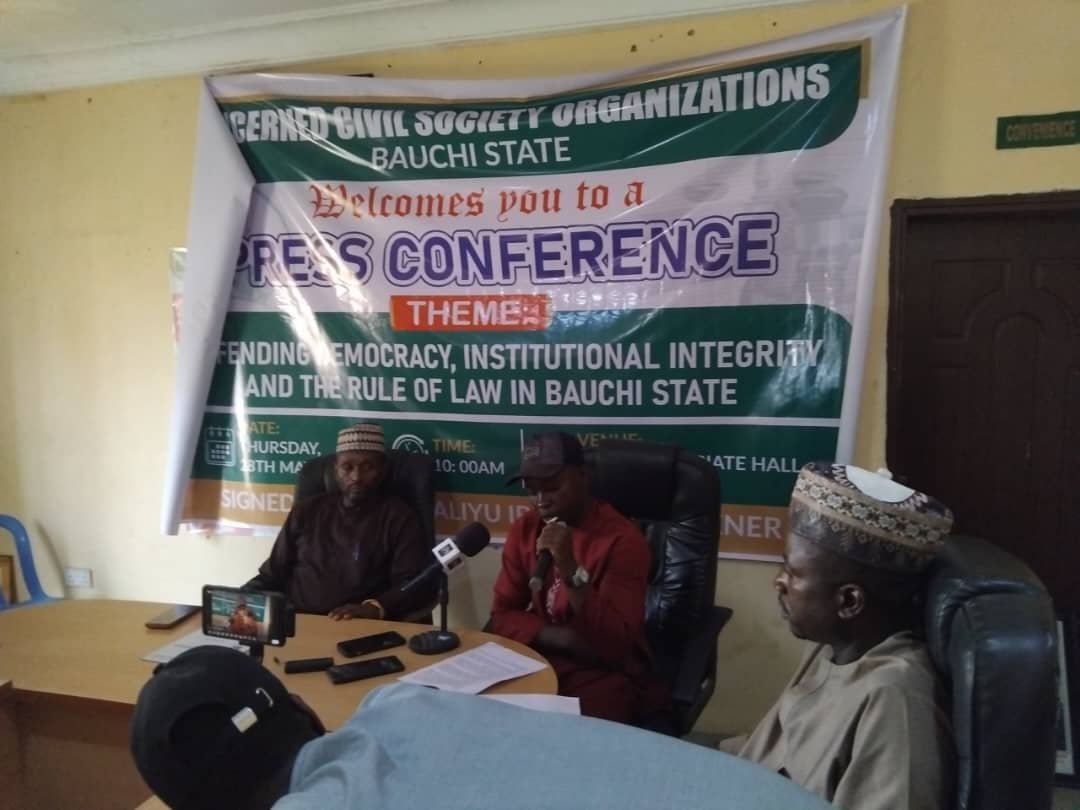
The call was made during a Press Conference addressed by Concern Civil Society Organizations in Bauchi State on the purported interim order restraining the conduct of gubernatorial primaries by the People’s Redemption Party (PRP), in the State.
Convener of the group, Najim Nurudeen, while reading the text of the confidence, stated that, “We address you today as Concern Civil Society Organizations in Bauchi State, a coalition of different civil society organisations across Bauchi State committed to the entrenchment of good governance, promotion of the rule of law, protection of democratic institutions, and the fight against injustice irrespective of whose interest is affected.”
He read further,”It is with great concern, disappointment, and deep reservation that we observed the purported interim order made in Suit No. BA/181/2026 between Idrees Safiyanu Gambo V. People’s Redemption Party (PRP), Senator Shehu Buba Umar and Independent National Electoral Commission (INEC), wherein the Honourable Court purportedly restrained the 1st Defendant from gubernatorial primary conducting the election/congress of the PRP in Bauchi State pending the hearing and determination of the Motion on Notice, while also restraining the Independent National Electoral Commission (INEC) from supervising or participating in the said primary election process.”
According to him,”Ordinarily, court orders are meant to be obeyed and respected by all persons and authorities. However, the judiciary itself is equally bound by the Constitution and statutes enacted by the National Assembly. The rule of law demands that courts act strictly within the jurisdiction conferred upon them by law.”
Najim Nurudeen added that,”In the instant case, Section 88(4) of the Electoral Act, 2026 expressly and unequivocally prohibits courts from granting interim orders, ex parte orders, or interlocutory injunctions restraining the conduct of party primaries, congresses, or conventions.”
“The provision of the law is clear, mandatory, and admits no ambiguity whatsoever. Once the law expressly removes or limits the jurisdiction of the court over a particular subject matter, any order made contrary thereto becomes null, void, and of no legal consequence,” he added.
The Convener further stated that,”Beyond the clear provisions of the Electoral Act, the appellate Courts in Nigeria have consistently warned courts against undue interference in the internal affairs of political parties except where expressly permitted by statute.”
He stressed that, “Political parties are generally recognized as independent voluntary associations entitled to regulate their internal affairs, including the conduct of their congresses and primaries, subject only to constitutional and statutory limitations.”
He cited that,”In Onuoha v. Okafor, the Supreme Court held that the choice of candidates by political parties is fundamentally an internal affair of the party in which courts ought not to interfere.”
He further cited, “Similarly, in Dalhatu v. Turaki, the Supreme Court reaffirmed that nomination and sponsorship of candidates remain internal affairs of political parties which are generally non-justiciable except where statutes specifically provide otherwise.”
“Furthermore, in Lado v. CPC, the Court of Appeal emphasized that courts must exercise restraint in matters relating to party primaries and internal political processes,” he added.
Najim Nurudeen then emphasized that, “It is therefore difficult to comprehend how an order expressly restraining the conduct of party primaries could be granted despite the clear provisions of Section 88(4) of the Electoral Act, 2026 and the settled judicial authorities cautioning against judicial interference in internal party affairs.”
“With utmost respect, the granting of such an order appears to amount to direct judicial involvement in the internal affairs and democratic processes of a political party contrary to the spirit and intendment of the Electoral Act and established judicial precedents,” he submitted.
According to him,”The Supreme Court has consistently maintained that jurisdiction is fundamental and indispensable to the validity of judicial proceedings. In Madukolu v. Nkemdilim, the Supreme Court held that where a court lacks jurisdiction, every proceeding conducted no matter how brilliantly becomes a nullity.”
He added,”Similarly, in Tukur v. Government of Gongola State, the Apex Court reaffirmed that any action taken without jurisdiction is null and void.”
He submitted further, “The law is equally settled that a court has inherent power to set aside its own order made without jurisdiction even suo motu. In Alawiye v. Ogunsanya, the Supreme Court reaffirmed the power of a court to vacate or set aside any order which is incompetent or made without jurisdiction.”
“In view of the foregoing, we respectfully but firmly call upon the Honourable Court to urgently reconsider and suo motu set aside the said order in order to preserve public confidence in the judiciary and demonstrate fidelity to the Electoral Act, democratic principles, and settled judicial authorities,” he called.
He added,”We hereby respectfully call upon the court to take necessary steps within a reasonable time to vacate and set aside the said order which, in our considered opinion, appears inconsistent with the express provisions of the Electoral Act, 2026 and established principles governing judicial non-interference in internal political party affairs.”
He added,”We wish to state clearly that courts are expected under the law to exercise caution and restraint in matters touching on party primaries and internal political processes, particularly where the Electoral Act expressly limits judicial intervention.”
According to him,”We therefore call upon members of the public, party faithful, political stakeholders, and concerned citizens to remain calm and law-abiding as the issues arising from the said order will ultimately be subjected to judicial scrutiny and lawful appellate review where necessary.”
He added that, “We also wish to caution politicians and political actors across all political parties against taking undue advantage of the present judicial development to unnecessarily heat up the polity or create political tension within Bauchi State.”
According to him, “Democracy thrives best in an atmosphere of peace, maturity, and responsible political conduct. We do not want a repeat of the unfortunate political atmosphere allegedly witnessed during the African Democratic Congress (ADC) crisis involving Nafiu Bala Gombe and Senator David Mark in Bauchi State, where politicians from across different political divides were reportedly drawn into activities capable of escalating political tension and overheating the polity. “
“We therefore urge all stakeholders to avoid inflammatory statements, political provocation, or actions capable of undermining public peace and democratic stability while allowing lawful judicial processes to take their proper course.”
According to him, “Our intervention is not politically motivated nor intended to undermine the judiciary. Rather, our position is founded on the defence of constitutional democracy, supremacy of the law, integrity of democratic processes, and preservation of public confidence in the judiciary.”
Najim Nurudeen concluded,”No democracy can flourish where express statutory provisions are disregarded with impunity. The judiciary must continue to remain the last hope of the common man while ensuring strict adherence to constitutional and statutory limitations governing judicial powers.”
About the Author