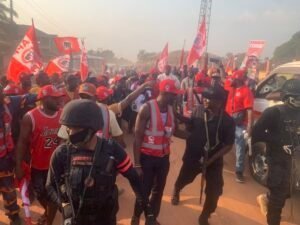
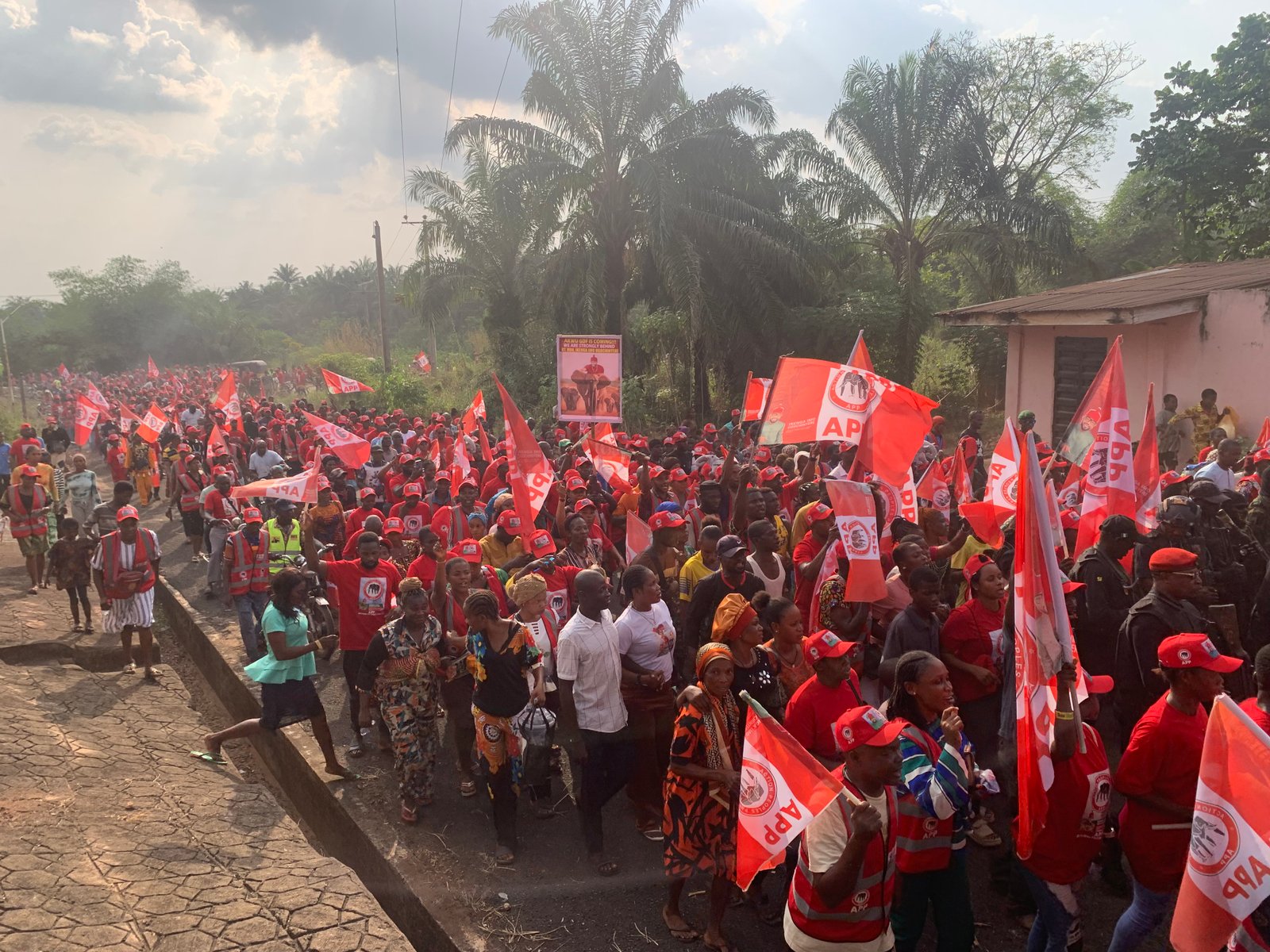
Caption: Supporters of Rep. Ikenga Ugochinyere gather outside the sealed gates of Isiekenesi Primary School 11, a visual testament to the confrontation between political expression and state authority in Imo State.
By Peter Okolie
Isiekenesi (Imo), Dec. 23, 2025 (NAN)
A planned civic reception for a federal lawmaker in Imo State transformed into a stark symbol of political friction on Tuesday, raising urgent questions about the use of state power, freedom of assembly, and the precarious state of democratic norms in Nigeria’s South-East region.
The event, organised by constituents to honour Rep. Ikenga Ugochinyere of the Action People’s Party (APP), who represents Ideato North and South Federal Constituency, was effectively shut down before it began. A joint security team comprising police and army personnel barricaded the entrance to the designated venue, Isiekenesi Primary School 11 in Ideato South Local Government Area.
This action prevented hundreds of dressed supporters, clutching party flags and insignias, from accessing the public facility. The scene—a crowd locked out of a community school by uniformed officers—immediately escalated local tensions and framed the incident within a broader, troubling pattern of political repression.
Beyond a Cancelled Event: Allegations of Systematic Harassment
Addressing his displaced supporters at an alternative location, Rep. Ugochinyere framed the blockade not as an isolated administrative decision, but as the latest episode in a sustained campaign against him and his supporters. He described it as an “unwarranted provocation by the Imo Police and State Government.”
His account suggests premeditation: his coordinators reportedly received a midnight text message revoking permission for all public facilities, a move he labelled a deliberate sabotage of the civic reception. The lawmaker further connected the dots to a history of violence, recalling past alleged assassination attempts and the recent “barbaric” destruction of his billboards.
“They have started again,” Ugochinyere stated, implying a cyclical pattern of intimidation. This context is crucial. In regions like Imo, where separatist agitations and state security responses have created a volatile mix, the line between maintaining public order and suppressing political opposition can become dangerously blurred. Ugochinyere’s warning that “such actions create unnecessary tension, given the current insecurity facing the state” underscores the risk of conflating legitimate political activity with civil unrest.
The Core Constitutional Conflict: Assembly vs. Authority
At the heart of the lawmaker’s protest is a fundamental democratic principle. He emphasized that his constituents were merely exercising their “constitutional right” to peaceably assemble and receive their elected representative. The concept of a “civic reception” is deeply rooted in Nigerian political culture, serving as a forum for accountability, celebration, and direct dialogue between representatives and the represented.
By sealing the venue, authorities did not just cancel a party; they obstructed this foundational political interaction. The chairman of the occasion, Chief Bonny Ebili, attempted to depoliticize the event, stating it was about “Ugochinyere’s personality and not about any political party.” However, the heavy-handed security response politicized the situation entirely, interpreting the gathering as a threat simply because of the party flags present.
A Call for Investigation and a Challenge on Governance
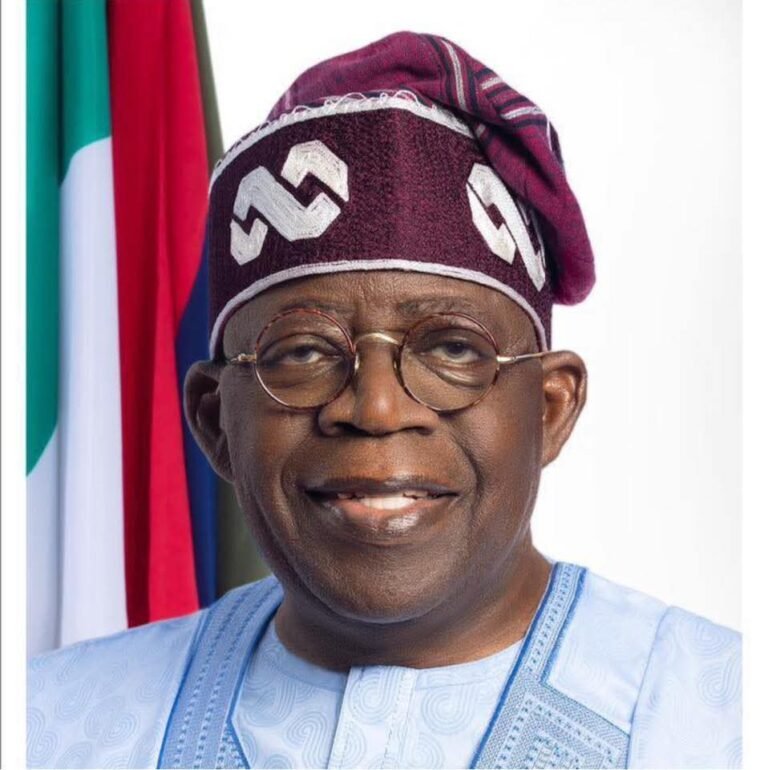
Ugochinyere’s response was twofold. First, he escalated the matter to national authorities, calling on the Inspector-General of Police to investigate the Imo Police Command and appealing to President Bola Tinubu and the National Security Adviser. He labelled the situation “political recklessness” threatening the nation’s democracy—a serious charge that frames a local dispute as a national concern.
Second, he pivoted to a critique of governance priorities, challenging the state government: “If you love my people, build the schools and fix the gully erosions.” He claimed that most social amenities in the area resulted from his personal efforts, not government action. This rhetorical move is significant; it shifts the debate from a clash of personalities to a failure of development, positioning the blockade as a distraction from the government’s core responsibilities of providing education, infrastructure, and healthcare.
The Official Silence and Unanswered Questions
When contacted by NAN, the police response was one of non-engagement. DSP Henry Okoye, spokesman for the state Police Command, stated he was not “officially briefed” and was unaware of any police role at the venue. His promise to “revert after enquiries” leaves a critical information vacuum. This absence of an official rationale fuels speculation and allows the lawmaker’s narrative to stand unchallenged. Key questions remain: On whose orders did the security agents act? Was there a genuine security threat that justified the closure, or was it, as alleged, a politically motivated obstruction?
The incident at Isiekenesi Primary School is a microcosm of larger tensions in Nigerian democracy. It touches on the weaponization of state institutions, the vulnerability of opposition voices, and the enduring challenge of ensuring that the government’s immense security powers are exercised impartially to protect, not suppress, democratic rights. As supporters dispersed and the sealed gates remained shut, the event left behind not just disappointment, but a potent image of a democracy under strain.
(NAN)(www.nannews.ng)
OPC/USO
Edited by Sam Oditah
About Author