By Soknan Shedul
Politics in Plateau State is never a tea party. Known across Nigeria for its fiercely independent electorate, deep-rooted grassroots loyalty, and allergy to political imposition, the Tin City state is once again boiling over as 2027 approaches. Only this time, the chessboard has been violently overturned.
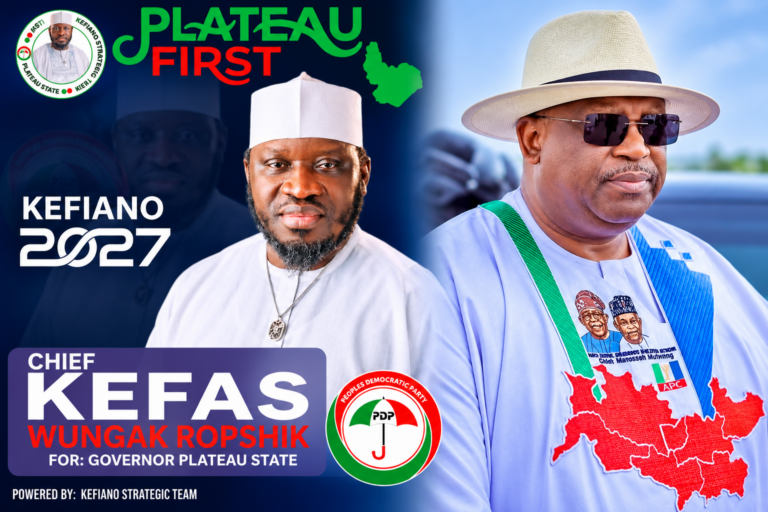
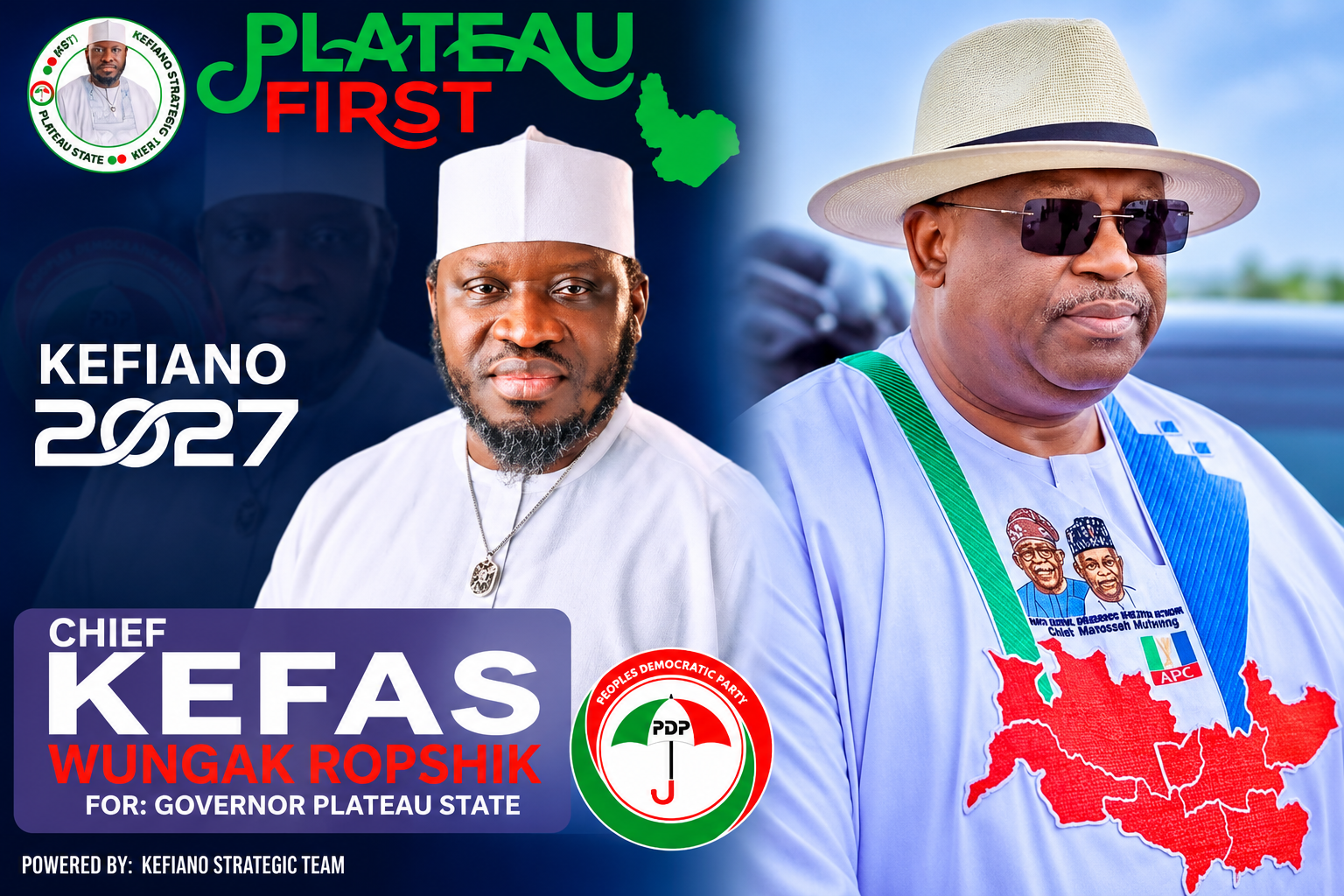
The race to Little Rayfield has narrowed down to an explosive two-horse clash between a recalibrated All Progressives Congress (APC) now piloted by incumbent Governor Caleb Mutfwang, and the surging Rainbow Coalition, an unconventional political movement rallying behind the Peoples Democratic Party (PDP) and its flag bearer, Kefas Ropshik.
A LONELY DEFECTION AND A HOUSE DIVIDED
The political earthquake that triggered this realignment happened when Governor Caleb Mutfwang dumped the PDP for the ruling APC between late 2025 and January 2026, insisting that connecting Plateau to the federal center was vital for survival and development. To his defenders, Mutfwang’s leap from opposition to the national ruling party mirrors the final political aspiration of the late emancipator, His Excellency Chief Solomon Lar, who ultimately sought to pull Plateau out of perennial opposition—where the state reaped little or no federal benefits—and plug it directly into the national political grid before taking a bow.
Yet, unlike governors elsewhere who emptied their former parties upon exit, Mutfwang left the PDP almost alone at the top.
While his deputy, commissioners, and local government chairmen trailed him into the APC, the real custodians of the PDP stood their ground. The state PDP Executive Committee and Plateau’s political heavyweights—including former Governors Jonah Jang and Fidelis Tapgun, Hon. Damishi Sango, and Amb. Bagudu Hirse—refused to budge.
To this traditional PDP family, staying put is a sacred duty: they are jealously protecting the party as a legacy institution handed over to them for keeps, vowing never to betray the trust of Chief Solomon Lar, the founding father of the PDP.
Worse still, Mutfwang did not walk into a warm embrace in his new home. Initially, sections of the Plateau APC apparatchik fiercely resisted his entry. Even after APC National Chairman Prof. Nentawe Yilwatda and State Chairman Rufus Bature officially welcomed him, hushed complaints and coded cries over the lack of genuine integration between the “legacy APC family” and the Governor’s camp refuse to die down. Turning two rival camps into one united war machine remains Mutfwang’s biggest headache.
ENTER THE RAINBOW TSUNAMI
Out of this confusion emerged the Rainbow Coalition—a street-smart political strategy threatening to rewrite Plateau’s electoral playbook. The coalition’s gospel is simple: vote President Bola Ahmed Tinubu at the federal level so Plateau isn’t left out in the cold, but vote PDP locally to protect the state’s traditional mandate.
During a fiery appearance on
Channels Television on November 18, 2026,
PDP candidate Kefas Ropshik boldly championed this formula, arguing that Plateau voters should back Tinubu nationally while keeping the PDP in Rayfield.
Predictably, the ruling party hit the panic button.
In November 2026, both Governor Mutfwang
and APC State Chairman Rufus Bature
dismissed the Rainbow Coalition as an illusion, insisting on a “top-to-bottom” APC sweep and threatening rebels with sanctions. Yet, the coalition’s strength lies in its ability to unite aggrieved APC members and die-hard PDP faithfuls under one roof.
MUTFWANG VS ROPSHIK:
POWER, EMPATHY, AND THE TRUST DEFICIT
At the center of this storm are two contrasting gladiators fighting for the soul of Plateau.
GOVERNOR CALEB MUTFWANG;
enters the ring armed with the formidable might of incumbency. His footsteps also speak to urban renewal, expanding rural and urban road networks, full control of local government structures, and direct backing from Abuja.
To his supporters, he is a steady hand who has stabilized governance and positioned Plateau to reap federal dividends.
However, Mutfwang is haunted by glaring flaws that his opponents are weaponizing daily. The almost daily targeted killings of innocent lives of citizens in the state. His defection from the PDP—the very platform that rode on massive grassroots sympathy to bring him to power—is viewed by many loyalists as a betrayal of trust.
Furthermore, critics like
Kefas Ropshik on Channels Television
have fiercely questioned his governance scorecard despite unprecedented federal allocation in three years more than the entire allocation to all the governors who ruled for eight years.
The lingering coldness between original APC stakeholders and his appointees threatens to trigger silent sabotage from within his own house.
KEFAS ROPSHIK..aka Kefiano)
On the other hand, is riding a wave of raw grassroots affection. Having placed second in the 2022 PDP primaries and choosing loyalty over bitterness. Ropshik has built a reputation as a humanitarian powerhouse, whose philanthropy touches ordinary people where it hurts most. His empathy, accessibility, and organic followership make him a formidable street-level contender.
Yet, the challenger faces serious trust and capacity hurdles of his own. Skeptics are asking tough questions: Where is he coming from in public administration, and does he possess the political grit to govern a complex, multi-ethnic state like Plateau? His audacious promise to serve only one four-year term—and perform a developmental miracle within that tight window—has raised eyebrows among voters tired of sweet campaign promises. Though a successful auto business mogul, his full support by the Rainbow national leader, FCT Minister Barrister Nyesom Wike—who has never lost an election—will no doubt haunt and keep the ruling state government on its toes.
THE BEROM SWING AND THE FINAL VERDICT
Making 2027 even trickier is the unpredictable posture of the Berom nation, Plateau’s ultimate electoral swing bloc. Currently, the Berom electorate appears caught between Mutfwang’s state machinery and deep-seated PDP sentiment. While the PDP’s choice of governorship running mate is widely touted as enjoying the blessing of influential Berom leadership platforms, the APC is banking on its heavyweights and federal leverage to split that vote down the middle.
Ultimately, 2027 will test the very soul of Plateau politics. The state’s true strength has always been its sense of family and collective destiny. As the APC’s state machinery collides with the Rainbow Coalition’s grassroots rebellion, Plateau voters face a defining choice: reinforce and improve an existing structure, or tear it down for an untested new foundation.
Come 2027, Little Rayfield will belong to whichever camp that convinces the Plateau family that its future is safe in their hands.
Shedul is a Media specialist and National coordinator Congress of minorities of Northern Nigeria and writes from Abuja
About the Author