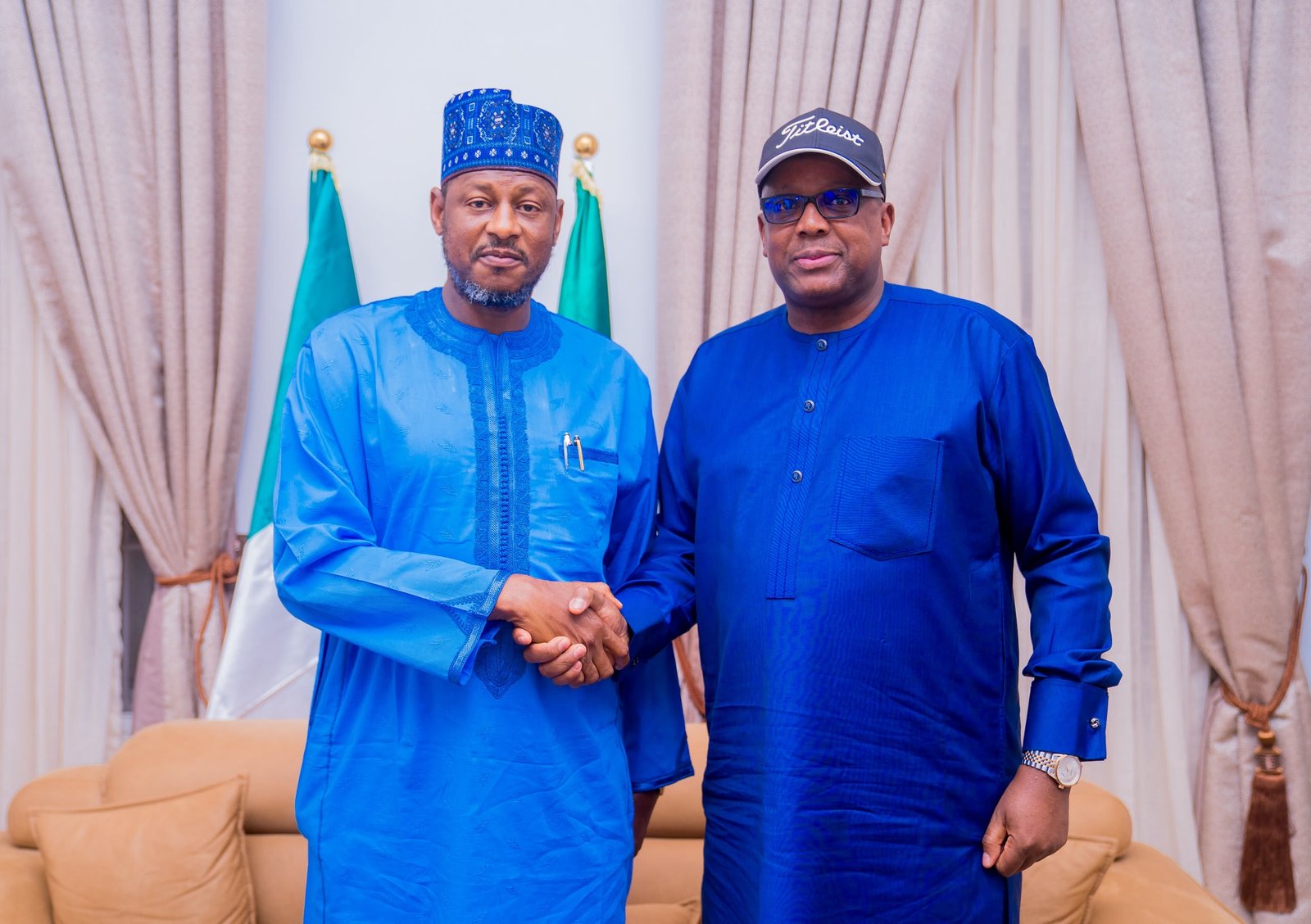
Katsina State Governor, Malam Dikko Umaru Radda, has called for federal support through the Federation Account Stabilisation Fund to accelerate development, revive abandoned infrastructure and address critical socioeconomic challenges across the state.
The Governor made the call in Daura while receiving a delegation of Federal Commissioners from the Revenue Mobilisation Allocation and Fiscal Commission (RMAFC), led by Professor Adekunle Wright, Chairman of the Commission’s Indices and Disbursement Committee, which is responsible for matters relating to the Stabilisation Fund.
The delegation was in Katsina on an assessment visit to verify the developmental achievements and funding priorities presented by the state government in Abuja about two weeks earlier.
The presentation, led by the Secretary to the State Government, highlighted the state’s interventions and priorities in mining and mineral resources, security, agriculture, irrigation, healthcare, education, livestock development, tourism, water supply and infrastructure.
The state government explained that access to the Stabilisation Fund would provide additional resources to strengthen these sectors, revive abandoned projects and accelerate sustainable development.
Governor Radda appreciated the delegation for undertaking the physical assessment, describing the exercise as a demonstration of transparency, accountability and the government’s commitment to independent verification of its achievements and funding priorities.
“Your visit to Katsina State to physically inspect the projects and initiatives we presented at the Commission’s headquarters in Abuja demonstrates the importance of this assessment. We appreciate your commitment and the time you have taken to examine our submissions and see things for yourselves,” the Governor said.
He said his administration had recorded progress in security, agriculture, healthcare, education, livestock development, mining and tourism, but stressed that additional resources were required to address remaining challenges and sustain development.
On security, Governor Radda identified the establishment of the Katsina State Community Watch Corps, supported by armoured personnel carriers and other operational equipment, as a major intervention in strengthening community-based security.
He observed that several communities previously affected by banditry, restricted movement and insecurity had experienced improvements following the deployment of the outfit and other security measures.
“Before we came into office, some local government areas and communities were experiencing serious security challenges. People could hardly move freely, and many communities were living under the trauma of insecurity. Through the establishment of the Community Watch Corps and other security interventions, we have made considerable progress in restoring security and protecting our people,” he explained.
The Governor, however, acknowledged that insecurity remained a challenge in some areas, noting that sustained operations and stronger interventions were necessary to consolidate the gains.
On education, he identified out-of-school children as a major concern, explaining that bandit attacks had disrupted learning and destroyed some school facilities in affected communities.
He said additional funding would support the rehabilitation of damaged schools, restoration of educational infrastructure and efforts to return affected children to the classroom.
“We are still facing the challenge of out-of-school children, which remains a major concern for us. Insecurity prevented many children from attending school, while some school facilities were destroyed. If we have access to these funds, it will help us recover, rehabilitate affected facilities and reduce the number of children who are out of school,” he said.
Addressing malnutrition, Governor Radda recalled that Médecins Sans Frontières (Doctors Without Borders) had previously identified Katsina among states facing significant challenges in the area.
He said his administration established a dedicated committee to coordinate interventions and strengthen the state’s response.
“At a time, Médecins Sans Frontières identified Katsina as one of the states facing serious malnutrition challenges. We took the matter seriously and established a committee to address the situation. Through the committee’s interventions, we have recorded considerable improvements, and Katsina is now among the states making progress in tackling malnutrition,” he noted.
Governor Radda expressed confidence that access to the Stabilisation Fund would help consolidate progress in these sectors, close development gaps and revive critical infrastructure across the state.
Highlighting abandoned irrigation facilities, he identified Safke Dam in Mai’Adua Local Government Area as a priority for rehabilitation, given its potential to support irrigation farming, water supply and possible hydroelectric power generation.
He explained that restoring the facility would improve water access for surrounding communities, expand agricultural activities and create further economic opportunities.
The Governor also highlighted plans to rehabilitate the abandoned Dandume irrigation project to strengthen dry-season farming, boost agricultural productivity and improve food security.
He further identified Jibia Dam as an important asset for water supply and agricultural development, stressing the need to maximise its benefits for the people.
On tourism and historical preservation, Governor Radda said the state was exploring opportunities to revive important heritage sites, including Durbi-Turkusheyi, to preserve Katsina’s history, promote tourism and stimulate economic activities in host communities.
He said the proposed Stabilisation Fund intervention would enable the state to address these priorities, complete critical projects and accelerate development across its 34 local government areas.
Earlier, Professor Adekunle Wright, Federal Commissioner representing Lagos State and leader of the RMAFC delegation, explained that the visit was part of the Commission’s assessment and verification process following the Katsina State Government’s presentation at its headquarters in Abuja.
He said the presentation, led by the Secretary to the State Government, outlined the state’s developmental achievements, priority projects, existing challenges and justification for accessing the Federation Account Stabilisation Fund.
Professor Wright disclosed that the delegation had inspected Safke Dam in Mai’Adua Local Government Area to assess its condition and potential for irrigation farming, water supply, agricultural development and possible hydroelectric power generation.
He also confirmed visits to Jibia Dam and Durbi-Takusheyi, where the team assessed the dam’s developmental potential and the historical site’s significance and prospects for tourism.
He noted that the inspection of Durbi-Takusheyi was important to the state’s efforts to preserve its cultural heritage and develop tourism as an additional source of economic growth.
The Federal Commissioner said the team was also scheduled to inspect Batsari, Funtua and Danja, as well as the Katsina State Imaging Centre, which is currently under construction.
Explaining the importance of the exercise, Professor Wright said physical inspections would enable the Commission to independently verify the information submitted by the state and understand the actual condition of the projects and facilities requiring additional funding.
“The assessment provides the Commission with an opportunity to verify the information presented by the state government and understand the actual conditions of the projects and facilities on the ground,” he said.
He appreciated the Katsina State Government for its cooperation and hospitality, noting that the visit had enabled the delegation to assess the state’s development priorities and realities on the ground.
Professor Wright added that the delegation’s findings would provide relevant information to guide the Commission’s consideration of Katsina State’s request for access to the Stabilisation Fund.
Those in attendance included Federal Commissioners representing Enugu, Bayelsa and Niger states, as well as Honourable Kabir Muhammad Mashi, representing Katsina State. Other officials included the Accountant-General, Alhaji Nura Tela; Commissioner of Basic and Secondary Education, Hon Suleiman Jibia, Commissioner for Budget and Economic Planning, Hon. Malik Anas; Commissioner of Agriculture Hon Aliyu Lawal Zakari Shargalle; Chairman of the Katsina State Internal Revenue Service (KTIRS), Hon. Isyaku Mohammed; Managing Director of KEMCO, Bello Isa Doro; and other relevant state government officials.
About the Author