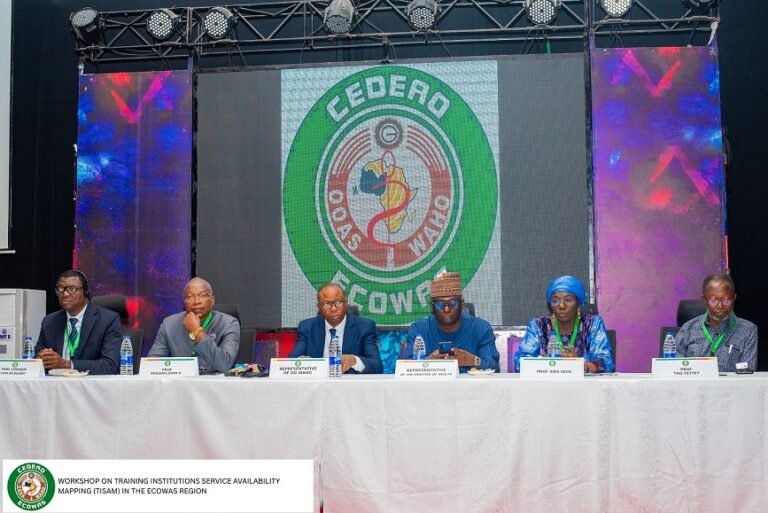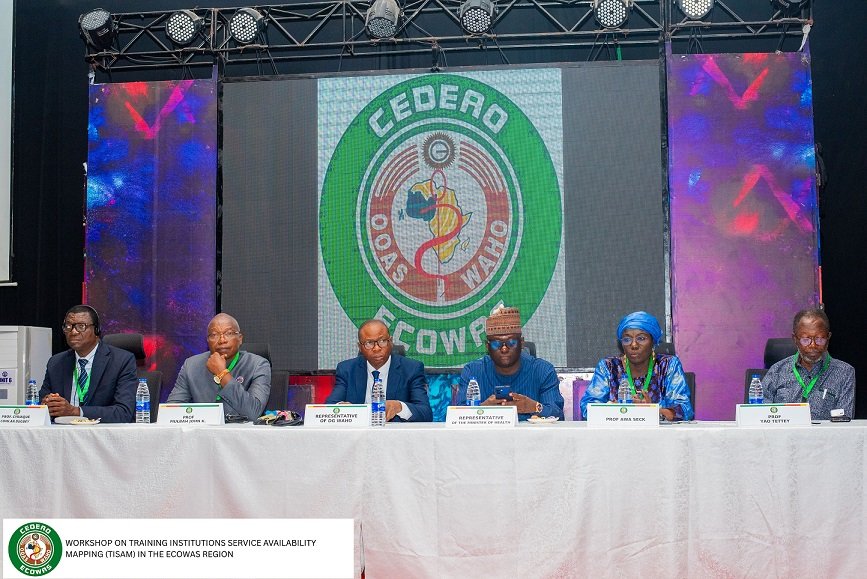
A three-day regional workshop devoted to finalising the Training Institutions Service Availability Mapping (TISAM) initiative in West Africa, ended in Nigeria’s capital, Abuja on Saturday, with the President of Senegal and current Chairman of ECOWAS, Bassirou Diomaye Faye, expressing satisfaction with the quality of discussions, the commitment demonstrated by every participant and the results achieved.
The Chair of ECOWAS, who was represented at the closing ceremony by Professor Awa Seck, recalled that at the opening of deliberations, participants and stakeholders had reaffirmed their common determination to strengthen excellence in health professional education through the development of major strategic tools, which are essential to gaining a precise understanding of the training capacities and needs of each of the Member States.
“Today, we can take satisfaction in the significant progress achieved through the expertise, dedication and collaborative spirit that have characterised our discussions. Our work has enabled us to compile important information on the availability of health training institutions and the services they provide, particularly their training programmes. This represents an important step towards improving our understanding of the training capacities available within our region,” she declared.
She however noted that beyond the documents and technical outputs produced, the greatest achievement of the workshop “lies in the spirit of collaboration that it has strengthened among us. Representatives of training institutions, Ministries of Health and other stakeholders have worked together constructively under WAHO. This collaborative approach is essential to strengthening regional integration and improving the quality of health professional education across our Community.
Professor Seck further reminded stakeholders that the conclusion of the workshop should not mark the end of their commitment but rather, it should represent an important milestone towards the effective utilisation of the information collected and the continuous updating of the mapping tools we are developing.
“We must ensure that the achievements of this workshop are sustained and translated into practical improvements in health professional education,” she said.
Also speaking, a representative of the Deans of Faculties of Health Sciences in West Africa, Professor Cyriaque Debe, noted that the commitment of participants and the intensity of work in the workshop was a clear demonstration of the shared determination by member countries to develop appropriate responses to the challenges facing health professional education within the region.
Prof Debe, who commended the Director-General of WAHO, Professor Palokinam T. PITCHE, and the Nigeria Government “for this important initiative,” also appreciated the facilitators, experts and resource persons for the quality of their contributions and their willingness to share their knowledge and experiences, noted that the three days had been particularly enriching in terms of learning, constructive discussions and the exchange of experiences.
“Beyond the technical presentations, this workshop has provided a genuine platform for dialogue among representatives of different countries and institutions. I particularly commend the quality of interactions between participants and facilitators, the spirit of mutual understanding, the willingness to collaborate and the atmosphere of fraternity and solidarity that characterised our discussions,” he said.
According to him, one of the most important lessons from this workshop was that TISAM is not simply an exercise in collecting information about health training institutions, (but) “it is a strategic instrument for governance, planning and evidence-based decision-making. It will enable our countries and institutions to better understand their training capacities, identify existing gaps, guide investments and anticipate future health workforce requirements.”
To ensure that the ECOWAS region fully benefits from the achievements of the workshop, Debe emphasised three priorities: “First, we must preserve and regularly update the data collected. Second, we must translate our recommendations into concrete actions and institutional commitments and; Third, we must strengthen regional cooperation through the sharing of expertise, pooling of resources and development of partnerships between universities and health training institutions.”
He reaffirmed the readiness of the Deans of Faculties of Health Sciences, to support the initiative and contribute to implementing the recommendations arising from our deliberations.
Professor Debe also reminded the participants that no single country or institution can independently address all the challenges associated with developing the health workforce, stressing, “it is through solidarity, complementarity and shared responsibility that we will build an ECOWAS region capable of training competent health professionals who can respond effectively to the needs of our populations.”
In his remarks, the representative of the West African Postgraduate Medical and Professional Colleges, Professor Yao Tettey, said it was important that academic institutions, professional regulatory bodies and the West African Colleges have all participated in this exercise.
He emphasised that the mapping exercise must remain dynamic, stressing that it should not be treated as an activity that we undertake once and then forget.
While encouraging the representatives of the West African Colleges participating in the workshop to take the initiative back to their respective colleges, Professor Tettey said, “each college should consider undertaking a mapping exercise covering its accredited institutions and training programmes. The resulting information should be made available on the colleges’ websites so that students, professionals, regulators and other interested persons can easily access it.”
He also advised that whenever a new institution or programme receives accreditation, the information should be updated accordingly. He equally encouraged WAHO to ensure that the regional mapping database is regularly updated, adding that professional regulatory bodies and accreditation authorities should be encouraged to provide information whenever new institutions are accredited or changes occur in existing programmes.
President-elect of the Regional Council for the Training of Health Professionals in the ECOWAS Region, Professor John Mulbah, in his closing remarks, noted that over the past three days, the participants had engaged in rigorous, constructive and forward-looking deliberations on a subject that lies at the very heart of health system resilience in West Africa: the comprehensive mapping of health training institutions and service availability across the ECOWAS region.
According to him, “a strong, equitable and responsive health workforce begins with accurate data, harmonised standards and strategic alignment between what our institutions teach and what our health systems urgently need.”
He explained that the insights generated and the frameworks refined during the workshop represented “a decisive step towards bridging training gaps and strengthening regional integration in health professional education.”
He also commended WAHO “for continuously demonstrating that regional solidarity is one of our greatest assets in addressing shared health challenges.”
Prof Mulbah believed that the true benefit of the workshop would be seen in “how effectively we translate its outcomes into stronger training capacities, improved healthcare delivery and better health outcomes for every citizen of the ECOWAS Community.”
The DG of WAHO, Professor Palokinam T. PITCHE, represented at the closing ceremony by Professor Joseph Olorunda, noted that what the participants had accomplished during the three-day workshop had required considerable intellectual effort, commitment and technical expertise.
“Sometimes, when we talk about data, we tend to regard it simply as information collected and recorded in a database. However, through this exercise, we have demonstrated how data can be transformed into evidence that informs policy decisions. Without reliable data, our planning will be inadequate. Without reliable data, our decisions may fail to address the real needs of our populations. Without reliable data, it becomes extremely difficult to plan effectively for the future. That is why the work we have undertaken here is so important,” he explained.
On the next phase of TISAM, the WAH boss said, “Our immediate priority is to finalise the inventory of health training institutions across the ECOWAS region. We will consolidate the information collected and develop a comprehensive inventory organised by country, institution and training programme. When this work is completed, we will have a regional resource that will enable people to access information about health training opportunities across our Member States.”
“For example, someone living in Guinea-Bissau will be able to obtain information about training institutions and programmes available in Senegal, Nigeria, Ghana. Rather than searching through different sources for fragmented information, we want to establish a coordinated system that brings together reliable information about health training institutions across West Africa. This will enable students, professionals, academic institutions and policymakers to make better-informed decisions,” he added.
Professor Pitche also spoke about promoting the sharing of skills and expertise, stressing the need to recognise the enormous potential that exists within ECOWAS region with its highly experienced professionals, including those who have retired from active service but still possess valuable knowledge and expertise.
“These professionals can continue contributing to health professional education as consultants, facilitators and resource persons. We must create opportunities to transfer skills, knowledge and expertise from one country to another. Nigeria, for example, has a large number of universities, yet the demand for higher education continues to exceed available capacity,” he noted.
On the validation and accessibility of the regional inventory, the WAGO DG declared that the work does not end with the three-day workshop, as he told the participants, “We will continue consolidating the information collected, and we may need to call upon your expertise again during the validation phase.”
Our objective is to develop a reliable regional inventory that can be made accessible through an online platform. Whether someone is in West Africa, Europe, America or Asia, they should be able to access information about health training institutions within our region.As we continue working on harmonised training curricula, specialised training programmes and strategies for health workforce motivation and retention, this inventory will provide another important source of information,” he said.
Declaring the workshop closed, Nigeria’s coordinating Minister of Health and Social Welfare, Professor Muhammad Ali Pate, represented by Dr. Datum Longji, noted that for years, there had been concerns about health workforce shortages in West Africa as though they were a mystery.
“We have lamented the migration of our doctors, nurses and midwives. We have highlighted the shortage of health professionals in our rural communities. We have expressed concerns about the quality of professional training. But how can we effectively address a problem that we have not fully understood or mapped?
“Today, through TISAM, we have taken an important step towards changing that situation. Over the past three days, you have done much more than attend a workshop. You have helped build a mirror for our region.
He said the product of the workshop represented “a mirror that enables us to see, clearly and objectively, where our health training institutions are located and where they are lacking. A mirror that shows us the programmes they offer and the areas where training quality is strong or requires improvement. A mirror that helps us understand how many students our institutions admit, train and graduate. A mirror that reveals where teaching personnel, clinical training facilities, laboratories and equipment are adequate and where significant gaps remain.”
Describing data as power and evidence as power, the minister told the workshop participants, “today, through your collective efforts, you have given West Africa an important instrument for making informed decisions.’
On the significance of the TISAM workshop, the minister explained that the outcome of the exercise “matters to every young student in West Africa who dreams of becoming a health professional.
According to him, “We can harmonise professional training standards so that qualifications obtained in one ECOWAS Member State are recognised and respected across the region. Above all, we can produce not merely more health professionals, but better-trained professionals. Professionals who are competent, confident and committed to serving the populations that need them most.
While calling for the adoption of initiatives aimed at addressing health workforce migration, such as creating conditions that encourage japada — “the return of our skilled professionals,” the minister said, “We must strengthen our training institutions, improve working conditions and create opportunities that enable health professionals to build rewarding careers within our region.”
He disclosed that the administration of President Bola Ahmed Tinubu, Nigeria was taking concrete steps to strengthen the health workforce by doubling training quotas, recruiting more than 30,000 healthcare workers and strengthening quality assurance mechanisms.
“These measures demonstrate our determination to expand training opportunities and improve the quality of healthcare delivery,” he said.
Having completed the difficult task of mapping the region’s training capacities, the minister called on member states to undertake the even more demanding and important task of building stronger institutions and translating evidence into action, by ensuring that the information generated through TISAM informs national policies, institutional investments and regional cooperation.
The true success of this initiative will be measured by the improvements it brings to health professional education and healthcare delivery across West Africa.
About the Author