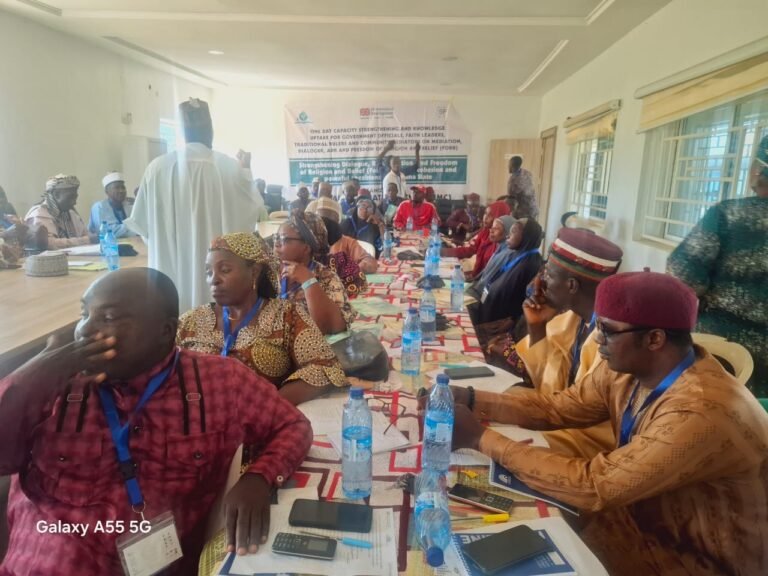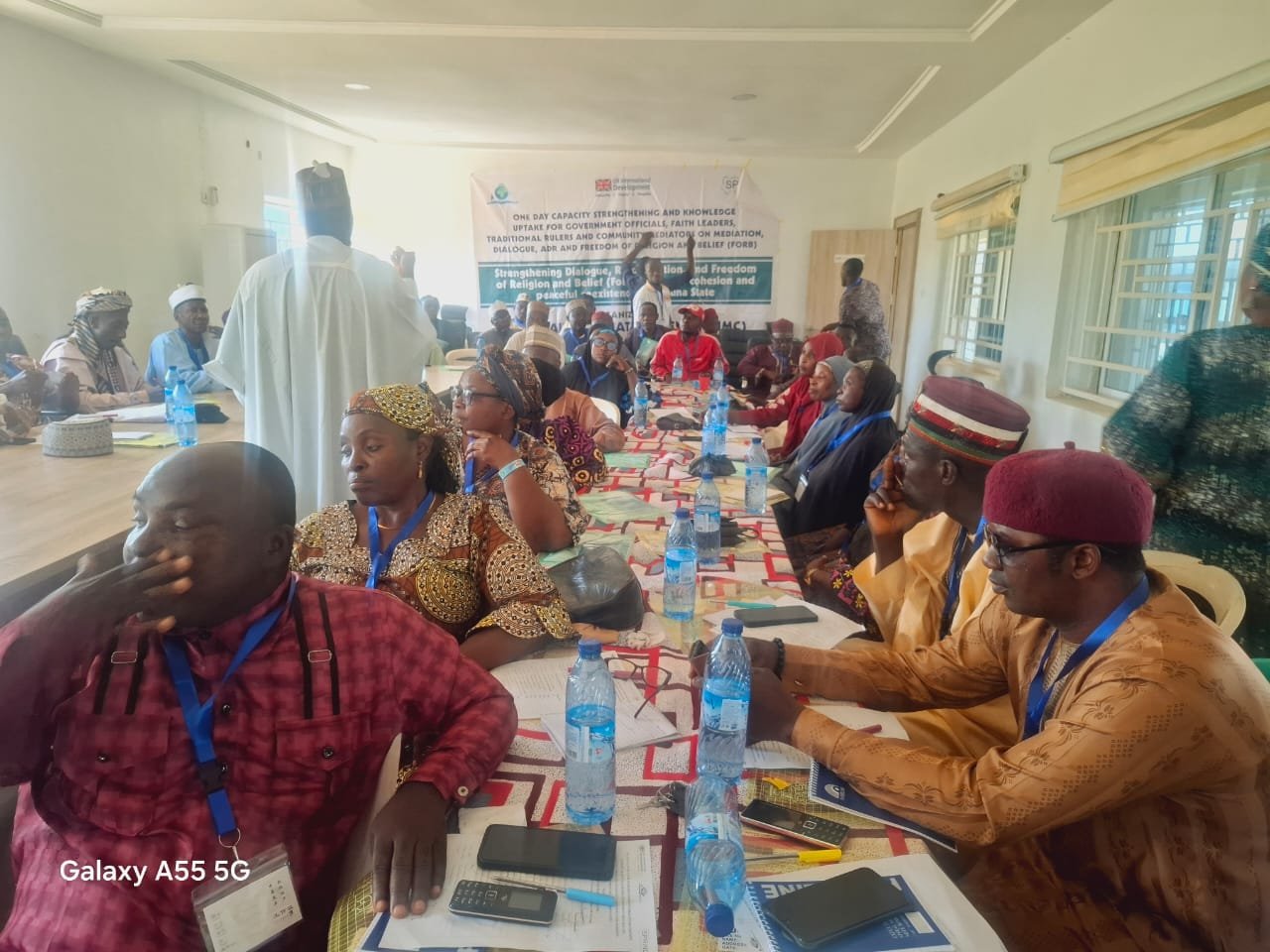
The Interfaith Mediation Centre (IMC) has trained faith leaders, traditional rulers, government officials and community mediators on dialogue, reconciliation, mediation and Alternative Dispute Resolution (ADR) as part of efforts to strengthen peaceful coexistence in Jema’a Local Government Area of Kaduna State.
The one-day capacity-strengthening and knowledge-uptake workshop also focused on Freedom of Religion or Belief (FoRB) and strategies for addressing conflicts through community-based approaches.
Speaking during the training, one of the facilitators, Reverend Michael Ikpa, urged participants to combine traditional conflict-resolution mechanisms with Alternative Dispute Resolution, which he described as a more convenient approach to resolving disputes.
He stressed the need for mediators to demonstrate fairness, impartiality and a sense of justice to all parties involved, irrespective of their religious, political or ethnic affiliations.
Ikpa said mediators must avoid taking sides in disputes, noting that their responsibility was to create an atmosphere where conflicting parties could freely express their concerns and work towards a peaceful resolution.
In his remarks, another facilitator, Malam Hayatu Nura of IMC, cautioned participants against engaging in peacebuilding activities without adequate knowledge and understanding of conflict management.
He warned that poorly handled interventions could escalate tensions rather than resolve them, urging participants to acquire the necessary skills before embarking on mediation and other peacebuilding initiatives.
Nura explained that the training was organised under the SPRING Project, which focuses on promoting peacebuilding, mediation and community capacity development through stakeholder engagement.
He noted that the project was designed to strengthen community structures and equip relevant stakeholders with the knowledge and skills required to address emerging conflicts.
According to him, IMC’s interventions have increasingly addressed broader community challenges, including farmer-herder conflicts and gender-based violence, beyond its traditional focus on interfaith relations.
He explained that the organisation was adopting community-based approaches to promote peaceful relationships among people of different religious backgrounds and other groups.
He identified three major thematic areas under the SPRING Project, including capacity strengthening for religious leaders, traditional rulers and other stakeholders in mediation, dialogue, reconciliation, ADR and FoRB; engagement with women and youths on Early Warning and Early Response (EWER); and peacebuilding education.
Topics covered during the workshop included Communication for Peacebuilding, Alternative Dispute Resolution, Understanding Mediation, Understanding Dialogue and Freedom of Religion or Belief.
Participants commended IMC for organising the training, describing it as timely and relevant to addressing disputes and strengthening peaceful coexistence in their communities.
They pledged to share the knowledge gained with their respective groups and communities, while applying the skills in resolving local disputes and establishing appropriate referral pathways for cases requiring specialised intervention.
The organisers expressed hope that the training would strengthen community-led peace initiatives and improve the capacity of local stakeholders to prevent, manage and resolve conflicts.
About the Author