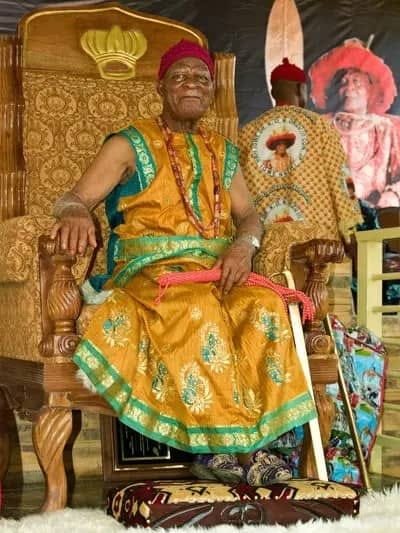
The traditional ruler of Nnewi, Anambra State, Igwe Kenneth Onyeneke Orizu III, has celebrated his 101st birthday, marking 63 years of reign on the throne of his ancestors.
The monarch, who ascended the throne on February 6, 1963, was formally crowned on June 2 of the same year, making him one of Nigeria’s longest-serving traditional rulers.
To mark the historic milestone, members of the royal family, the Nnewi Royal Cabinet and other indigenes of the community are expected to gather at his palace on Friday for a church service to offer thanksgiving to God for his long life, good health and continued leadership.
In a tribute to the monarch, a Lagos-based corporate and investment banker, Chief Anayo Matthew Nwosu, described his physical and mental alertness at 101 as remarkable, noting that the monarch had continued to demonstrate wisdom, intellectual sharpness and a strong sense of responsibility.
Nwosu disclosed that despite his advanced age, Igwe Orizu still attends to important traditional matters, including the settlement of cultural disputes, mediation and the resolution of sensitive community issues.
He attributed the monarch’s longevity and resilience to his patient disposition, peaceful nature and ability to handle disagreements without allowing them to undermine his leadership.
According to him, Igwe Orizu has presided over a significant period in Nnewi’s history, witnessing the transformation of the community from a traditionally fragmented settlement into one of Nigeria’s leading commercial and industrial centres.
Nwosu noted that the monarch had sustained the traditional heritage of his predecessors while strengthening unity among the constituent communities that make up Nnewi.
He described Igwe Orizu as a living symbol of Nnewi’s history and identity, tracing the royal lineage through successive generations of traditional rulers dating back to Mazi Nnewi, after whom the community was named.
The historical account contained in the tribute highlighted several generations of rulers, including Digbo, Otolo, Enem, Nnofor, Udude, Ezeagha and Ezeoguine, before the emergence of the Orizu dynasty.
It also recalled the influence of Ezeoguine, regarded as one of the prominent pre-colonial rulers of Nnewi, whose reign was marked by military expansion and the consolidation of the community’s influence.
However, the arrival of British colonial forces brought significant changes to Nnewi’s traditional and political structure, ending the inter-community wars that had characterised the earlier period.
The tribute further noted that Ezeugbonyimba, later known as Orizu I, recognised the importance of Western education and ensured that his son, Josiah, who became Orizu II, received formal education and embraced Christianity.
Josiah Orizu was the father of the present traditional ruler, Igwe Kenneth Orizu III.
Nwosu identified the present monarch’s decision to relinquish the title of Obi Nnewi as one of the defining moments of his reign.
He explained that the decision was taken at a time when disagreements surrounding the traditional title threatened the unity of the community, adding that the monarch chose a more conciliatory arrangement to prevent further division.
According to him, the move demonstrated Igwe Orizu’s willingness to make personal and institutional sacrifices for the sake of peace and communal harmony.
He maintained that the relative unity enjoyed by Nnewi today was partly attributable to the monarch’s consistent leadership and commitment to keeping the different sections of the community together.
Nwosu also acknowledged the contributions of Nnewi indigenes to the town’s emergence as a major commercial and industrial destination, noting that their achievements across various sectors had earned the community national and international recognition.
He described the monarch as a bridge between Nnewi’s historical heritage and its modern-day accomplishments, observing that his 63-year reign had provided continuity through different political, social and economic periods in Nigeria’s history.
At 101, Igwe Orizu’s reign has spanned the colonial era, Nigeria’s independence, the Civil War, successive military administrations and the current democratic dispensation.
Nwosu, who described the monarch as his uncle, expressed gratitude to God for his life and enduring service to Nnewi, while praying for more years of good health and wisdom for the revered traditional ruler.
About the Author