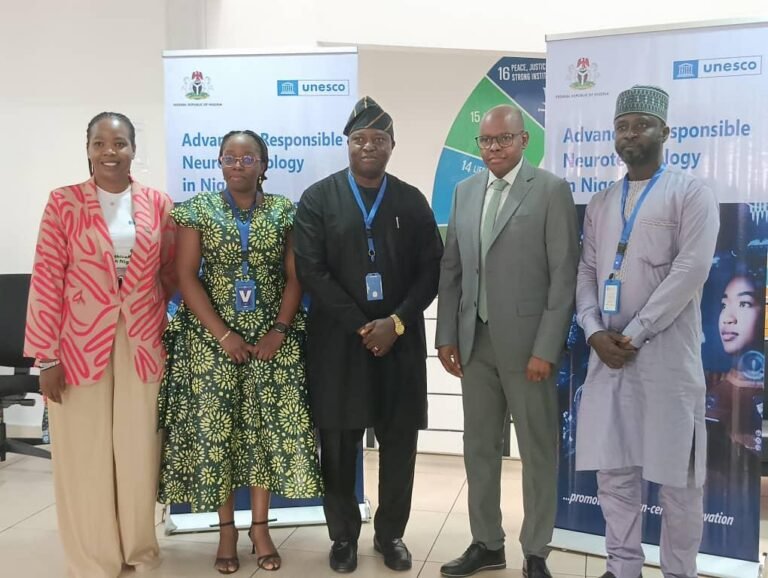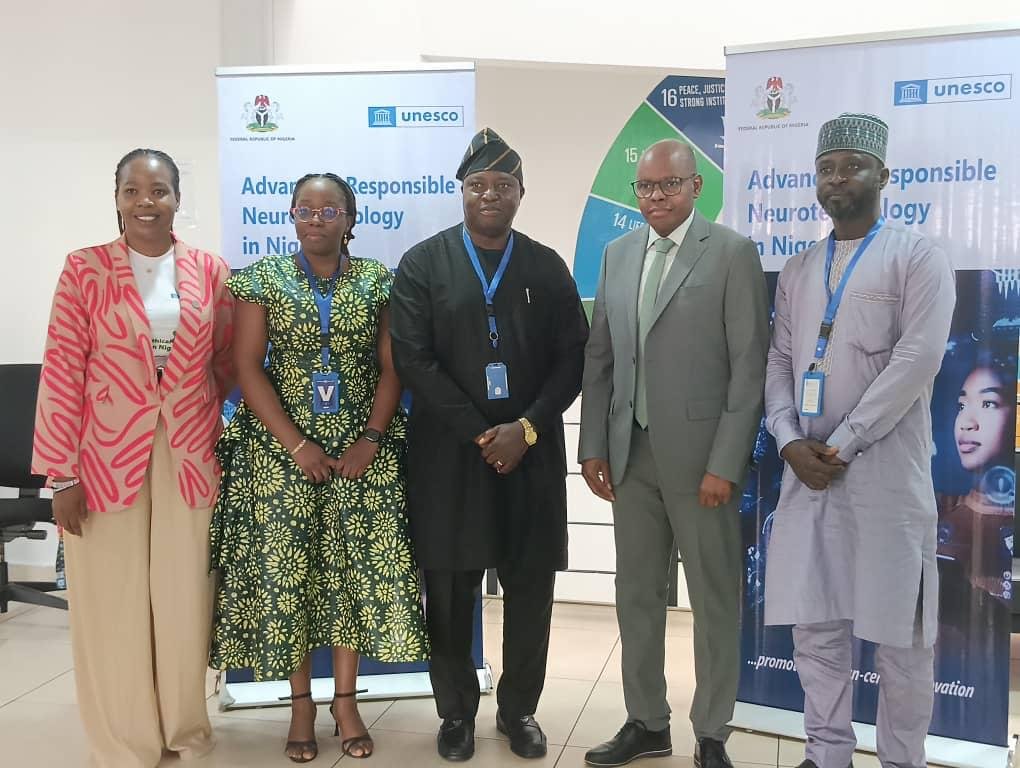
The United Nations Educational, Scientific and Cultural Organisation (UNESCO), the Federal Government and the scientific community have called for the development of an ethical and regulatory framework to guide the responsible development and application of neurotechnology in Nigeria.
The call was made on Wednesday in Abuja at a two-day stakeholders’ roundtable on the ethics of neurotechnology, where experts warned that rapid advances in technologies capable of interacting with the human nervous system could create profound challenges for human dignity, privacy, autonomy and fundamental rights.
Speaking at the event, UNESCO Representative to Nigeria, Dr. Isaias Barreto da Rosa, said neurotechnology was opening extraordinary possibilities in healthcare, rehabilitation, education and inclusion, but warned that the closer technology came to the human brain, the more fundamental the ethical questions became.
He said neurotechnology could improve understanding of the brain, enhance diagnosis and treatment, support rehabilitation and enable people living with disabilities to communicate and live more independently.
However, Barreto da Rosa said neurodata could be among the most sensitive forms of personal information, raising questions about who controls such data, how meaningful consent could be guaranteed, and how mental privacy, autonomy and freedom of thought could be protected.
He also warned against the possibility of neurotechnology widening existing inequalities rather than reducing them.
“These questions cannot be addressed after the technology has already transformed our societies. Ethics must evolve alongside innovation, not struggle to catch up with it,” he said.
The UNESCO representative recalled that the organisation’s member states adopted the Recommendation on the Ethics of Neurotechnology in November 2025, describing it as the first global normative framework dedicated to the field.
He said the recommendation built on UNESCO’s longstanding work on bioethics, science and emerging technologies, including its Recommendation on the Ethics of Artificial Intelligence.
According to him, the central principle was that scientific progress must remain at the service of humanity, human rights and the common good.
Barreto da Rosa noted that Nigeria had already contributed to the international process that produced the recommendation, with Nigerian experts and the Neuroscience Society of Nigeria participating in consultations that helped shape the global framework.
He said the task before Nigerian stakeholders was to translate the global principles into national reflection, policies and action.
“For Nigeria, this is also a question of opportunity,” he said, noting that the country’s universities, research institutions, medical community, technology ecosystem and young innovators had the capacity not only to participate in the future of neurotechnology but also to help shape its governance in Africa.
He urged stakeholders to examine who benefits from neurotechnology, who bears its risks, who has access to it, whose rights must be protected and who should be accountable when things go wrong.
The National Project Focal Point in the Federal Ministry of Innovation, Science and Technology, Dr. Adebayo Adeyemi, said the Federal Government considered the consultation timely, given the opportunities and risks associated with neurotechnology.
Adeyemi, who conveyed the goodwill of the Minister of Innovation, Science and Technology, Dr. Kingsley Udeh, said the minister was passionate about the initiative and welcomed the appointment of a national project focal point.
He said the UNESCO recommendation adopted in November 2025 provided clear boundaries and safeguards for the use, application and promotion of neurotechnology globally.
According to him, the immediate task was to interpret those recommendations within the Nigerian context.
“What is expected from this two-day meeting is that we are to be able to put those recommendations in a perspective that represents Nigeria, a perspective that will be able to speak to our realities,” he said.
Adeyemi said developing a Nigerian perspective would make it easier to formulate relevant policies and enforce regulations capable of responding to the country’s specific circumstances.
He also described the consultation as an opportunity for Nigeria to assume a leadership role in contributing to the global framework on neurotechnology.
He urged participants to bring their expertise and diverse professional experiences to the deliberations to produce practical outcomes applicable to Nigeria and Africa.
The President of the Neuroscience Society of Nigeria, Prof. Angela Danborno, said the ethical debate had become more urgent as advances in neuroscience and technology were transforming understanding of the human brain and opening new possibilities for diagnosis, treatment, rehabilitation, education and human-machine interaction.
Danborno identified brain-computer interfaces, neuroimaging, artificial intelligence, neuromodulation and other emerging neurotechnologies as areas with enormous potential to improve human health and wellbeing.
She noted that the importance of the subject was reflected in the theme of the society’s 2026 conference, “Neuroeducation and Neurotechnology.”
However, she said the benefits of emerging technologies must be weighed against their potential implications for individual rights and freedoms.
“Who owns and controls neural data? Who has the right to access information about a person’s brain? How do we protect mental privacy and cognitive liberty? How do we ensure informed consent when technologies become increasingly complex?” she asked.
Danborno stressed that the questions were not theoretical but required immediate consideration as neurotechnology continued to advance globally and found greater application in Nigerian society.
She particularly drew attention to optogenetics, an emerging neurotechnology involving the precise investigation and modulation of neural circuits.
According to her, the technology’s potential to manipulate specific neural circuits raised ethical questions around autonomy, informed consent, safety, genetic modification, identity, privacy and the possibility of altering behaviour or cognition.
Danborno said these concerns made emerging technologies particularly relevant to discussions on ethics and governance.
She called for Nigeria’s approach to be grounded in its unique social, cultural, economic and healthcare realities.
“For Nigeria, the conversation must also be grounded in our unique social, cultural, economic, and health-care system,” she said.
The neuroscientist stressed that scientific progress and ethical responsibility must advance together, warning that innovation should not come at the expense of human dignity, autonomy, privacy, justice and fundamental human rights.
Also speaking, a representative of the Federal Ministry of Health, Ado Danladi, said the ministry was particularly interested in the initiative because of the health benefits and ethical concerns associated with neurotechnology.
Danladi, who conveyed the greetings of the Minister of Health, the Permanent Secretary of the Federal Ministry of Health and Social Welfare, and the Director of Planning, Research and Statistics, said neurotechnology could play an important role in addressing a range of health conditions.
He cited Parkinson’s disease among organic conditions that could benefit from neurotechnology, while also noting its potential application in addressing conditions such as anxiety and depression.
However, he said the growing availability of neurotechnological devices and applications had raised important questions about the ethical implications of their use, particularly where they generated sensitive neurodata.
“How should this data be protected? Who uses this data? To what benefit, and all that?” he asked.
Danladi said the questions were particularly important as Nigeria sought to establish appropriate safeguards for the use of emerging neurotechnologies.
He described the UNESCO initiative as a pioneering effort and said Nigeria had an opportunity to position itself among countries taking the lead in protecting human dignity and maintaining ethical standards in scientific research.
He assured that the Federal Ministry of Health would align with UNESCO on the initiative to ensure that Nigeria was properly positioned to contribute to the emerging global governance of neurotechnology.
Danladi said the ministry would support efforts to promote ethical standards in research and the responsible application of neurotechnology in healthcare.
He urged participants to use the two-day consultation to develop recommendations capable of guiding Nigeria’s response to the opportunities and risks presented by the rapidly evolving field.
Barreto da Rosa, meanwhile, urged scientists, policymakers, medical professionals and innovators to go beyond asking whether a technological possibility existed.
He challenged them to also ask whether it should be done, under what conditions and for whose benefit.
He said the measure of scientific progress was not only what humanity could discover but how wisely and fairly such discoveries were applied.
UNESCO, he assured, would continue working with Nigeria to advance ethical governance, scientific capacity, inclusive innovation and international cooperation as neurotechnology continues to evolve.
About the Author