By Sam Israel
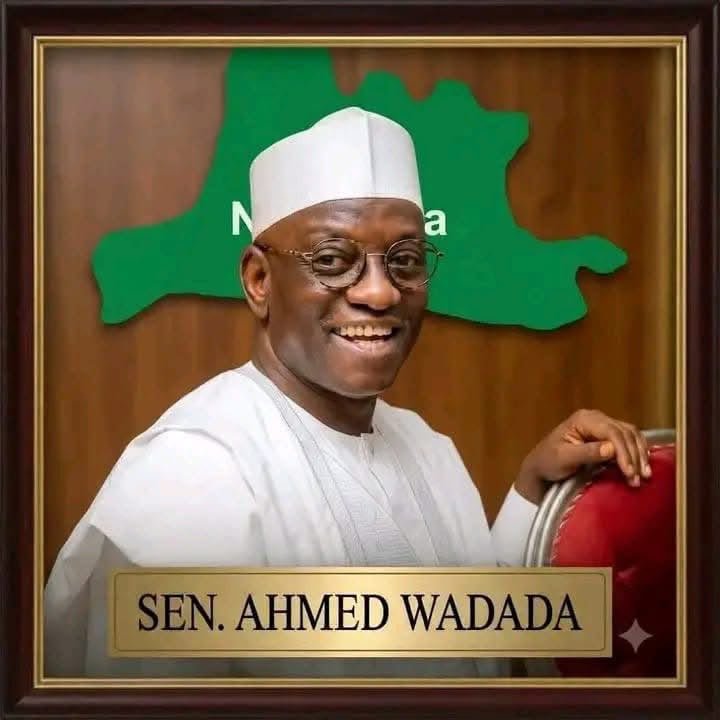
As Nasarawa State moves towards the 2027 governorship election, the emergence of Senator Ahmed Wadada Aliyu as the All Progressives Congress (APC) candidate has placed his political record, development agenda and vision for the state at the centre of public discussion. The contest is already assuming significance beyond party politics, with questions of continuity, inclusion, zoning, development and political succession featuring prominently in the conversation.
Wadada’s emergence followed the APC governorship primary conducted across Nasarawa State in May 2026. Officially announced results credited him with 195,285 votes across the state’s 147 electoral wards, placing him ahead of the other aspirants who participated in the exercise. The outcome established him as the APC’s standard-bearer for the 2027 governorship election.
The political significance of the primary extends beyond the numerical result. It demonstrated the scale of the internal contest within the governing party and subsequently placed on Wadada the responsibility of consolidating the party’s structures ahead of the general election. Recent reporting has also documented disagreements arising from the primary, underscoring the importance of party cohesion as the political season progresses. (Premium Times Nigeria)
Another important development has been the emergence of Chief Emmanuel Michael Ombugadu as Wadada’s running mate. Governor Abdullahi Sule announced the decision following consultations among party stakeholders and aspirants for the position. The governor subsequently urged party members to remain united ahead of the 2027 election.
For Wadada, the ticket therefore presents an opportunity to communicate a broader political message about representation and inclusion across Nasarawa’s three senatorial zones, 13 local government areas and diverse communities. The candidate has described the partnership as one intended to strengthen the ticket and advance a programme centred on unity, development and issue-based politics.
At the centre of Wadada’s policy messaging is the HEARTS Agenda, which places emphasis on health, education, agriculture, rural development and transportation or critical infrastructure. In recent engagements with religious and community stakeholders, he has linked the agenda to economic opportunities, human-capital development, youth and women’s empowerment, agriculture, healthcare and infrastructure.
The candidate has also presented leadership as a responsibility that requires listening to citizens and understanding their concerns. During an engagement with Christian leaders in Akwanga, Wadada said his proposed administration would be accessible and focused on tangible development, while calling for unity across religious, ethnic and political lines.
This emphasis on inclusion is particularly relevant in a state as socially and geographically diverse as Nasarawa. The state brings together communities with different ethnic, religious and political identities, making questions of equitable representation and balanced development central issues for any governorship campaign. A credible political conversation will therefore require candidates to explain how their programmes would reach communities beyond their traditional political constituencies.
Wadada also enters the contest with legislative experience as the senator representing Nasarawa West Senatorial District. His campaign has increasingly placed his legislative record alongside his proposed state-level development agenda, inviting voters and stakeholders to examine how experience at the federal level could translate into policies and programmes at the state level.
The 2027 contest is nevertheless larger than any individual candidate. The electorate will ultimately confront competing programmes, records, personalities and political platforms. Issues such as employment, education, healthcare, agricultural productivity, infrastructure, security, rural development, internally generated revenue and the management of public resources are likely to remain important components of the debate.
For Wadada, the central political challenge will be to transform the momentum generated by the APC primary into a broader statewide conversation about governance. That will require sustained engagement with communities, traditional institutions, religious leaders, professional groups, young people, women and other stakeholders, while maintaining an issue-based campaign.
The candidate has repeatedly framed his message around unity, describing the desired future in terms of “One Nasarawa, One people, One future.” Such a message places responsibility on the campaign to demonstrate in practical terms how its proposed policies would accommodate the interests of the state’s different communities and political constituencies.
Ultimately, the 2027 governorship election will provide Nasarawa voters with an opportunity to examine competing visions for the next phase of the state’s development. Senator Ahmed Wadada Aliyu’s
candidacy, his legislative experience, the HEARTS Agenda and the APC ticket with Emmanuel Michael Ombugadu will form part of that wider debate.
The task before the political class is therefore not merely to mobilise supporters, but to present clear and measurable answers to the challenges confronting the people. For the electorate, the most consequential question will be what each candidate proposes to do, how those proposals will be financed and implemented, and what mechanisms will be put in place to ensure accountability.
As the 2027 political calendar gathers momentum, Wadada’s candidacy has become one of the principal developments shaping the political landscape of Nasarawa State. The months ahead will determine how effectively the APC candidate communicates his programme, builds political cohesion and engages the electorate on the issues that will define the state’s next chapter.
Israel JP is the Senior Special Assistant on media to Senator Wadada
About the Author