African nations have been advised to as a matter of urgency, develop democratic systems that reflect their respective histories, cultures and political realities while upholding fundamental principles of democracy, including justice, equality, human rights, accountability, free and elections which results are acceptable to all.
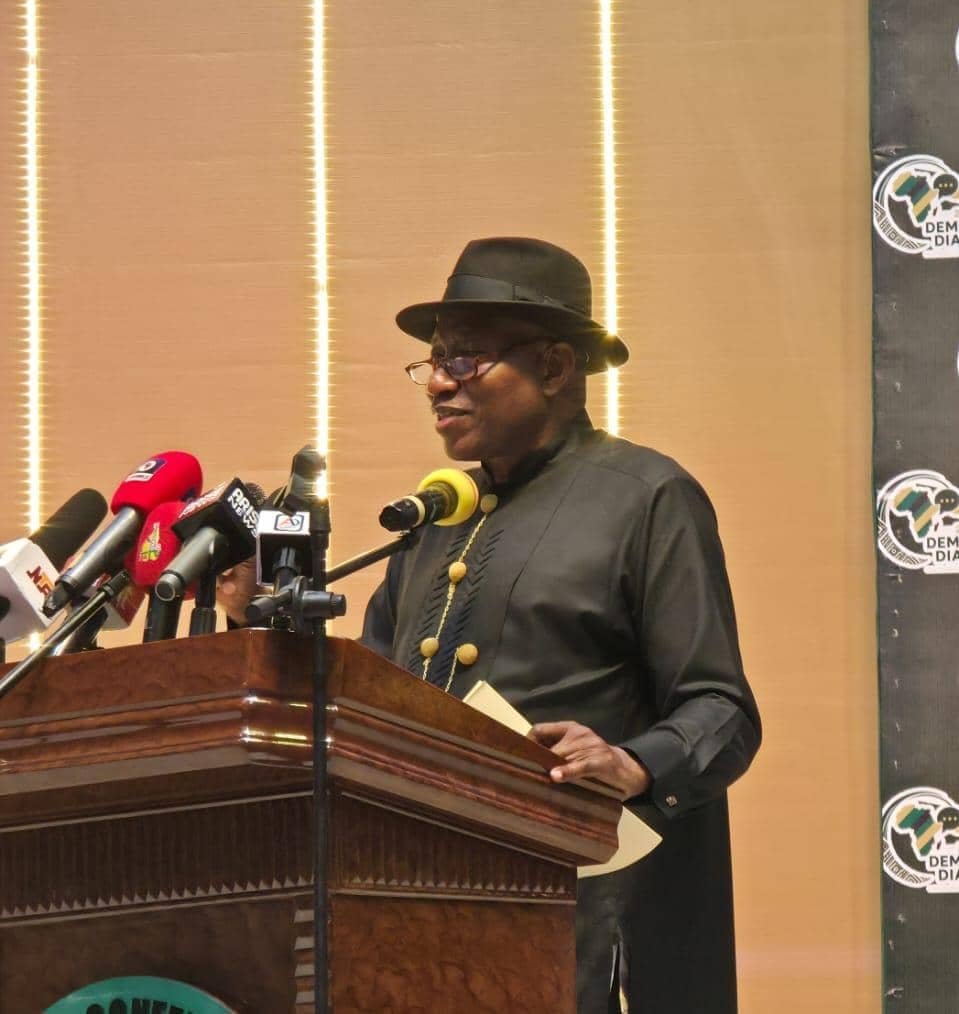
The advice was given by former Nigeria’s President, Dr Goodluck Ebele Jonathan, while delivering a vote of thanks at the 2026 edition of the annual GJF Democracy Dialogue, with the theme: “Beyond Elections: Can Political Parties and Judiciary Save African Democracy?” held at Ahmadu Bello International Conference Centre (ICC), Bauchi, on Tuesday.
The former President also called on African countries to critically examine the democratic models they are practising, because according to him, there are no universally accepted systems that can be applied uniformly across the continent.
Goodluck Jonathan further suggested that some elements of the Swiss model of government could offer useful lessons to African countries, particularly in preventing excessive concentration of political power in one individual.
According to him, “At the top level of the presidency, perhaps the Swiss model, where you don’t have one powerful President, may be the best for some African countries.”
He explained that Switzerland operates a system in which executive authority is exercised collectively rather than being concentrated in one individual, making it more difficult for one person to take far-reaching decisions without consultation.
The former President recalled, “I remember when I was Vice President, I once said that their forefathers believed that when one person has so much power, it is dangerous to society.”
He warned that the concentration of enormous political powers in the hands of a single individual in many African countries could pose serious risks to democratic governance and public institutions.
Goodluck Jonathan also challenged the tendency to measure democracy primarily by the conduct of elections, stressing that elections, although important, are only one component of a functioning democratic system.
He cited the 2024 Afrobarometer survey covering 39 African countries, which, according to him, revealed a significant gap between citizens’ preference for democracy and their satisfaction with the way democracy is practised.
He also said that more than 70 per cent of respondents across the countries surveyed expressed preference for democratic governance, but satisfaction with the actual practice of democracy was considerably lower in many of the countries.
He stressed that, “This clearly shows that there is something fundamentally wrong with our democracy.”
The former President further said that, “Democracy must guarantee fairness, justice and equal treatment. Citizens should have the power to influence government by freely choosing leaders and participating in the political processes.”
“If that is lacking in a country, then, of course, there is no democracy there,” he said.
He called for an independent judiciary that would be free from executive interference, while also urging governments to ensure that legislatures have sufficient independence to effectively perform their oversight responsibilities.
He, however, acknowledged that achieving complete separation between the executive and legislature could be challenging in political systems where members of both arms of government belong to the same political party.
Goodluck Jonathan also identified the protection of fundamental human rights as essential to democratic governance.
He listed freedom of speech, freedom of religion, freedom of assembly and freedom of the press among the rights that must be protected in a democracy.
He stressed that, “If citizens are gagged, if the civic space is choked by the executive, then, of course, there is no democracy. Accountability and transparency are also critical pillars of democracy.”
He said that elected leaders must be answerable to citizens for their actions and decisions, while transparency in government would help build public trust and reduce corruption.
Goodluck Jonathan recalled that while in office, he signed the Freedom of Information Bill (FOI), into law to empower citizens to demand information on government activities.
“The law allows you to ask questions. And if they don’t provide the information, they are culpable,” he said.
He further stressed the importance of regular, free and credible elections, saying the electoral process must be conducted without intimidation, manipulation or other forms of interference.
According to him, “Elections allow citizens to choose their leaders and hold them accountable.”
He warned that where free and credible elections are absent, it becomes difficult to describe a political system as genuinely democratic.
Goodluck Jonathan also identified political pluralism as another important pillar of democracy, saying democratic systems must accommodate multiple political parties, diverse opinions and opposing viewpoints.
He urged governments and political leaders to protect minority voices and allow them to participate meaningfully in public discourse, even when they do not command the majority.
The former President then stressed that the minority must not be silenced, arguing that the freedom to express divergent views is essential to a healthy and functional democratic system.
About the Author