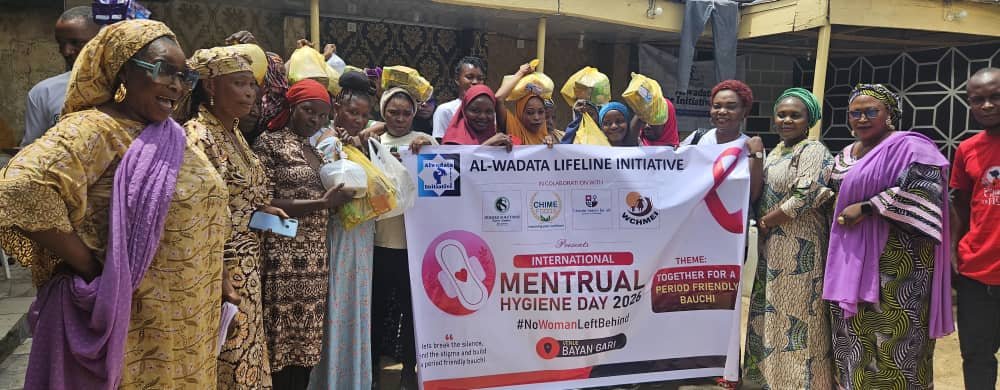
Thirty-five commercial sex workers in Bauchi have been trained and sensitized about menstrual hygiene and how to avoid infections in the course of duties.
The programme was organized by Al-wadata Lifeline Initiative in collaboration with other partners to comemurate the 2026 Menstrual Hygiene Day celebration, held on Wednesday.
During the programme, there was a call on Policy makers and other relevant authorities in the country, to as a matter of urgency, formulate policies that will ameliorate those things pushing ladies into engaging in commercial sex working.
The call was made by the Executive Director of Al-wadata Lifeline Initiative, Winnifred Robinson, while speaking at the One-day sensitization organized for Commercial Sex workers in Bauchi to comemurate the 2026 Menstrual Hygiene Day celebration.
She stressed that all the policy challenges facing the commercial sex workers should be addressed as well as also have focus towards them, saying, “They should not be left behind when these policies are being made, that they also need our attention and then they also need support. So that is why we are here today.”
“We are actually in Bayangari, celebrating with some female commercial sex workers. Yes, so that’s because of the International Menstrual Hygiene Day celebration. That’s why we are here today celebrating it. Menstrual hygiene cuts across a lot of ages. Yes, from the girl that hasn’t started her period, menarche, and the one that is having her first period, maybe at the age of 9, 10, and then the adult, same girls, and then women of reproductive age,” She added.
Winnifred Robinson added that, “The period of menstruation come in between that age bracket. And really, if you see our banner, together for a menstrual-friendly, a period-friendly Bauchi. The theme is for a period-friendly world. We’re in Bauchi, period-friendly Bauchi. And then our target is, no woman is left behind.”
She added that,”There are women, and from experience, I’ve been working in this area, for four or five years now, and then I’ve seen that really, nobody really mentioned commercial sex workers, even though they are women, they are females, they menstruate, they go through all the challenges every other girl goes through, the economic challenges, the stigma, probably even worse, but nobody talks about them.”
According to her, “So, this time, we are actually raising an awareness and making them look at, they count, they matter, yes, they are females, they menstruate, and they matter and they shouldn’t be left behind. And then we are also using the opportunity for our engagement with them.”
“Also, some of our speakers today, include the Human Rights Coordinator who told them that actually menstrual health is a human right, and they are human beings and they also have a right to menstrual hygiene. So that is why we are here today,” She added.
The ED further said that,”We are not just sensitising them, we are actually giving them dignity packs. Yes, and the dignity packs include disposable sanitary pads, though in Al-wadata Lifeline Initiative, we are makers and producers of reusable sanitary pads, but for these people, because we discussed with them before we came, and they actually requested for disposable pads, so that’s why we have brought disposable pads for them for free.”
She added that,”But we’re also telling them about the reusable and the advantages of the reusable. Yes, and then in the pack, we have the disposable sanitary pads, we have detergent, we have bathing soap. We have condoms. Yes, these are the things we have in there. And then we also brought, of course, refreshments, but not just drinks but food, proper food for them to eat.”
According to her, “This particular one, we are not doing it alone. We are collaborating with Chime Foods. Chime Foods, they make Acha, Flour, Acha, Cereal, which is the fufu. Acha is, they make pap, the nutrients pap, yes, ginger flavor, banana flavor. They make so many products..Then also with Uhime Solutions. They sell hospital equipment, reagents, anything hospital equipment. Uhime Solutions.”
She added that,”And then we are also collaborating with Ubuntu Sisters for All, Radiant Care Foundation. So, we have support from Nurture Her Initiative. And then, of course, we always have support from the National Human Rights Commission.”
She then called on them to be responsible people in spite of their situation saying,”Yes, they are a woman first, and then, menstruation, it’s a natural process for a woman. And then they also menstruate, whatever they do, menstruate with dignity. So there must be some ways they take care of themselves while they are menstruating so that there will be dignity for them as women.”
She also advised them,”to avoid infections, menstrual infections, you know, and things like that. And then also to let them know that there are things you can do to avoid infection. Yes, and then for the owners of the hotels, there must be water, there must be clean toilet and separate facilities for the women. There must be a complete WASH facility for them.”
There must be locked toilets for them so that nobody can force himself on the woman when she’s having her period. It has to be her choice. And then we’re also letting them know, because some of them are already asking questions, can you have sex when you’re having your period, and how to do that. Some of the questions were answered with some health issues. ”
She concluded, “There are some things they should do and at least they should be aware of. And then if they decide not to adhere to it, it’s their choice.”
Bauchi State Coordinator, National Human Rights Commission (NHRC), Yahchit Dala, in her brief said that, “Menstrual hygiene is a human rights issue because it has to do with the dignity of the human, of the woman. It has to do too with the right to privacy. It has to do with the right to non-discrimination, issues around stigma, right to access to facilities, and access to information.”
She stressed that,”So these are all human rights issues that have to do with that. So we’re just here to sensitize them to let them know that it’s a human rights issue during that period. It is not a thing of shame, so nobody should stigmatize them.”
She added that,”And they should be able to have access to privacy, be able to take care of their menstrual issues. That the government and the civil society organizations have taken it so seriously that there’s even a national policy on menstrual hygiene. There’s even a UN resolution on menstrual health issues. So we’re just educating them to let them know that they’re not alone. It’s something that the government is even, there is an issue stuck in the government whereby there has been agitation, advocacy to remove tax on menstrual equipment like sanitary towels because these are not luxury items, you understand?”
“So a woman should be able to afford the basic thing to take care of herself. So you can imagine they were saying the cheapest sanitary towel is N500 and a woman, during her monthly period uses roughly between three to five days to complete her period. And sometimes in a day, a woman uses between five to seven sanitary towels. And if a woman is during a period of three to five days, she needs about five packs of sanitary towels. This is a N500,” She added.
Yahcit Dala then asked,”How many women can afford about N3,000 N4,000 a month? We are grappling with other issues like feeding and all that. So it’s just to enlighten them and to educate them and to let them know that these are human rights issues that they can actually arise as they go about there duties.”
According to her, “And then, because of the community in which they come from, these are women from the Bauchi community, in conflict with law enforcement, a lot of arrests are made. So we educate them that even when the law enforcement arrests them, they have a right to dignity. So in the process of the arrest, they must not be treated in a degrading manner, they must be given access to the hygiene facilities that they need and all that.”
She added that, “And then of course, we went ahead to also talk to them about other human rights issues that are outside of menstrual health to let them know that they have equal access to justice when their rights are violated. We’re not stopping law enforcement from doing its job, we’re just saying to do it in line with the law and ensure the dignity of the women.”
The Coordinator added that,”It is necessary because quite a number of them do not even realize that it’s a human rights issue. Quite a number of them do not realize that when they are being raided or locked up, they have a right to demand for privacy or for facilities to take care of themselves, not only on health and menstrual issues. If you are on HIV antiretroviral drugs, if the Police arrest you and you are positive, they are mandated to allow you to have access to your medication, diabetes and other ailments.”
“So, it’s just to enlighten them to know that they have rights and to also let them know that there are people available like the National Human Rights Commission that can help them to ensure and get justice,” She concluded.
Also speaking, a staff of Women and Children Health Made Easy Initiative, Habiba Abubakar, stressed that the issue of menstrual hygiene is a very important thing to women.
According to her, the choice of commercial sex workers was informed by the fact that they are regarded as the high risk aspect of the population who needed to be well informed and enlightened on such issues.
She added that because of their position in the society, it was expedient to talk to them on how to be safe and keep the society safe in all ramifications.
Habiba Abubakar then advised them to seek for ways of reconciliation so that they can get back to their families and live a normal life.
Some of the commercial sex workers who spoke variously, Mariam Alkaleri, Maisaratu Usman and Doris Fatima, commended the organizers of the programme saying that they learned new things about menstrual hygiene and will continue to imbibe it for their good.
End
Group photograph of participants at the programme
About the Author