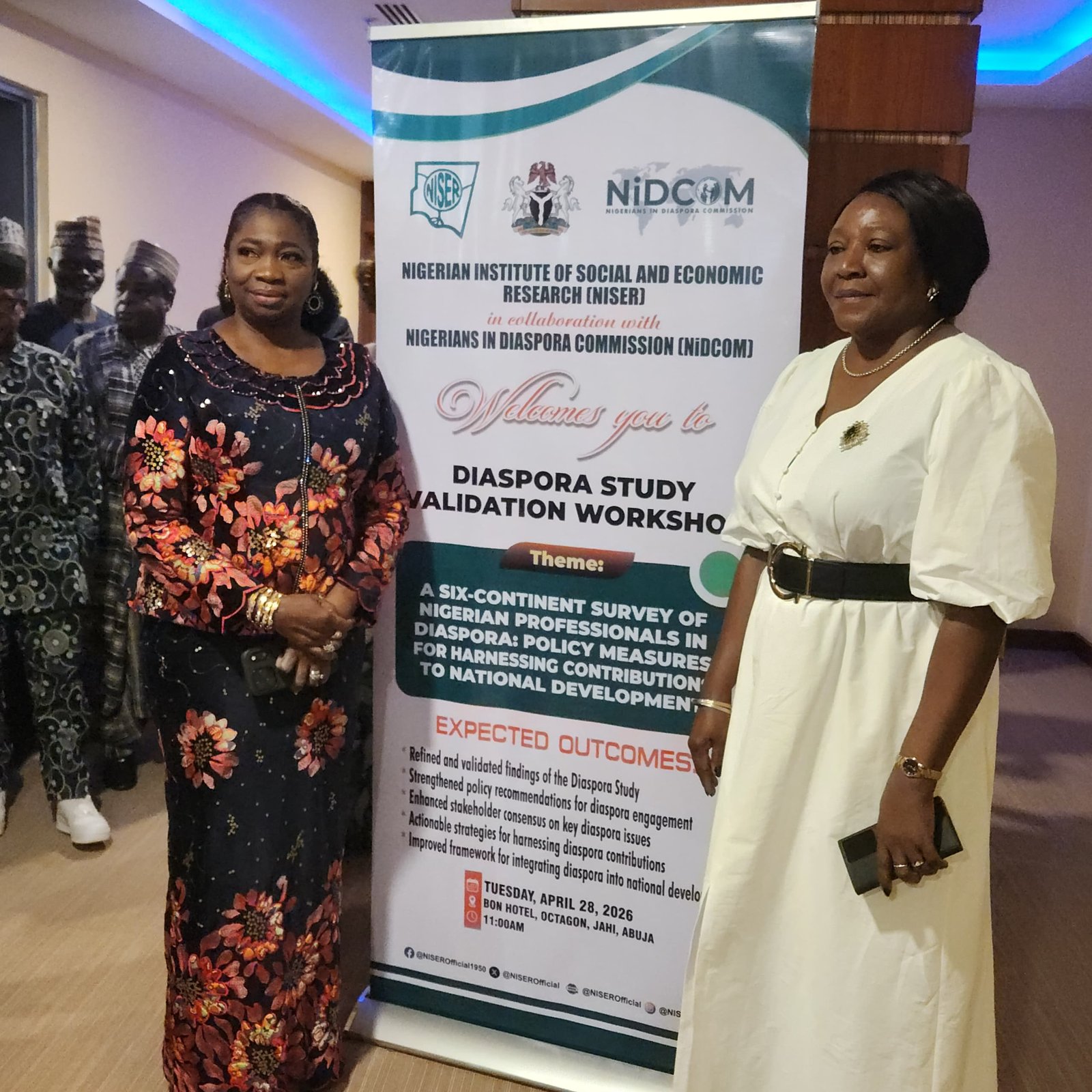
The Nigerian Institute of Social and Economic Research (NISER), in collaboration with the Nigerians in Diaspora Commission (NiDCOM), has commenced the validation workshop for a major diaspora study titled, “A Six-Continent Survey of Nigerian Professionals in Diaspora: Policy Measures for Harnessing Contributions to National Development.”
The workshop, held at BON Hotel, Octagon, Jahi, Abuja, brought together key stakeholders, policymakers, members of the National Assembly Committees, diaspora experts, professional bodies, development partners, members of the media, and representatives from relevant Ministries, Departments, and Agencies (MDAs) to deliberate on strategies for strengthening Nigeria’s engagement with its diaspora community and maximizing their contributions to national development.
This was contained in a statement by Abdur-Rahman Balogun, Director of Media, Public Relations and Protocols, NIDCOM.
Delivering her welcome address, the Director-General of NISER, Antonia Taiye Simbine, described the study as a critical step toward evidence-based policymaking and sustainable diaspora engagement.
She stated that the validation workshop reflects the collective commitment of stakeholders to advancing Nigeria’s development through informed engagement with the diaspora community, noting that the large turnout of experts and partners underscores the importance of the exercise and the value attached to evidence-driven policymaking.
Simbine explained that NISER, as Nigeria’s foremost policy research institution, is mandated to provide rigorous, evidence-based policy recommendations that address critical socio-economic challenges confronting the country. She said the Institute works closely with relevant MDAs as well as national and international partners in fulfilling this mandate.
According to her, the diaspora study aligns directly with NISER’s core responsibility of providing policy solutions to national development challenges and was undertaken in partnership with NiDCOM as part of a shared commitment to leveraging research for national progress.
She noted that Nigeria’s diaspora community remains one of the country’s most strategic assets, contributing significantly through annual remittances exceeding 20 billion US dollars, making Nigeria one of Africa’s top remittance-receiving countries.
Beyond remittances, she emphasized that Nigerians abroad contribute immensely through knowledge transfer, skills development, innovation, technology transfer, specialist expertise, mentorship, and international networks that continue to support Nigeria’s economic growth and global competitiveness.
However, she pointed out that despite this enormous potential, several challenges continue to hinder effective diaspora engagement, including policy inconsistencies, limited institutional coordination, trust deficits, regulatory bottlenecks, and inadequate frameworks for channeling diaspora expertise into national priorities.
Simbine explained that the study was conceived to provide empirical insights into the dynamics of diaspora engagement and to propose practical and implementable policy measures for better integration of diaspora contributions into Nigeria’s national development agenda.
She further stated that the validation workshop is expected to refine and strengthen the study’s findings through expert input, enhance stakeholder consensus on critical diaspora-related issues, generate actionable strategies, and support the development of an improved framework for integrating diaspora professionals into national planning and implementation.
She urged participants to actively engage in robust discussions, noting that the quality of deliberations and stakeholder contributions would significantly influence the final output of the study and shape future diaspora policies in meaningful ways.
Speaking at the event, the Chairman/CEO of NiDCOM, Abike Dabiri-Erewa, described the Nigerian diaspora as one of the most vibrant, intelligent, resourceful, and globally exposed communities across Africa, Asia, the Americas, Europe, and Oceania.
She stated that Nigerians in the diaspora continue to break barriers across medicine, science and technology, public service, entrepreneurship, as well as the orange and blue economies, making them critical stakeholders in Nigeria’s development journey.
Dabiri-Erewa explained that the workshop provides a strategic opportunity to assess diaspora contributions, identify challenges, and explore stronger opportunities for engagement and investment.
She stressed that for NiDCOM, the focus remains on moving from remittances beyond consumption to remittances for investment, where diaspora contributions are strategically directed toward sustainable development, wealth creation, and national transformation.
According to her, the thematic focus of the validation workshop is clear: to professionally interrogate the findings of the six-continent survey for authenticity, accuracy, and relevance, while jointly refining the policy recommendations to serve as a practical roadmap and framework for engaging Nigeria’s global diaspora.
She highlighted key areas requiring urgent attention, including structured diaspora engagement, streamlined policy coordination and coherence, creation of investment-friendly ecosystems, technology transfer and innovation, and the development of comprehensive data-driven policies.
The NiDCOM Chairman further urged stakeholders to use the platform to reduce brain drain, actualize brain gain, and foster brain circulation for the benefit of national development.
Also speaking, the Head of the Institute of Chartered Accountants of Nigeria (ICAN), Abuja Office, Mr. Adamu Yusuf, commended the initiative and described the validation workshop as a significant step toward harnessing the immense potential, expertise, and contributions of the diaspora community.
He noted that the validation process reflects a collective commitment to ensuring that the study outcomes are credible, inclusive, and reflective of stakeholder realities and aspirations.
Yusuf emphasised that the diaspora remains a vital partner in knowledge transfer, investment, innovation, institutional growth, and sustainable development.
He encouraged participants to engage openly, contribute constructively, and generate practical recommendations that will strengthen the final report and support effective implementation of its outcomes.
He also commended the organisers, facilitators, researchers, and participants for their dedication and collaborative spirit in advancing the initiative.
Speaking on behalf of the President of the Nigerian Medical Association (NMA), Prof. Bala Mohammed Audu, represented by Dr. Liman Idris Mohammed, Consultant Obstetrician and Gynaecologist at National Hospital Abuja, underscored the importance of diaspora collaboration in strengthening Nigeria’s healthcare system and professional development.
Mohammed stated that the NMA places great importance on Nigerian medical practitioners in the diaspora and deeply appreciates their contributions toward improving healthcare delivery in Nigeria.
He noted that upon receiving the invitation to the workshop, the President of the NMA showed strong interest in the study and directed the Association to actively participate, recognising its relevance to the future of healthcare delivery in the country.
According to him, the findings of the workshop will be presented to the NMA President and carefully reviewed to determine how the recommendations can be applied within the Association and across the broader health sector to improve medical services in Nigeria.
He explained that even before the study was conceptualized, there were already practical examples of successful diaspora contributions to Nigeria’s healthcare sector. He cited the establishment of major medical facilities in Abuja and Lagos by Nigerian professionals who acquired expertise abroad and returned to invest in the country.
He also referenced a medical doctor from the Association who studied In-Vitro Fertilization (IVF) in the 1990s and successfully established the practice locally in Nigeria, noting that today IVF services are widely available across the country.
Mohammed stressed that Nigerian professionals often excel beyond the systems where they acquired their training, demonstrating the immense capacity and excellence of Nigerian medical practitioners globally.
He called for stronger utilisation of the expertise of Nigerian medical professionals abroad, emphasising the need for continuous knowledge exchange, professional collaboration, and what he described as “the circulation of skills” between home and the diaspora.
About the Author