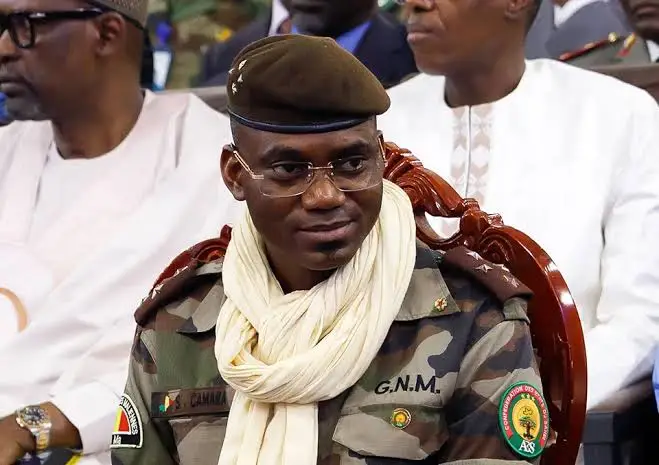
Mali’s defence minister has been killed in an apparent suicide truck bombing on his residence near the capital Bamako.
Multiple news outlets reported the death of Sadio Camara, part of a wave of coordinated attacks by jihadist militants and separatists carried out across the country.
State TV confirmed the death several hours later, saying he died of wounds received while engaging with the attackers. Reports say the head of the military junta, Gen Assimi Goita, was moved to a safe location after his home was targeted.
Further north Russian mercenaries hired by Mali’s military agreed to withdraw from Kidal after two days of clashes, the separatist Azawad Liberation Front (FLA) group said.
For years, Mali has been plagued by insurgencies by groups affiliated with al-Qaeda and the Islamic State group, and the FLA.
Quoting Camara’s family and French media, news agencies said the attack – launched by militants affiliated with al-Qaeda in Kati on Saturday – also killed at least three of Camara’s family members.
Government spokesman Issa Ousmane Coulibaly read out a statement on Sunday evening saying Camara was killed when “a vehicle laden with explosives and driven by a suicide attacker targeted the minister’s residence”.
It said he exchanged fire with the attackers and “succeeded in neutralising some of them”. However, he was wounded and later died from his injuries in hospital.
The attack led to the collapse of Camara’s residence and the destruction of a nearby mosque, where a number of worshippers were also killed.
Fighting on Saturday had been reported in the town, a major military base outside the capital, in Gao and Kidal in the north, and the central cities of Sevare and Mopti.
Reports suggest the assault by the separatists – who seek a breakaway ethnic Tuareg state in the north – was primarily focused on northern cities, while the jihadist group Jama’at Nusrat al-Islam wal-Muslimin (JNIM) had staged simultaneous attacks on multiple locations across the country.
Ulf Laessing, head of the Sahel programme at the Konrad Adenauer Foundation in Mali, told the BBC the incident appeared to be the “largest co-ordinated jihadist attack on Mali for years”.
FLA spokesman Mohamed Elmaouloud Ramadane said Kidal had “not fallen completely” during those attacks, at the time, telling the BBC they remained in the city because “elements of the Malian army and Russian mercenaries” were still present.
On Sunday, clashes between the FLA and the Malian government resumed in Kidal.
Shortly after these reports, Ramadane said: “An agreement was reached between the Azawad forces and the Russian elements of the Africa Corps with a view to ensuring their secure withdrawal from the fighting.”
In later updates, he said they were “permanently withdrawing from Kidal” and “Kidal is now free”. There has been no confirmation of these claims from Mali’s military. (BBC)
About the Author