Nigeria and China have reaffirmed their commitment to strengthening cooperation in culture, media, science and technology, with officials from both countries emphasizing dialogue, mutual respect and people-to-people exchanges as critical pillars for building stronger bilateral relations and fostering global understanding.
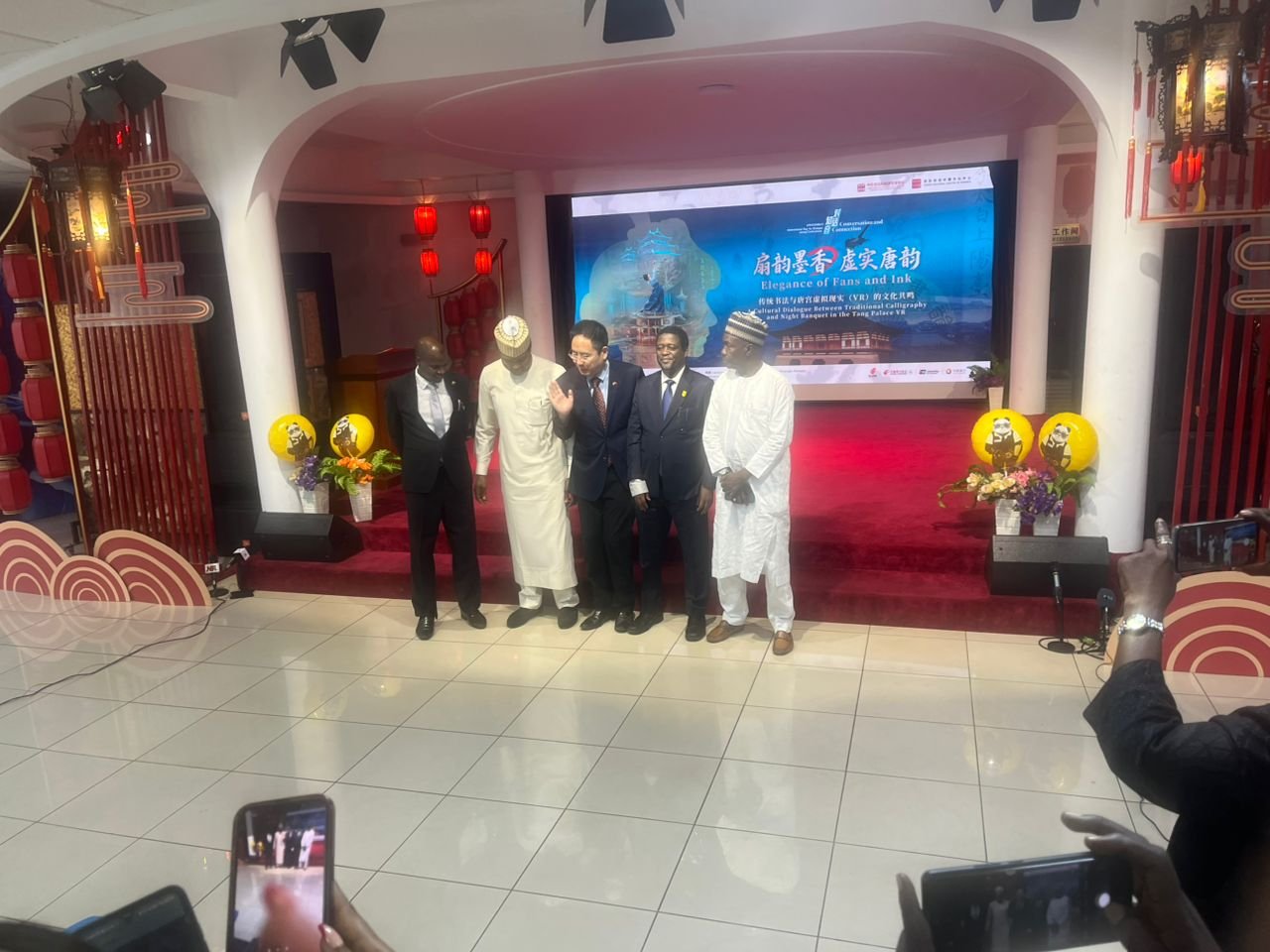
The commitment was reiterated on Wednesday in Abuja during the celebration of the International Day for Dialogue of Civilisations and the opening of the exhibition, Fan, Charm and Ink Fragrance: The Cultural Resonance of Traditional Calligraphy and Tang Dynasty Virtual Reality, hosted by the China Cultural Centre in Nigeria.
The event brought together diplomats, government officials, media executives, academics, students and cultural enthusiasts to explore how traditional heritage and modern technology can be combined to strengthen understanding among peoples and nations.
Speaking at the ceremony, Cultural Counselor of the Chinese Embassy and Director of the China Cultural Centre in Nigeria, Yang Jianxing, described the exhibition as a practical demonstration of how ancient traditions can be preserved and promoted through modern innovation.
According to him, the project combines traditional Chinese calligraphy, painting and seal carving with immersive virtual reality experiences that allow visitors to engage directly with China’s cultural heritage.
He noted that the exhibition features works by young artists from leading Chinese institutions, including the China Academy of Art and the Central Academy of Fine Arts, while the virtual reality component transports participants into the world of ancient Chinese poetry and literature through interactive technology.
Yang said the initiative was designed to promote cultural exchange and mutual learning between Nigeria and China, particularly at a time when both countries are marking the 55th anniversary of diplomatic relations and the China-Africa Year of People-to-People Exchanges.
He highlighted recent economic initiatives aimed at strengthening China-Africa relations, including China’s implementation of zero-tariff measures for 53 African countries with diplomatic relations with Beijing, including Nigeria.
The cultural diplomat stressed that dialogue among civilisations has become increasingly important in a world facing growing divisions, conflicts and mistrust, noting that cultural engagement remains one of the most effective tools for fostering peace and cooperation.
The Permanent Secretary of the Federal Ministry of Innovation, Science and Technology, Muktar Yawale Muhammad echoed similar sentiments, describing Nigeria-China relations as a strategic partnership that extends beyond culture into technology, innovation and scientific development.
He said Nigeria, as Africa’s most populous nation, stands to benefit significantly from deeper engagement with China in areas that drive economic growth and improve human welfare.
According to him, the numerous agreements and memoranda of understanding already signed between both countries provide a strong foundation for future collaboration in research, innovation and technological advancement.
He emphasized that the International Day for Dialogue of Civilisations should serve not merely as a symbolic observance but as an opportunity to translate existing partnerships into practical outcomes that benefit citizens of both countries.
The Permanent Secretary also praised the exhibition’s focus on traditional Chinese calligraphy, describing it as an opportunity for Nigerians to appreciate one of China’s most celebrated cultural expressions while strengthening mutual understanding between the two nations.
In his remarks, Director-General of the Voice of Nigeria, Jibrin Baba Ndace, highlighted the growing role of media cooperation in advancing bilateral relations, revealing that Nigeria’s international broadcaster has commenced Mandarin-language broadcasting following collaboration with Chinese partners.
Ndace described the development as a significant milestone in media relations between the two countries and disclosed that Voice of Nigeria now broadcasts in nine languages following the addition of Mandarin to its existing language services.
He credited the achievement to growing institutional cooperation between Voice of Nigeria and Chinese media organisations, facilitated through the China Cultural Centre and other Chinese partners.
The VON Director-General said cultural dialogue remains essential in an increasingly interconnected world, arguing that societies can embrace modernity and technological progress without abandoning their identities and traditions.
Drawing lessons from China’s development experience, he observed that the Asian nation has successfully integrated technological innovation with the preservation of its rich cultural heritage.
According to him, one of the most important lessons for younger generations is that progress does not require the abandonment of cultural roots.
He urged Nigerians to respect cultural diversity and appreciate differences in language, religion and traditions, stressing that peaceful coexistence depends on mutual respect and understanding.
Ndace further noted that the exhibition’s combination of traditional calligraphy and virtual reality technology demonstrated how innovation can be used to preserve and promote cultural heritage rather than replace it.
Across the various presentations, speakers repeatedly emphasized the importance of dialogue as a pathway to stronger international cooperation, peaceful coexistence and sustainable development.
They argued that in an era of rapid technological transformation and growing global uncertainty, cultural diplomacy remains an indispensable tool for building trust and strengthening relations among nations.
The exhibition, which will run until July 10 at the China Cultural Centre in Abuja, offers visitors an opportunity to experience traditional Chinese art alongside cutting-edge virtual reality technology, reflecting a broader vision of cultural exchange that bridges history, innovation and international friendship.
For both Nigeria and China, the event underscored a shared commitment to deepening cooperation across multiple sectors while using culture, technology and communication as vehicles for greater understanding between their peoples.
As both countries celebrate more than five decades of diplomatic relations, officials expressed optimism that expanding collaboration in culture, media, science and innovation would continue to strengthen the enduring partnership between Africa’s largest nation and the world’s second-largest economy.
About the Author