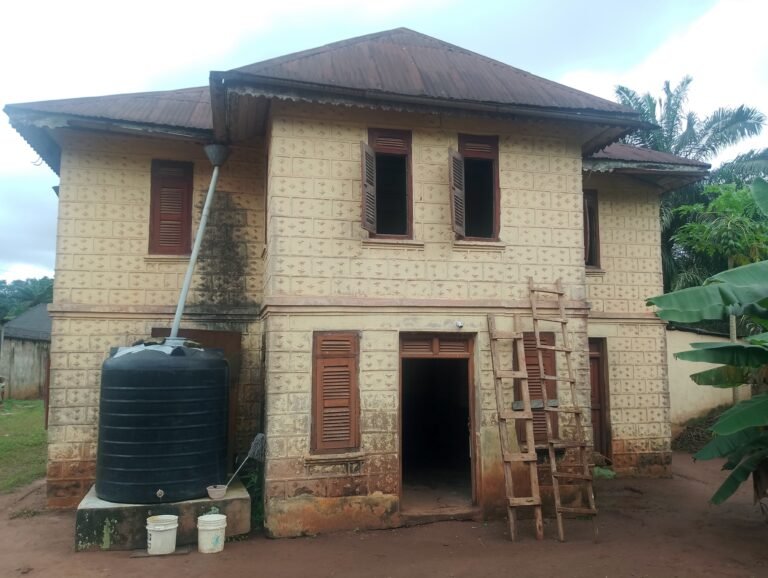
The planned renovation of an 87-year-old storey building in Igbo-Ukwu, Aguata Local Government Area of Anambra State, is expected to strengthen the community’s position as a major cultural and heritage tourism destination.
Mr Ozioma Ubabukoh, grandson of the late Chief John Ubabukoh, who built the structure, disclosed this while speaking with journalists on Saturday.
According to him, the building, completed in 1939, is one of the oldest pre-colonial storey buildings in the South-East and the first storey building constructed in Igbo-Ukwu.
Ubabukoh said he had commenced plans to renovate the historic structure and give it a vintage, ancestral and monumental appearance while preserving its historical significance.
He explained that efforts were also underway to establish a connection between the building and the Igbo-Ukwu National Museum, with the aim of attracting tourists and contributing to the state’s economy.
He added that some movie producers had already shown interest in using the historic building as a location for epic films.
“Anambra has about four cities already. Onitsha is the commercial city, Nnewi is the industrial city, Awka is the capital, while Ekwulobia is gradually becoming a city.
“The renovation of this 87-year-old building will make Igbo-Ukwu a cultural city because it will be annexed to the National Museum to become a heritage site that will promote Igbo culture,” he said.
Ubabukoh urged the Anambra State Government, corporate organisations and well-meaning individuals to support the initiative, describing Igbo-Ukwu as an ancestral centre of Igbo culture and arts.
He said his father, Mr Ifeanyichukwu Ubabukoh, who inherited the building, instructed him before his death in February 2024 to preserve the structure rather than demolish it, describing it as a family and community legacy.
Family Recalls Historic Legacy
Mr Okey Ubabukoh, 73, the only surviving child of Chief John Ubabukoh, said constructing the building was a major achievement at the time.
He recalled that colonial authorities had taken control of much of the available timber for export during the war effort, forcing his father to travel into the forest to source the wood used for the construction.
He described Chief John as a successful businessman who operated in Northern Nigeria and spoke Hausa fluently. He was also said to have worked as a contractor, constructing schools, churches and houses, while serving as a customary court judge.
Okey Ubabukoh further disclosed that his father worked with British archaeologist, Prof. Thurstan Shaw, during archaeological exploration and excavation of bronze artefacts and other antiquities in Igbo-Ukwu, discoveries that eventually contributed to the establishment of the Igbo-Ukwu National Museum.
He said the family would support Ozioma Ubabukoh in preserving the historic structure for future generations.
Another relative, Pa Emeka Ubabukoh, 86, described the building as a remarkable part of Igbo-Ukwu’s history, recalling that it stood out in the community during his childhood.
He said the structure had contributed to the development and identity of Igbo-Ukwu and deserved to be preserved and celebrated.
Igbo-Ukwu’s Tourism Potential
Pa Timothy Anigbogu, a close associate of the Ubabukoh family, described Igbo-Ukwu as an ancient city with a rich archaeological and cultural heritage.
He noted that the Federal Government’s establishment of the Igbo-Ukwu National Museum reflected the importance of the community’s archaeological discoveries to Nigeria’s history.
Anigbogu said renovating the 87-year-old building, alongside other heritage attractions in the area, could significantly raise Igbo-Ukwu’s profile as a cultural and tourism destination.
The initiative, he said, would not only preserve an important family legacy but could also create a platform for promoting Igbo history, arts and culture to visitors from Nigeria and beyond.
About the Author